
The Green Bay Packers inevitably will reinforce the wide receiver room from now until September. However, the fact that they still don’t have a succession plan in place after trading Davante Adams shows how the lack of investment in the position affects the future of the offense. Since the Packers selected Adams in the second round of the 2014 draft, they haven’t used early picks to build depth.
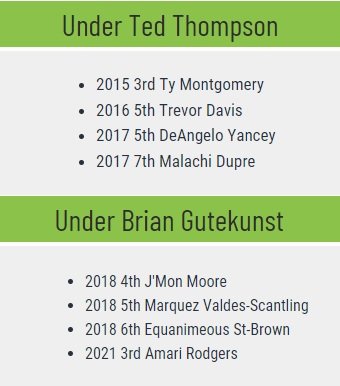
Under Ted Thompson and Brian Gutekunst in this period, the Packers drafted two hybrid weapons in the third round — Ty Montgomery and Amari Rodgers – and a bunch of late-round darts. Marquez Valdes-Scantling was the only late-round pick who had significant production.
Green Bay’s investment has been timid outside the draft, too. They signed Allen Lazard off the Jacksonville Jaguars’ practice squad and traded a sixth-round pick to the Houston Texans for Randall Cobb as a way to please Aaron Rodgers.
Aside from low-level players, Green Bay’s only free-agent signings have been Devin Funchess (who opted out of the 2020 season and was cut during training camp in 2021) and Tavon Austin, a gadget player who totaled 20 scrimmage yards for the team in 2020.
History
Since Rodgers became the starting quarterback in 2008, the Packers have transitioned from one WR1 to another with aplomb. Greg Jennings was the WR1, and Donald Driver was the second option until 2012. But Jordy Nelson had been drafted in 2009 and saw his role grow year to year, from WR3 behind Jennings and Driver to top option in 2013. When the time came, Nelson was ready to step up.
The Packers drafted Davante Adams in 2014. Nelson started to decline physically, and Green Bay cut him after the 2017 season, establishing Adams as the primary receiver.
Missed opportunities
The 2020 draft might have been the biggest opportunity for the Packers to draft their receiver of the future. Gutekunst was reportedly high on players like Justin Jefferson and Brandon Aiyuk, but they were taken before Green Bay picked at No. 30. So, Gutekunst decided to trade up to 26 and select quarterback Jordan Love.
Even if the Packers had kept their original pick, they would have been able to draft receivers like Michael Pittman or Tee Higgins, players who could have contributed right away as secondary options. Now they would have been ready to step up as WR1. The extra first-round pick in 2019 was also a missed opportunity because Gutekunst opted to trade up to draft Darnell Savage. Still, good wide receivers were available in the original selection – Deebo Samuel, A.J. Brown, and D.K. Metcalf, for example.
Now what?
After trading Adams, the Packers have no high-end talent at the position. Cobb, Amari Rodgers, and Allen Lazard are role players, but none of them is ready to be the main target for Aaron Rodgers. With extra draft capital and some cap space, Gutekunst will be forced to invest heavily — be it signing guys like Julio Jones, Will Fuller, and Sammy Watkins or drafting receivers in the first two rounds.
Still, it’s hard to guarantee they will be ready to have immediate top production, especially in the case of rookies. A year or two in the system with a lesser role would be essential, but that’s a scenario the Packers gave up because of their unwillingness to invest in wide receivers.