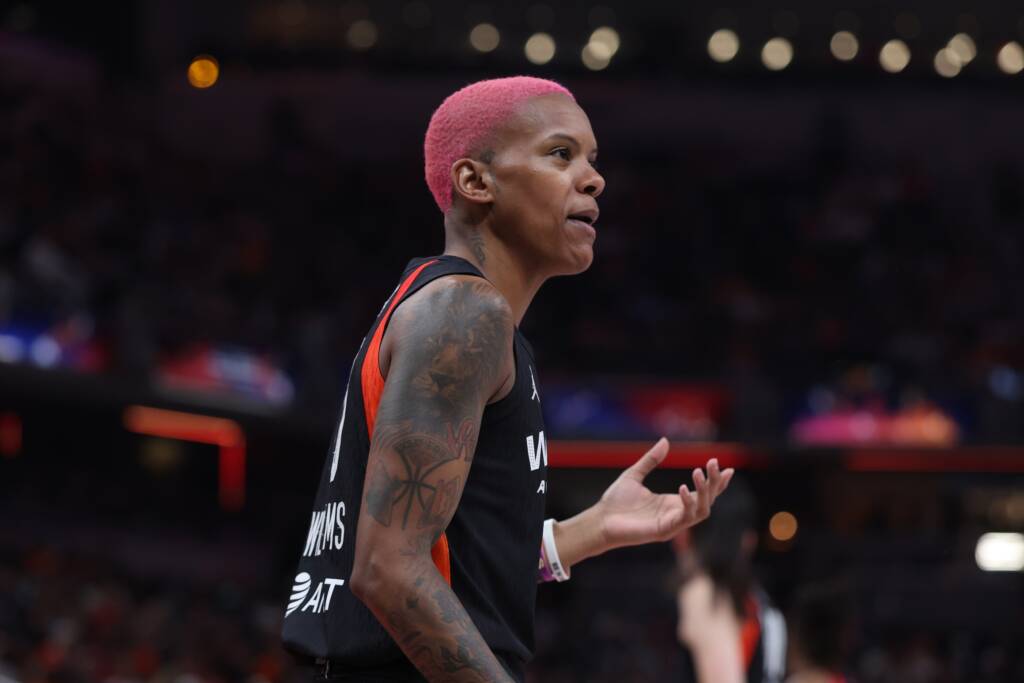

On Monday, Courtney Williams spoke about the ongoing CBA negotiations between the WNBA and WNBAPA. Speaking on the revenue-sharing agreement, Williams shared the players’ view.
“Yeah…. It’s the work that has been put in,” Williams said. “We just want a piece of our pie, that’s it.”
While asking for a piece of the pie may seem vague, WNBA players receive a relatively small portion of the overall pie. They only get 9.3% of basketball-related revenue, excluding merchandise. That percentage appears shocking, but it’s likely to change by 2026, and it made sense at the time the players’ association and the league signed it in 2020. To understand the current CBA, we have to travel back to 2019, the year before its signing.
In 2019, the WNBA was in danger. They had just suffered a 3.5% drop in attendance, with teams averaging just 6,535 fans per game. It’s also important to note that this number includes fans who bought tickets but didn’t attend the game. Even the Minnesota Lynx saw a 9.6% drop in attendance. For teams like the Atlanta Dream, the drop resulted in them changing home venues, moving out of State Farm Arena.
While attendance had declined, WNBA TV viewership improved in 2019, rising a substantial 35% overall to an average of 258,000 viewers per game. That suggested an increase in interest in the WNBA, but for some reason, fans weren’t attending the games in person.
Most of the television increase was due to the WNBA inking a deal with CBS and its partner networks just before the start of the season. Although the financial details were not disclosed at the time, people now estimate that the agreement was worth $25 million annually to broadcast 40 national TV games. That confirmed the premise that if the public had the product available, they would consume it.
The increase in TV revenue brought the league’s total revenue to approximately $102 million. However, even with the increase, the league lost an estimated $10 million overall.
With the league still in the red, the players in the 2020 CBA prioritized quality-of-life improvements, such as vision and dental insurance, pregnancy support, and paid leave. For the first time, players would be required to book their own hotel rooms for road games. Their in-season lodging would require an extra room for children under 13 who live with the player.
While those could be considered wins, in hindsight, the WNBA got the better end of the CBA. Initially, the players were advertised to receive 25% of the incoming revenue. However, the percentage was based on relatively unachievable goals, considering the total revenue, which was limited because CBS only paid them $25 million annually.
The COVID-19 pandemic in 2020 significantly impacted WNBA revenue when the league played in the “Wubble.” The drop in revenue would result in the players’ revenue percentage dropping from 11.1% to 9.3%. It would remain there even up to the current season, despite the WNBA’s revenue doubling to over $200 million in 2024.
That’s where things become a little more complicated. The WNBA’s revenue hit a record high $200 million in 2024, but the league reported a record $40 million loss. That doesn’t make sense until you dig into the details.
The league began requiring charter flights for players on road trips, an initiative estimated to cost the league $25 million. At the time, people saw it as an act of goodwill by the league. However, it has created additional losses, which are now much more in line with the historical average loss of $10 million (or $15 million without flights) to $40 million.
That leads to the current conundrum. In 2024, the league’s revenue doubled, but the players’ percentage remained unchanged. It decreased to 9.3% due to the pandemic and then stayed at that level. To make matters more complicated, the league is poised to experience a significant surge in revenue.
The WNBA’s new TV contract with Disney has been signed and is worth $2.2 billion over 11 years, averaging $220 million per year. That contract alone, compared to the CBS and Ion contracts, will be nearly five times their current TV revenue, estimated at $45 million.
The $175 million increase will nearly double the league’s revenue overnight when it starts in the 2026 season. With other less significant monetary sponsors coming in, the league’s expected revenue for 2026 is expected to be between $350 million and $500 million, depending on attendance.
The league is also rapidly expanding. The Golden State Valkyries joined the WNBA in 2025, followed by two more teams in 2026. Each expansion team pays a $250 million expansion fee, which gets divided solely between the existing owners, with none of the fee going to the players.
With the large amount of money coming into the league, the players associated decided to opt out of their current CBA, meaning it will expire after the 2025 playoffs. The WNBA players’ main argument is that they want a bigger percentage of the revenue pie.
Compared to the other sports leagues, they seem to have some standing. The NBA receives a 49% split of basketball-related revenue (TV contracts, ticket sales, merchandise). The NFL receives 48%, MLB gets 40%, and the NHL is at 50%. The MLS players and NWSL players receive 20% of the revenue.
These other percentages drive home the players’ point. They feel that they deserve a raise in their revenue percentage due to the league’s growth, the upcoming TV deal, and the owners recouping decades of losses with the expansion money. With so much money on the table, it would seem that as long as all sides are willing to negotiate, everyone should be able to have a big slice of the pie and avoid a lockout.