
There’s an old SNL Chris Farley sketch that I remember vividly popping up during the Best of Chris Farley VHS tape that I had growing up. Strangely, I thought of it when asking about Olivia Miles and her game.
I remember Farley sitting alongside various celebrities and interviewing them on a mock talk show brilliantly titled The Chris Farley Show. In the sketch, he would awkwardly introduce the show and his guest before erupting in self-criticism over his stutter or mixing up words or names.
As the interview got going, sweat poured down his brow as he sat in an ill-fitting suit next to his guest, stumbling over facts about them. Then the question portion would start.
Farley would start every question with, “Do you remember when…” as he nervously twitched and smiled. It would prompt a simple yes-or-no answer from the guest, which would, in turn, prompt another “Do you remember when…” question from Farley.
Below is his 1993 interview with Paul McCartney, which I watched on VHS in crystal-clear picture.
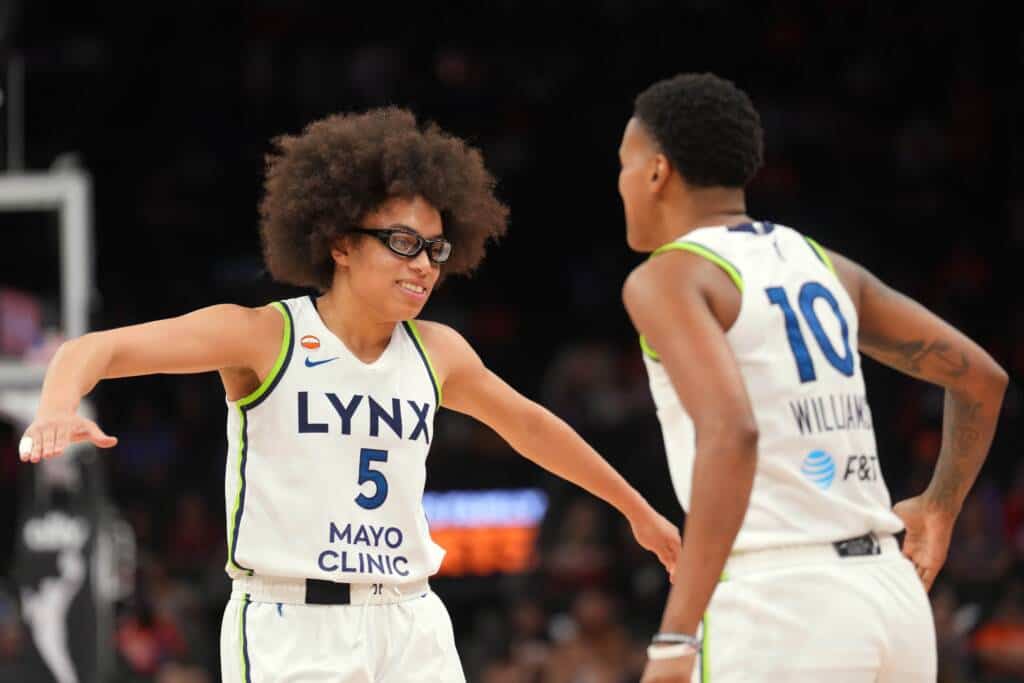
The reason this memory popped up is that through nine games of the Olivia Miles experience, I feel just like Farley in every postgame show, media scrum, or just talking to Lynx fans.
Do you remember when Liv hit the far corner off a drive?
Do you remember when she passed it between the defense on the drive with 30 seconds left?
Do you remember the no-look to Tash?
Do you remember…
It’s been a season of highlight play after highlight play that has captivated Lynx fans and everyone on the team and in the league.
“There were audible gasps on our bench from our coaching staff and our support staff at some of the passes that she made,” Cheryl Reeve said, explaining the reality of having Miles on the Lynx. “[It] just makes everyone else’s lives easier.”
While Miles has undoubtedly been a walking highlight, her introduction to the WNBA has also been sensational statistically in some areas. She’s averaging 15.8 points per game, which is third on a 7-2 Lynx team in scoring. Her 5.0 rebounds rank fourth, she leads the team with 6.3 assists, and her 1.7 steals per game rank second on the team.
Miles averages +12.1 per game, just 0.1 points shy of leading all Lynx players. Her 2.9 fouls per game are significantly lower than expected, given her responsibility as the point person on both offense and defense.
Her 110.6 offensive rating is just 0.1 points lower than the team that ranks third in the league, and her defensive rating of 91.4 is 5.5 points better than the Lynx’s league-leading defensive team rating. She has a 19.2 net rating, which ranks tenth in the league regardless of minutes or role. Of the 9 players ahead of her, only five of them have played in more than five games, and none of them have more minutes than Miles.
Olivia Miles averages the sixth-most attempts in the restricted area per game at 6.2. She is converting at 67.9%, the second-highest percentage among the top 6, only behind teammate Natasha Howard. Miles’ efficiency on her resume in 9 games is unreal. In such a short time, she has become the head of a Lynx team that has dominated the rest of the WNBA, winning five straight, with three of those wins by 20 points or more.
Her passing is harder to nail down using efficiency stats, and that’s why the “remember” conversations get brought up with Miles. It can be noted that Miles is leading the Lynx in assist percentage, with 7.3%, compared to the second-place Lynx player. She also has 37.5% of the Lynx’s total amount of assists. However, the thing that scares other teams most about Miles is that, despite everything I’ve laid out about her statistically, she still hasn’t played to her full potential.
Miles is shooting just 11.1 percent on threes, just 2/18 overall on the season. It’s a percentage that quite literally can go nowhere but up. Theoretically, it should also go up. Miles is shooting 42 of 46, 91.3% from the free throw line this season, and high free throw percentages typically translate to good distance shooting.
She also shot 146-of-388 (37.6%) from three in her last two seasons in college, while shooting over five a game. Teams are leaving Miles open on the perimeter because of her distance shooting. Still, Miles can drive and be effective. Once her shot improves, the league’s best chance of defending her might disappear.
The other area for Miles to grow is regarding turnovers. In her final season at TCU, she had just a 1.77 assist-to-turnover ratio. Although Miles ranked 7th in assists overall, her ratio to turnovers ranked 70th in the NCAA. Surprisingly, in the WNBA, it has improved slightly to 1.90, but it still ranks 55th in the pros. Players like Skylar Diggins and Veronica Burton are the gold standard among high-volume guards who take care of the ball, with 3.9 and 3.54 ratios, respectively.
Even looking back to 2025, a 1.90 ratio would have ranked 47th and would have ranked fifth on the Lynx, just above Center Alanna Smith at 1.86. That’s where the growth for a young guard can be frustrating because everything moves faster and opponents are so much faster and stronger in the WNBA. As Miles has a propensity to throw flashier passes, the calibration just needs to happen, which is a slow process. Experience is really the only true way to grow as a playmaker.
That’s the list, though. For Olivia Miles to grow into an even better player than the All-WNBA caliber guard that she has already displayed she can be, the shooting needs to come around, and she needs to turn the ball over less. Both of which should be expected based on Miles’ college shooting and her natural growth in the league.
In the meantime, though, the Lynx have yet another player who coaxes out; remember when she finished a and one against Toronto and hit a Shimmy?
Or remember when…