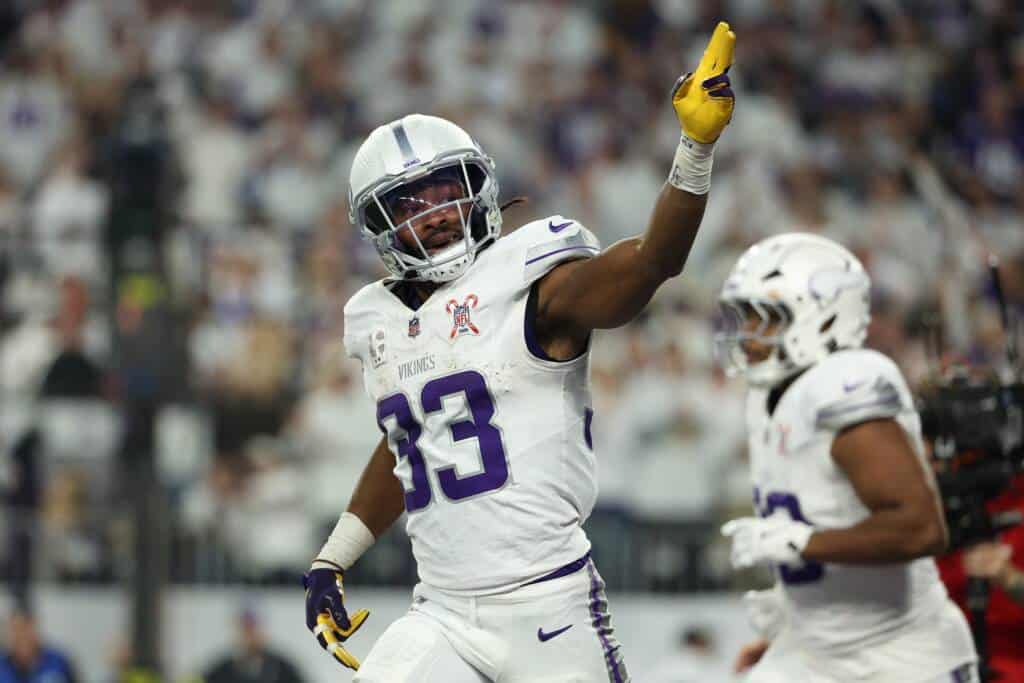

Minnesota hasn’t been known for running the ball under head coach Kevin O’Connell, leaving fans confused and sometimes angered. Overall, the amount the team is running the ball has increased over KOC’s tenure. Still, he has yet to fully marry the run and pass.
Aaron Jones, Jordan Mason, and Demond Claiborne each have distinct skillsets that could lead to success in 2026. So, how can O’Connell effectively use all three of these backs all season long?
Aaron Jones
Jones saw the light after seven seasons with the Green Bay Packers and joined the Vikings on a one-year deal in 2024. In his first year in purple, he set career-bests in touches (255) and yards (1,138).
A Week 2 injury led to Jones missing five games in 2025. His production decreased, and Mason showed what he could do during those five missed games. Jones rushed the ball 132 times for 548 yards, his lowest production since 2018. He also caught 28 passes on 41 targets for 199 yards and one touchdown.
In 2026, the question is so much how often the Vikings can use Jones but where they can best deploy him. They should only use Jones on early downs and in must-pass situations, given his ability to break the game open when he has the open field. At 31, Jones simply cannot be the primary back anymore, especially given that Mason picked up the slack when he needed rest or was out with an injury. But even if his usage is well below those gaudy 2024 numbers, he’s still quite a threat when effectively deployed.
Jordan Mason
Like Jones did two years ago, Mason had a career year in 2024, although in this case it was for the San Francisco 49ers. After Christian McCaffrey was unable to start the 2024 season opener due to an injury, Mason filled right in and showed that he could handle the workload of a premier back.
So, when the Vikings were able to trade for Mason, they took the dynamic back and a sixth-round pick in exchange for a fifth- and sixth-round pick, and he wound up doing the same service for the Vikings when their presumed RB1 went down with an injury. In his first start with Minnesota, Mason was able to further prove his worth with 16 carries, 116 yards, and two touchdowns against the Cincinnati Bengals.
Mason has suffered multiple injuries himself in his four NFL seasons. Still, between 2024 and 2025, he has accumulated 312 rushes for 1,557 yards, nine TDs, and 25 receptions on 30 targets for 142 yards as a receiver.
His ideal spot in Minnesota’s offense next year would be to give Jones a break, and also to be the power back for short third-down situations given his ability to break tackles. In contrast to Jones’ five broken tackles last season, Mason broke 13 while playing fewer snaps.
Mason has the build and ability to be the bruiser running back, in tandem with Jones’ big-play ability. This isn’t much different from the plan for last season. The real shake-up could come from the guy who wasn’t in that group last year.
Demond Claiborne
The team knows what they have in the incumbent backs, but Minnesota’s sixth-round pick in the 2026 NFL draft might be the most intriguing player out of the backfield.
Claiborne’s speed will be the Vikings’ biggest asset in 2026. As a player who has drawn comparisons to Jahmyr Gibbs and De’Von Achane, the rookie should provide explosiveness in the run game along with a great change of pace.
He was second-team All-ACC after the 2025 season with Wake Forrest, and ran a 4.37 40 at the combine.
While he is not as big as the other two, standing at 5’10”, 195 lbs., he adds value on the outside. Screens and pitch plays that change the pace will be the name of the game for Claiborne as he continues to learn the offense and adjust to the NFL.
The Vikings have three very different running backs coming into the 2026 season, and it is up to KOC to use each to their own unique strengths. They should involve Jones, Mason, and Claiborne frequently in 2026 — certainly more frequently than the have in the past few years.


