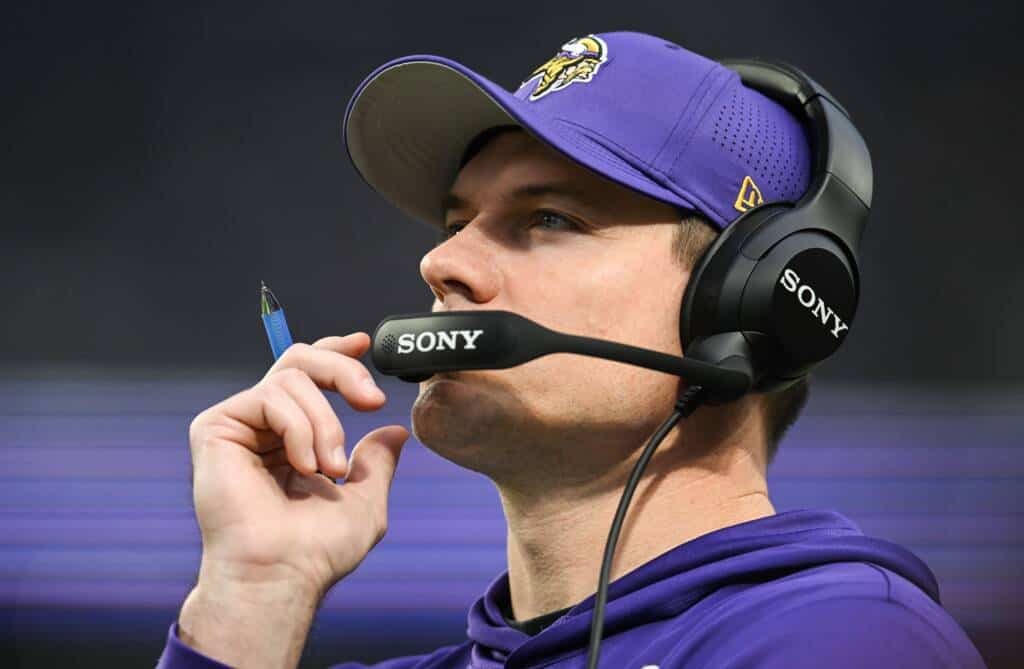

Kevin O’Connell has said the right things about emphasizing a run game the Minnesota Vikings can lean on. The Vikings closed the disappointing 2025 season with a five-game winning streak in which they ran the ball more than they passed in four of those games.
“I think the [ultimate] lesson we learned [in 2025] was, in addition to winning differently than maybe we’ve won in the past, [was] really leaning on our defense, trying to run the football, not turn it over, and play smart football,” O’Connell told Paul Allen during February’s scouting combine.
O’Connell has seemingly made the necessary changes to the coaching staff, moving on from Chris Kuper, who had been the team’s offensive line coach since O’Connell arrived in 2022. The Vikings replaced him with Keith Carter, their assistant offensive line coach in 2025, who has a reputation for a brash coaching style that seems more in line with Mike Zimmer’s staff.
That wasn’t it, though. Minnesota named Frank Smith, who spent the past four seasons as the Miami Dolphins’ offensive coordinator, as their new assistant head coach. Smith, who was Ben Roethlisberger’s center at Miami (Ohio) in college, has a history coaching the offensive line and can help bring new ideas to O’Connell’s offense.
Minnesota wasn’t overly aggressive in free agency outside of signing Kyler Murray, but they added Ryan Van Demark, a 6’6”, 307 lb. tackle who spent his first three seasons with the Buffalo Bills. The Vikings are expecting Christian Darrisaw to be closer to his pre-injury form this season. Still, they weren’t going to allow the backup tackle position to derail their offensive line again.
In the draft, Minnesota doubled down on the tackle position, taking Caleb Tiernan 97th overall. They then selected fullback/tight end Max Bredeson with the 159th pick, and drafted speedy running back Demond Claiborne a round later.
Signing Jauan Jennings also reflected Minnesota’s renewed commitment to the run game. Few wide receivers embrace blocking the way Jennings does, something O’Connell specifically praised after the signing.
The idea of an improved run game sounds intriguing in the offseason, when games have yet to be played. Sometimes, game flow dictates play-calling, forcing teams to adjust and abandon the run sooner than they would like.
Last August, O’Connell told ESPN’s Kevin Clark that he wanted to run the ball more in 2025.
“I want to run the football,” O’Connell told Clark. “I want to get back to the truest nature of where the foundation of this offense was, which is running the football, marrying the run and the pass, generating explosives that way, and trying to be an effective early-down offense that can sustain for 17-plus weeks.”
Ultimately, he ended up with mixed results. Minnesota had success running the ball; they just didn’t run the ball enough. The Vikings ranked 11th in yards per attempt (4.5) but 27th in total attempts. Their -12.9 rush EPA ranked 15th in the league, while their 42.4% success rate ranked 12th.
That hasn’t helped the narrative that O’Connell doesn’t want to run the ball. But circumstances dictated play calling. Minnesota’s offense ran 301 plays with the lead in 2025. A year earlier, with Sam Darnold, the Vikings ran 572 plays with a lead. So even though Minnesota ranked 26th in yards per run (4.1), they still ranked 14th in rushing attempts.
Perhaps O’Connell could be more stubborn and lean into the run. But he wouldn’t be the first coach to alter his run-pass balance. In 2012, Kyle Shanahan was entering his fifth season as an offensive coordinator. In his first four seasons, his offenses ranked 13th, 30th, 30th, and 25th on the ground.
Shanahan, then Washington’s offensive coordinator, had to overhaul his offense to fit Robert Griffin III, whom owner Dan Snyder coveted. RG3’s mobility forced Shanahan and an offensive coaching staff made up of Sean McVay, Matt LaFleur, and Mike McDaniel to use the pistol offense. That allowed Washington to keep its principles of the traditional Shanahan/West Coast offense while also giving RG3 easy reads to exploit in the passing game.
Washington would rank first in rushing in 2012, catching defenses off guard with their new-look offense. RG3 ran for 815 yards, while rookie Alfred Morris added 1,613 yards on the ground.
RG3 was never able to replicate his rookie success, but the experiment and success helped shape Shanahan’s offensive philosophy moving forward. Only three times since that season have Shanahan’s offenses ranked in the bottom half of the league in rushing, six times ranking in the top 10.
Washington’s assistants also learned from that season. McVay learned from that season, and O’Connell served as his offensive coordinator with the Rams in 2020 and 2021.
That isn’t to suggest that bringing in Murray and simply putting him in pistol will magically turn O’Connell into a run-game guru. It isn’t to suggest that Frank Smith, who operated an offense in Miami that featured De’Von Achane, will be able to turn Claiborne into a back who has a 5.6-yards-per-carry career average.
But it highlights that even Shanahan, maybe the league’s premier play caller, once struggled to run the ball. Perhaps being a former college receiver played into it. Maybe having subpar talent with the Texans in 2008 and 2009, and then with Washington in 2010 and 2011, forced him away from the ground game.
Yet in 2012, he had to innovate. Maybe RG3 wasn’t the quarterback he or head coach Mike Shanahan wanted. But drafting RG3 forced the younger Shanahan to rethink his offensive approach.
O’Connell has yet to win a playoff game in four seasons with the Vikings. There are easy excuses to make, some more fair than others (quarterback injuries derailing the 2023 and 2025 seasons). He may not be squarely in the hot seat entering the 2026 season. Still, one would have to imagine that Kwesi Adofo-Mensah’s ouster in January has placed added pressure on O’Connell moving forward.
If Murray can operate as a league-average quarterback, it would solve many of Minnesota’s offensive woes. But to win late in the season and in January, they will have to turn to the running game when defenses inevitably sell out to shut down Justin Jefferson in the passing game.
O’Connell has often cited coaching quarterbacks the way he wished he had been coached during his playing career. If he wants to take the next step as a head coach and push the Vikings further into the playoffs, he will have to embrace new ways of operating his offense.