
Red-zone efficiency is critical for every NFL team. The field gets shorter, mistakes become more evident, and teams and fans feel like points should be a given. The 2025 Minnesota Vikings struggled mightily in these situations throughout the season, settling for three when six was well within range.
So, what gives? Why couldn’t the team get it done when it mattered most?
Self sabotage
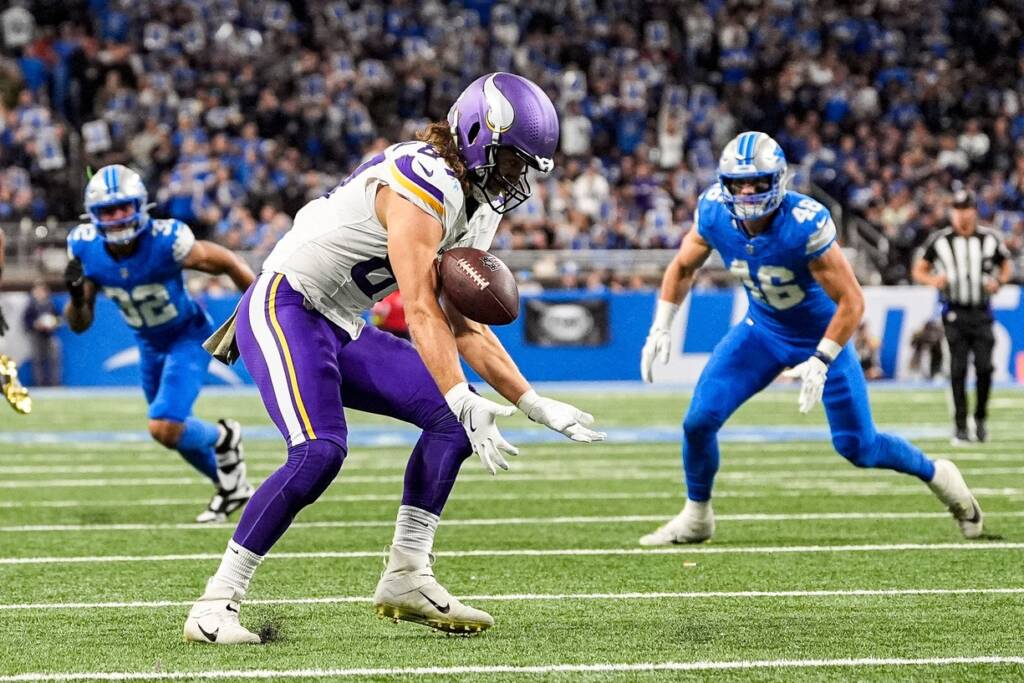
Part of Minnesota’s red-zone inefficiency was its inability to get out of its own way. Penalties, sacks, interceptions, and incompletions all created issues inside the red zone for the team, and it happened consistently, nullifying touchdowns and making Will Reichard Minnesota’s most valuable player.
While these self-inflicted issues hurt, they became that much worse when they started to compound. There were a couple of instances when the self-sabotage fully took over, and no single quarterback was immune.
The first happened in Week 2 at home against the Atlanta Falcons. On their only red-zone trip, on a first-and-goal at Atlanta’s two-yard line, the Vikings had to settle for three points after a fumble, a penalty, and two sacks pushed them back to the 15-yard line.
The next major occurrence occurred at home against the Philadelphia Eagles in Week 7. Minnesota went one for six in red zone opportunities. The issue became evident on the offense’s opening drive when a third-and-10 on Philadelphia’s 19-yard line turned into a fourth-and-32 due to a bad snap to Carson Wentz.
Finally, who could forget the Seattle Seahawks game when Max Brosmer threw a fourth-and-one pass right into the arms of the defender, who returned it for a touchdown.
While all the quarterbacks seemed to have red-zone issues, it may not have been entirely their fault.
Run the ball
Minnesota’s unforced errors account for some, if not most, of the issues. Still, it wasn’t the only problem. The Vikings have been extremely pass-heavy under head coach Kevin O’Connell, a criticism he faced throughout the season.
The Vikings have not had more rushing touchdowns than passing touchdowns since Adrian Peterson led the backfield in 2015. They had 18 rushing scores and 14 passing that season. Still, those numbers were close this season. They had 18 passing touchdowns and 15 rushing touchdowns.
The modern NFL favors the passing game. Still, the Vikings averaged 4.5 yards per run this season, while the passing game averaged 4.7 yards per play over double the number of snaps. So, why lean more on the run game, especially in these situations?
The run game was dynamic throughout the season. After how Aaron Jones played in 2024 and how well Jordan Mason played early this year, the Vikings should have committed to the ground game. It may not have always been possible, given all the self-inflicted negative plays and injuries, but the backs showed promise throughout the season.
Still, the Vikings were pass-happy in the red zone. So, where was tight end threat T.J. Hockenson in these situations?
Misusing T.J. Hockenson
Another reason the run game might have made a bigger difference is that Hockenson had to block more with Christian Darrisaw in and out of games.
While Hockenson played in the most games since 2022 last year, he had the fewest receiving yards since his rookie season. He also had the lowest yards per target of his career and set a career best in catch percentage. In layman’s terms, that means that while he was able to catch most passes intended for him, those targets went for very few yards.
Hockenson’s role changed to help with pass protection because the offensive line became inconsistent. They wanted to give J.J. McCarthy more time to process his reads and keep him healthy. In turn, that leads to fewer routes run and one less safety blanket for McCarthy.
If the plan is to keep Hockenson in as a blocker, why not run the ball more?
Now that his contract is set to expire after the 2026 season, time is ticking on who has been Minnesota’s TE1 since they traded for him in the middle of KOC’s first season.
It’s no wonder the Vikings missed the playoffs, given their unforced errors, that they turned away from the run game, and the blatant misuse of a healthy T.J. Hockenson in the red zone. It’s kind of surprising they were within half a game at the end.
While I trust in KOC as a head coach and elite offensive mind, something does need to change, and quickly. After missing the playoffs with an expensive, talented roster, he enters next season under a lot of pressure.