
Each year on February 2, Puxatawney Phil reveals to North America how many weeks of winter remain (this year: six).
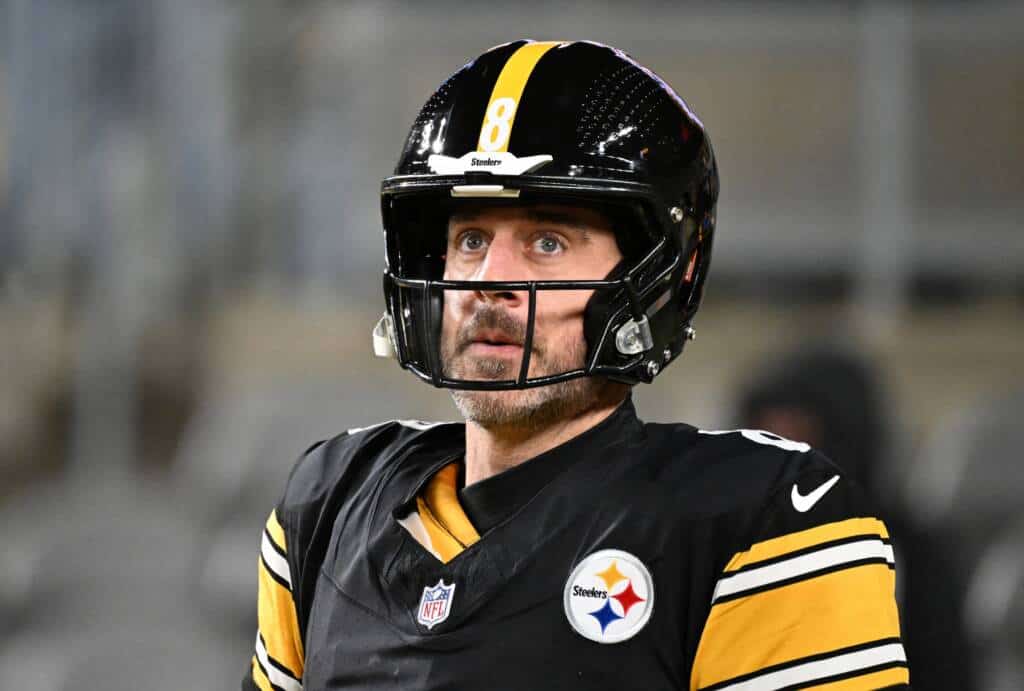
And over the past few years, the football world has spent those final winter weeks wondering whether quarterback Aaron Rodgers will retire. For Minnesota Vikings fans, this winter will carry on in much the same way as did 2025, with questions as to the team’s future No. 1 quarterback, and whether or not it will – or should be – the enigmatic Rodgers.
On Wednesday morning’s edition of Get Up, ESPN host Mike Greenberg led a roundtable analysis of comments delivered by ESPN’s Adam Schefter on Tuesday, where he alleged, “Last year, I think [Rodgers] did want to play in Minnesota. So if he wanted to do that last year, I don’t know why he wouldn’t want to do it this year.”
Schefter goes on to cite Minnesota’s 2025 plans to develop J.J. McCarthy, Aaron Rodgers’ “dominant” personality, and the potential incompatibility between the two. Rodgers went on to sign a one-year, $13.65 million contract with the Pittsburgh Steelers, where he reached the playoffs for the first time since 2022.
ESPN analyst Harry Douglas sees mostly upside to the potential addition, for both Rodgers and the Vikings:
Hands down, I think it’s a way better situation than he had in Pittsburgh because of the players that are surrounding him in Minnesota. Justin Jefferson…you have T.J. Hockenson…a really good number-two in Jordan Addison…it’s not like Aaron Rodgers is foreign to [McConnell’s] system. By the way: They’re playing in a dome.
While Douglas’ analysis focuses on the Vikings as a fit for Rodgers – and not the other way around – he offers some compelling reasons as to why the now 42-year–old would wish to play his 22nd season in Minnesota.
After his 2025 regular season, it’s clear that Rodgers can still play. He finished last season with 3,332 passing yards (15th) and a respectable 24 touchdowns (13th), by no means the worst performance in the NFL, and far better than any of the quarterbacks to take snaps for the Vikings in 2025. The long rumors of his interest in playing in Minnesota seem to reemerge every year, with the most credible and likely of them ending in March 2025 when O’Connell and Vikings leadership announced they would be “[moving] forward with J.J. McCarthy.”
It’s hard to say if, nearly a year later, McCarthy as QB1 remains the best course of action for the Vikings and their fans. During the Get Up interview, Douglas fairly faults the Vikings with “incompetent quarterback play.” And, absent a miraculous turnaround of McCarthy’s form and the offensive schemes designed to reveal his promise, the single most pernicious issue shared among the teams of the National Football League will remain, inherently, a roadblock to Minnesota’s aspirations for the NFC North, the conference as a whole, and the Lombardi Trophy.
As the NFL combine begins, the Vikings, as they have for decades, lack a franchise quarterback to lead their offense. McCarthy is young enough to perhaps avoid being a lost cause (cue lamentations over Sam Darnold), but, like the draft pick for whom he was selected, offers no certainty.
What we can be certain of is this: Aaron Rodgers is not the solution to Minnesota’s quarterback issue.
The potential of an electric offensive circuit connecting Rodgers’ still-impressive arm, Jefferson’s playmaking, and Hockenson’s toughness is unquestionably exciting. Rodgers may prove to be the exact mentor J.J. McCarthy needs to reach the promise of his time at Michigan.
At least on paper, Rodgers’ addition would likely boost predictions for the Vikings to reach the playoffs. Considering a win against Chicago in Week 11 would have made the Vikings NFC North Champions, a 2026 division title would certainly enter the conversation, as well.
National coverage and interest would certainly increase. Two divisional showdowns between the Vikings and the Packers would ignite playoff-caliber fervor, drawing prime-time audiences and pundits. A same-side reunion between Rodgers and Vikings RB Aaron Jones, Sr. would underscore the brotherhood among NFL players and offer a moment of human reflection.
None of these elements is worth the risk of taking on Rodgers. His personal and professional history overwhelm team storylines with scrutiny of his particular behaviors. Any on-field success begs the question: How long can he keep it up? Any seeming failure: Should he have retired?
As the most-covered quarterback in the NFL, Rodgers’ place on the roster automatically supersedes the carefully wrought schemes designed by KOC and his offensive staff. In short, Rodgers’ place on any team becomes the A-plot for that season, an object of media hyperfocus at the expense of a hundred other storylines that may better serve that team’s short- and long-term goals.
At the end of Wednesday’s Get Up segment, Greenberg directed the discussion to Dominique Foxworth, who flatly disagreed with Douglas in his assessment of Rodgers not only as a quarterback, but as an NFL personality:
I can’t argue with the talent around him [in Minnesota], but I think we’re making an assumption that Aaron Rodgers is just a very easy-to-fit square puzzle piece. … I’m just not going to assume that wherever you put Aaron Rodgers means it’s going to work out for him.
Foxworth’s hesitation takes the long view of Rodgers’s career contributions to the three teams with which he has spent his Hall Of Fame career.
The Vikings, in their rapidly narrowing window of championship opportunity, must take a similarly long view of their roster and avoid a plug-and-play solution at quarterback, which, while enticing, threatens the best intentions and preparations the Vikings can make to capitalize on the talent and leadership already present within the system. The remaining gaps within that system – a deep, stingy secondary; a No. 1 running back; that franchise quarterback – are far fewer in number than some organizations currently face. Their unique shapes, like Foxworth’s “puzzle pieces,” each have specific solutions that the Vikings are currently seeking without the leadership of a general manager.
Aaron Rodgers and whatever remains of his peerless career cannot provide any of these solutions, and certainly not in the long term. If the opportunity has emerged again, as Schefter speculates, the Vikings should pass.