
Love them or hate them, the Philadelphia Eagles have a lot they can teach the Minnesota Vikings. While their offense still has flaws, the one thing you can be sure of is that the Eagles will somehow, some way, find the end zone.
Between the 20-yard lines, Kevin O’Connell is something of an offensive scientist himself. However, he consistently falls short in the red zone.
Our friends in Philly ended 70% of their red-zone trips with a touchdown last season, leading the NFL by over three percentage points. Meanwhile, it’s been over three years since the Vikings were even a top-half team in this statistic.
Here’s how Minnesota has fared in the red zone since 2023:
2025: 56.8% (17th)
2024: 54.8% (19th)
2023: 47.1% (29th)
Despite the offensive train wreck that was 2025, the Vikings were better at punching the ball into the end zone than they were in the 14-3, Sam Darnold-led 2024 season. Still, it’s clear Minnesota is leaving something on the field, and you’d shudder to think what Minnesota’s scoring might look like if they didn’t employ Will Reichard.
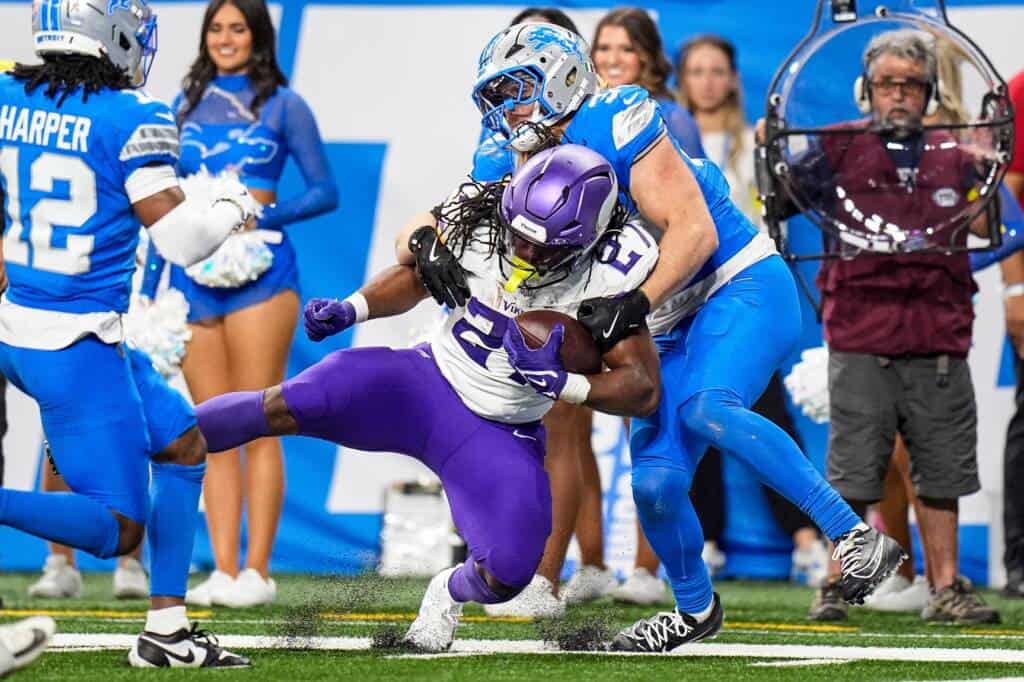
In a pass-happy league, O’Connell has maybe even taken things a little too far in the red zone. Jordan Mason led the Vikings in red-zone rushing attempts in 2025 with 29, which ranked 30th in the league, even behind a few quarterbacks. Aaron Jones had only 14 attempts on the ground, while the trio of Vikings quarterbacks slung it 77 times inside the 20.
O’Connell’s apprehension to pound the rock is only one of the issues, though. While the Vikings’ pass catchers were talented, the squad lacked a true red-zone threat. At a hulking 195 lbs., Justin Jefferson was the “big” receiver for Minnesota in 2025. Tight end T.J. Hockenson should theoretically be Minnesota’s red-zone weapon. Still, his drop-off after the knee surgery and Minnesota’s need to find blocking help after the offensive line was decimated with injury didn’t allow it.
With a healthy Christian Darrisaw, there’s always a chance that Hockenson regains his 2023 form when he erupted for 95 catches and five scores.
The Vikings have taken a few strides this offseason to improve their numbers, including adding one of the NFL’s best red-zone threats. At 6’3”, 212 lbs., Jauan Jennings was the fifth-most targeted wide receiver in the red zone last season with the San Francisco 49ers, and reeled in seven touchdowns from inside the 20.
Jennings brings a big body to the Minnesota offense that they haven’t seen in some time. While former WR3 Jalen Nailor provided plenty of speed on the outside, he didn’t offer much size. So if O’Connell remains insistent on throwing inside the red zone, at least the Vikings finally have someone to rely on.
If and when Kyler Murray wins the starting job, he’ll also immediately elevate Minnesota’s red-zone offense. Despite an injury-shortened season in 2025, Murray completed 65% of his red-zone passes, good for fifth in the NFL, and towered over the Vikings’ collective 50% rate. He also added a touchdown on the ground in just five games.
Should defenses try to spy Murray, it should leave one of Minnesota’s elite pass-catchers in single coverage. Alternatively, if the opponent dares to let Murray run wild and free, there aren’t many defensive linemen in the league who can contain him. It’s a perfect, evil plan in theory, especially if the Vikings can keep unforced errors like penalties or turnovers to a minimum.
The other positive is that, despite his limited attempts, Mason was highly effective in goal-line situations last year. In his seven attempts from inside the five-yard line, he scored on four, highlighting his ability to slam it in with his 230-lb. frame. Being big doesn’t necessarily equal being a good power back. Otherwise, every offense in the league would run out their nose tackle for a goal-line rush. Still, Mason has shown he’s capable of handling a bigger workload inside the five-yard line.
The Vikings have been plagued by penalties, turnovers, and questionable play-calling in the red zone, but there’s hope that 2026 could turn things around. With newcomers Murray and Jennings and a non-zero chance that O’Connell leans more toward the ground game, Minnesota’s play inside the 20 could be the best in years.
The last time the Vikings had a top-10 red-zone offense was in O’Connell’s first season when the team went 13-4 and won the division. After three seasons, it’s time to get back to what brought the team so much success in the first place. With a dynamic trio of receivers, a dual-threat quarterback, and a proven power back, there are no excuses in 2026.


