
The Minnesota Vikings’ 2026 draft class was initially met with mixed reviews. While no rookie class will come in perfectly ready to dominate, the Vikings may have more hurdles to clear than some other teams with their fresh crop of talent. As rookie minicamp quickly approaches, with OTAs to follow soon after, the development plans will become clearer.
So, where do each of Minnesota’s newcomers have to improve to become pro-ready in Year 1?
DT Caleb Banks
Banks broke his foot during the combine after breaking it a few months ahead of the 2025 season. While certainly not ideal, the good news is that it wasn’t the dreaded Jones fracture, and this second injury was most likely due to wearing improper cleats. Still, he won’t be ready for football activity until at least June, according to his pre-draft letter to teams, and fans will have to wait until mandatory minicamp to see Minnesota’s No. 1 pick.
Injuries aside, Banks’ elite size and athleticism made him a first-round pick. But being 6’6”, 327 lbs. alone won’t make him a successful NFL player (see Jerry Tillery or Javon Kinlaw). Banks will need to work on anchoring himself in the run game to become a three-down player. He had the worst career run missed-tackle rate at 22%, and second-worst run stop rate at 3.2% among drafted defensive tackles since 2016, according to PFF. He also tends to get washed away by double teams.
Brian Flores and Co. will need to improve Banks’ patience and lower-body strength this summer once he’s healthy.
LB Jake Golday
Golday is good at football, but he’s not quite a great player yet. He’s a jack of all trades but master of none at this point in his career, and it was evident last year with Cincinnati. Golday lined up in the box 320 times, the slot 251 times, and edge 122 times in 2025, according to PFF. He made plays all over the field. But while that range is a blessing, it can also be a curse.
Golday’s good size and attacking nature are obvious bonuses for a Flores-led defense. Still, his ineffectiveness at rushing to the passer for a player his size and his limited success defending the pass could be reasons for concern. Much like Banks, Golday wins in the run game thanks to his elite size for the position. However, to become an Eric Wilson or Blake Cashman successor in a year or two, he’ll need to improve his fluidity in coverage and build out a more polished pass-rushing repertoire.
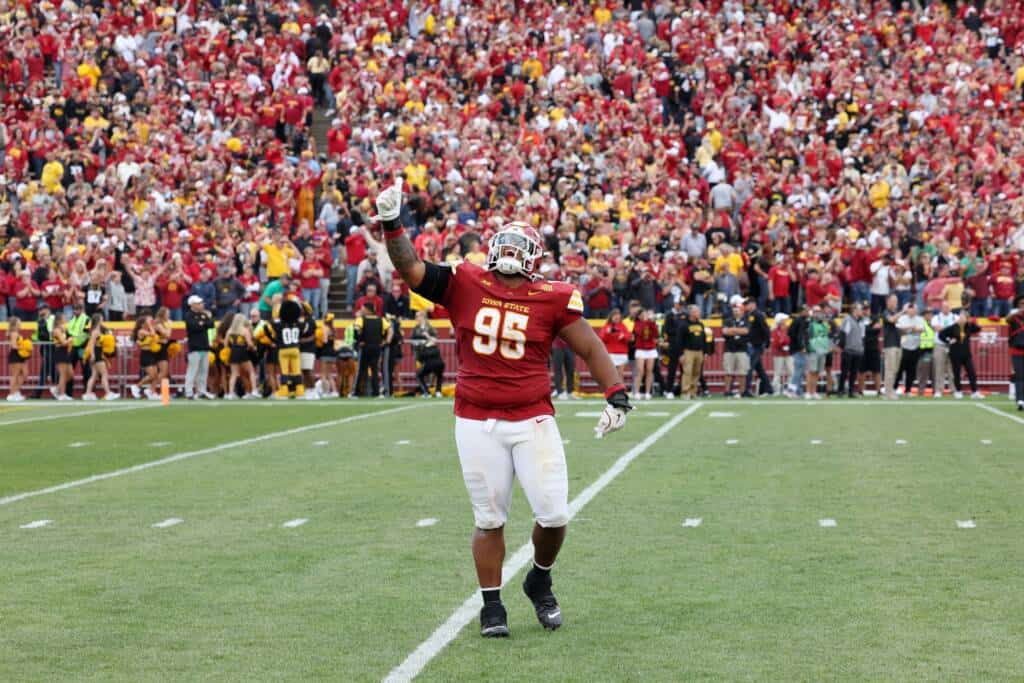
NT Domonique Orange
“Big Citrus” was brought into this roster to eat up space in the middle and let Banks and Jalen Redmond get to work on the quarterback. But wouldn’t it also be great if Orange developed a bit of a pass rush himself?
He has just one career sack and an abysmal 6.6% win-rate in 2025 with Iowa State. However, he already offers a high floor in the run game. Minnesota will surely try to work on his skills collapsing the pocket, even if the sack numbers never come. So while it may take time for Orange to develop into a multi-dimensional player, he still can be a good two-down player in the meantime.
OT Caleb Tiernan
With just 32” arms, the Vikings may break out their patented Arm-Stretcher 3000 to give Tiernan a more ideal build for offensive tackle. If that doesn’t work, Minnesota could use him as their next Blake Brandel and have him serve as the backup for virtually every spot on the line thanks to his versatility.
Still, Tiernan plays a bit stiff and will need to improve in the run game. Luckily, he’ll have a year (or more) to sit and learn.
S Jakobe Thomas
If Harrison Smith hangs it up for good this summer, there’s a world where Thomas has a chance to compete for a starting job in 2026. He’s a ballhawking safety with nine career interceptions who isn’t afraid to get his hands dirty in the run game, either. His hyper-aggressiveness is surely what drew Shadow GM Brian Flores to him. Still, he needs to clean up his tackling technique and play processing to have a chance at starting early.
TE/FB Max Bredeson
The C.J. Ham replacement is here, but he still has a ways to go to get on the same level as “The Hammer.” While Bredeson offers strong blocking ability in big packages, he has very little experience on special teams (just 146 career snaps). It’s an area he’ll need to become prolific in to justify a spot on the 53-man roster for years to come.
CB Charles Demmings
If Demmings came from an SEC school, he would’ve been a first-round pick. With ideal size, strong coverage skills, and a 4.41 40-yard dash, he’s got all the tools to be a good corner in the league. Unfortunately, coming from Stephen F. Austin, it’s hard to predict how all of that will translate to the NFL.
Demmings has great ball skills, intercepting four passes in 2025, but the Vikings will need to refine his technique to ensure that all that raw ability makes the jump to the pro level.
RB Demond Claiborne
At 5’9”, 188 lbs., Claiborne is small, but it’s hard to tackle something you can’t catch. His 4.37 speed is something the Vikings’ offense desperately needed, but ball security is a problem. He had six fumbles last season, and you can bet the staff will be punching at the football until their knuckles bleed.
C Gavin Gerhardt
Gerhardt will face an uphill battle to make the roster, with limited flexibility beyond center. He’s a four-year starter with good tape, but his average athleticism and inconsistency could hold him back. Really, if the Vikings can mold him into a reliable backup, that will be a huge win.


