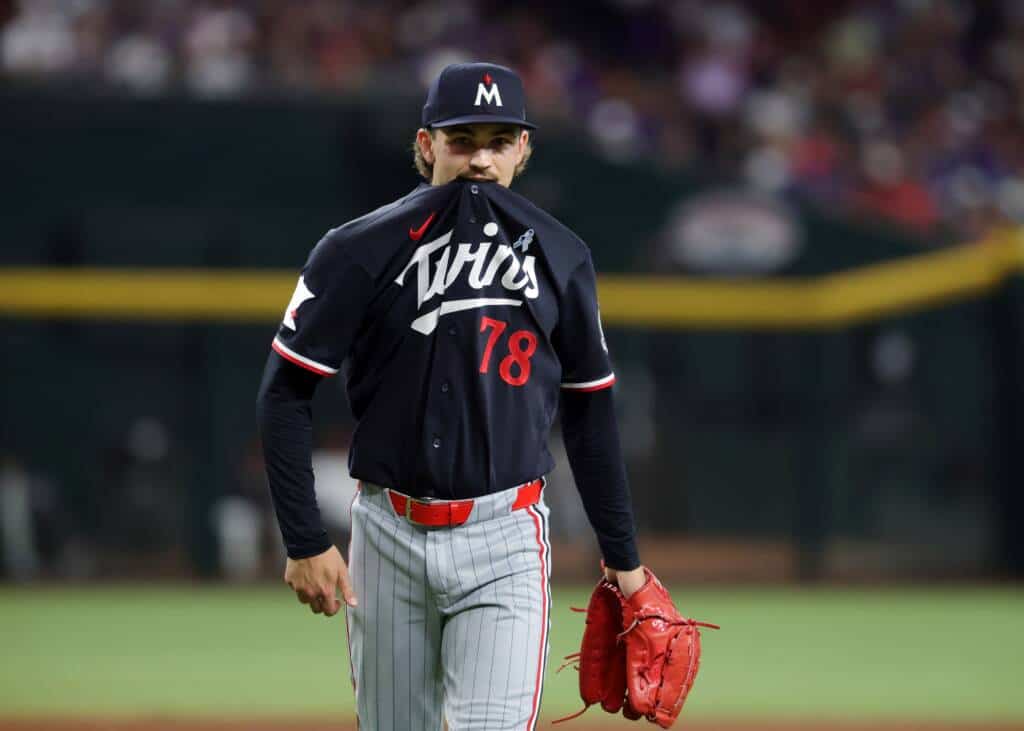

The Minnesota Twins are one game below .500 at the All-Star break, and Andrew Morris has been a meaningful contributor to their recent success.
Minnesota’s hitting has made the team the top-scoring team in the American League. But Morris’s adaptability and consistency have helped lead this team, which is 8-2 in their last 10 series.
The Twins’ history of transitioning starters to relief pitchers has helped Andrew Morris in his rookie season. Meanwhile, the timing of his promotion to the big leagues has been a driving force behind Minnesota’s recent success.
The Twins have done this before
When it comes to transitioning a starter into a high-leverage reliever, the Twins have had a lot of success in the past. Glen Perkins, LaTroy Hawkins, and Joe Nathan are three former players who started for the Twins before eventually becoming effective relief pitchers.
Even the Philadelphia Phillies and Toronto Blue Jays are capitalizing on Minnesota’s ability to transition starters to the bullpen, trading for All-Star relievers Jhoan Duran and Louis Varland.
The Twins had stretched out Morris as a power arm in the minors, with the thought of him being a starter. When the bullpen was blowing leads and injuries began to take their toll, the Twins called up Morris to replace the injured Cody Laweryson.
The truth behind Morris’ numbers
After being successful in Triple-A last season, going 4-6 with a 4.09 ERA, 89 strikeouts, 28 walks and a 1.33 WHIP on 94.2 innings, and the start of this season, a 1.23 ERA, five strikeouts, two walks and a 0.95 WHIP on 7.1 innings in two no-decision starts, it was only a matter of time before Morris reached the majors.
The initial thought may have been to use Morris as another backup starter. Or they could put him in a long-relief role if another starter needed to exit earlier than expected in a given game. Instead, the Twins have leaned on Morris as a high-leverage arm, especially as the season has gone along.
Morris has decent numbers this season. He has a 4-2 record, 3.33 ERA, three saves, 48 strikeouts, 14 walks, and a 1.26 WHIP across 46.0 innings. Still, he has been a problem for the opposition since June 12. Since mid-June, Morris has gone 3-0 with a perfect 0.00 ERA, two saves, 17 strikeouts, three walks, and a ridiculous 0.53 WHIP across 17 innings.
Once he reached the majors, Morris was used as a one-and-done type of guy, which caused some confusion among fans, as he was primarily a starter in the minors, making 62 of his 68 appearances there. He’s now showing that he is blending the multi-inning traits of a starter with the power of a reliever, creating a pitcher that no team wants to see right now.
Given the bullpen’s lackluster performances, the Twins’ decision to bring Morris up looks wise.
Perfect timing
Morris’s success has been the missing piece the bullpen has needed since the start of the season. While this bullpen is near the bottom of the league in ERA with a 5.19 ERA, Morris may be the only one keeping them from being dead last in MLB.
The Twins were also able to bring him in early enough in the season for him to ease into high-pressure situations. As this season nears its end and the team tries to fight its way into a playoff spot, every moment seems like the right one for him.
Taking into account Yoendrys Gomez’s recent success, who has a 1.71 ERA since joining the team, the Twins look to have what could be the scariest yet most fun combo to close games out.
The timing could not be better for Morris and the success he has had.
The Twins have been masters at turning former starters into quality relief pitchers. What they have been able to do with Morris is no exception. Mix in his development, his current scoreless inning streak, and his ability to be elite as his career continues, and you have a combination that should make all Twins fans excited.
If he maintains his current dominance, this could be the last All-Star break without Andrew Morris.


