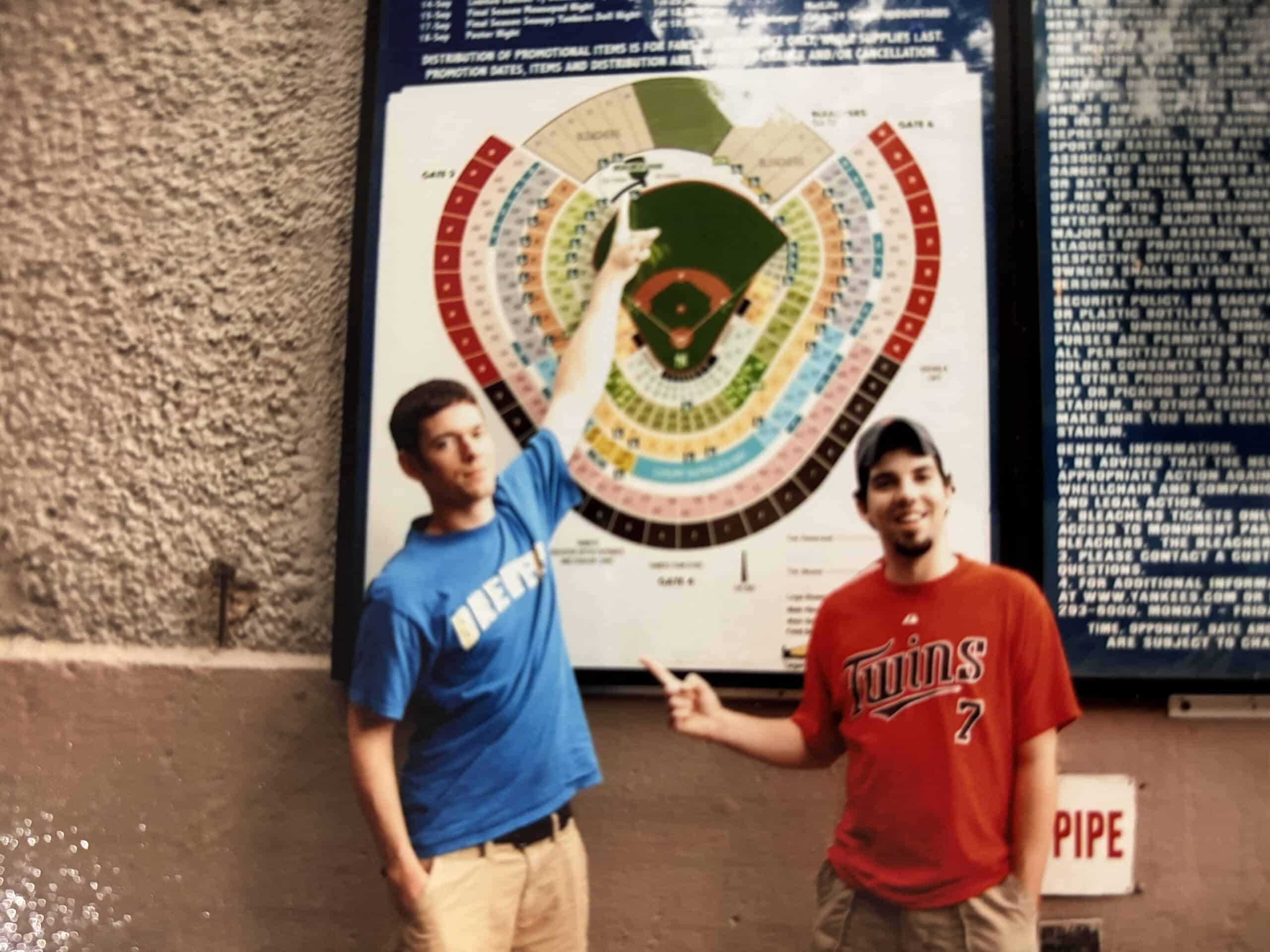
My college roommate and I waited until the last moment to visit Old Yankee Stadium and were richly rewarded.
I had completed my fourth year of teaching, and he — a St. Louis Cardinals fan from Jacksonville, Ill. — had finished his Master’s in percussion performance in Akron, Ohio. Hurriedly, we threw together a plan to make a midnight dash from Cleveland to New York, catch a day game in the Bronx, then head up to Cooperstown to spend a day before heading back through Queens to catch a prime-time game at Shea Stadium and drive, without sleeping, back to Cleveland.
We had to take our last chance, before the end of the season, to see a game there. And it just so happened — it feels impossibly lucky now — that the New York Yankees’ opponent at the 1:08 start time on Wednesday, July 23, 2008, was the Minnesota Twins.
Shut out by Mike Mussina until the ninth, Twins first baseman Mike Lamb singled home Alexi Casilla, prompting “Enter Sandman” and treating us to the entrance of Mariano Rivera, who struck out pinch-hitter Jason Kubel to end the game. Despite our conflicting loyalties, we sang “New York, New York” with the bleacher creatures, then made our pilgrimage to Cooperstown that evening.
Still more impossibly: When we arrived in Queens on Friday night, the Mets’ opponent was the St. Louis Cardinals.
To this day, my roommate and I marvel at the serendipity of those three days. We couldn’t have planned it any better: The sort of improbable, unique reward that the miraculous chances baseball affords to any who stand under its orbit.
CONSTANT
Like most lifelong baseball fans, we also have a deep affection for 1989’s Field of Dreams.
Chief among its insights is one of the finest dialogues ever written about baseball. And on this 250th anniversary of America’s nationhood, it might do to hear it again:
The one constant through all the years, Ray, has been baseball. America has rolled by like an army of steamrollers. It’s been erased like a blackboard, rebuilt, and erased again. But baseball has marked the time.
I love the choice of the word constant, especially as a noun. Those new to baseball marvel at the frequency of play, while long-time fans look forward to the comfort of its daily presence during the summer months. We glory in unexpected victory and agonize in the slivered margins of defeat. The pace at which it delivers these is constant.
But the constancy of baseball extends beyond its vast schedule, and that’s where P.A. Robinson’s screenplay captures baseball’s solemnity, particularly at this reflective moment in time and in mass culture alike.
CARRIAGE
The notion that baseball, beyond all other cultural indicators, has marked America’s development is difficult to refute. The relationship between America’s national identity and its national pastime was first forged in the pages of the New York Mercury in 1856. In those 170 years, baseball has carried the design of the United States itself — its Constitution, its will, and its ability to be amended, by the will of the people — as closely as a child carries a caught foul ball in her mitt. Both seem a miracle of chance, ingenuity, and beauty, because both are.
Both carry ugly histories, too, and are tormented by contemporary ugliness. It’s not a coincidence that both suffer from vast schisms at present, but it’s not fate, either. As goes America, so goes America’s pastime. Or vice versa.
In the last year, few cities, if any, have felt the intrusion of political occupation more acutely than the city of Minneapolis; few clubs have been devastated by the evils of baseball’s economics more than their Twins. In 2026, as in 2001, as in 1989: baseball marks the time.
In keeping with Robinson’s metaphor: It’s telling us to look to the blackboard.
CHANGE
The blackboard is a mess. To read it leaves Americans and baseball fans alike asking: How did we get here, again?
Like the United States, baseball changes with the times — and sometimes even ahead of it. Integration predated the Civil Rights movement by seven years. Yankee Stadium replaced “Take Me Out to the Ballgame” with “God Bless America” after the events of 9/11. Pitch clocks serve as a reminder to pitchers (and their managers) that the game is better with a sense of rhythm. ABS arrived to provide fans one more reason to sit on the edges of their seats when they “watch the game…as if they’d dipped themselves in magic waters.”
The magic is in baseball’s design. It promises conversation before pace. Individuals briefly distinguish themselves, but their contributions remain part of the whole. Players have to understand the value of their unique contribution, even in the losses. Persistence, invention, and fair play usually win out in the end: The wondrous province of a game in which only unlikely things can happen.
Baseball’s uniqueness comes from the chances it affords. And the exact same thing can be said of the United States of America.
The two are unlikely to separate. Thus the lessons and failures of one permeate the other, even if no one’s paying attention. This is because, as Daniel Okrent has noted, “we’ve been playing [baseball] fundamentally the same way for so long.”
Fundamentals start the discussion. Amendments value it.
CROSSROADS
In the final months of 2026, midterm elections in the U.S. will cement, or prompt, changes to American life. Simultaneously, Major League Baseball will enter into its most divisive labor negotiations since the strike-shortened 1994 season. The paths chosen at these crossroads will profoundly shape the nation’s next decade and its peculiar pastime.
That’s not serendipity. The concurrence of baseball’s labor struggles and America’s political turmoil reinforces their relationship, as articulated by Walt Whitman and Horace Traubel in 1888:
“Well – [baseball’s] our game. … America’s game; it has the snap, go, fling of the American atmosphere; it belongs as much to our institutions; fits into them as significantly as our Constitution’s laws; is just as important in the sum total of our historic life.”
Baseball, and Traubel’s notion that it represents a “sum total,” is as crucial as Robinson’s “constant.” A sum acknowledges the whole of ugliness and beauty. It recognizes the turmoil with the accord. Baseball wants us to find that sum in the scoreboard (runs, hits, and errors, too!) and respond accordingly. Baseball has no game clock; it’s never too late. If there’s one out left in the bottom of the ninth inning, there’s still a chance.
Baseball rewards that chance. Its insistence that we keep taking them is coded into the xylem of its design. Its lessons, if we let them, can meaningfully shape our individual efforts to create or preserve the changes we deem best serve the lives we lead; after all, we have far more influence in the voting booth than we do at the ticket counter.
Despite being 80 years late to the party, baseball provides a framework for understanding America’s complex identity. “It reminds us of all that once was good, and it could be again.”