
The Green Bay Packers addressed some of their biggest needs in the first wave of free agency, but their interior defensive line still needs maintenance.
Adding veteran Javon Hargrave goes a long way, especially for the interior pass rush. Hargrave still has plenty of juice in the tank and played some of his best football under new defensive coordinator Jonathan Gannon. Still, that doesn’t solve Green Bay’s glaring need for a run-stopper.
Hargrave might be a better run defender than anyone else the Packers have, especially after trading defensive tackle Colby Wooden for linebacker Zaire Franklin. Still, it isn’t his best skill set.
Unfortunately, an inability to stop the run isn’t anything new for the Packers. It’ll be a long time before fans forget the 2019 NFC Championship game, and we aren’t far removed from the Baltimore Ravens’ rushing attack embarrassing Green Bay toward the end of the 2025 season.
A leaky run defense can be the downfall of any defense, and the Packers still don’t have clear answers with the current interior defensive line. Thankfully, it’s mid-March. Green Bay doesn’t play a game for months, and there is plenty of time to get talent. The bad news is that we’re a week into the new league year, and most teams have the impactful nose-tackle types locked into new contracts. At this point in the off-season, what are Green Bay’s options to find a true run-stuffer?
With Wooden now in Indianapolis, former UDFA Nazir Stackhouse is the only run-stuffing specialist on the team. Ideally, Stackhouse can take a step forward and be a rotational player, but there is no guarantee he’ll even be on the initial 2026 53-man roster. Therefore, the Packers must invest in a run-stopper.
Most of the top interior defensive linemen available have already signed deals, but there are a handful of options still available. If the Packers are open to signing older players, as they have been this offseason, D.J. Reader and DaQuan Jones are available.
However, at this point, it seems unlikely the Packers will go that route.
Despite the obvious need, the Packers don’t want to risk their 2027 compensatory picks by signing too many unrestricted free agents. Many teams are stocking up on 2027 draft capital, believing it will be an impactful class across multiple positions.
The Packers aren’t the only team looking to conserve those picks; Jacksonville Jaguars general manager James Gladstone recently commented on the formula.
We’re at a stage now where a higher volume of draft capital is what we’re hunting up and those compensatory picks. When you think about high-priced free agents of ours ended up signing elsewhere… in return, by not signing any outside free agents, we recoup 2027 draft capital.
The Packers love their draft picks. Given their success in the middle and later rounds, it’s hard to fault them, even if it means passing on a player who could help them immediately.
That leaves the draft as their most likely avenue to fill their run-stopping void. But while it’s the team’s biggest need, it isn’t the only one, and Brian Gutekunst doesn’t like to be pigeonholed into drafting for immediate need. The team also doesn’t like to rely on rookies immediately, for better or worse, if they don’t have to.
Even then, with no first-round pick, Green Bay doesn’t have its first selection until pick No. 52, late in the second round. We don’t often play the “they won’t be there” card here. However, if there’s a run on interior defensive linemen before 52, Green Bay might not be able to rely on drafting an interior player who can be impactful against the run immediately with that first selection.
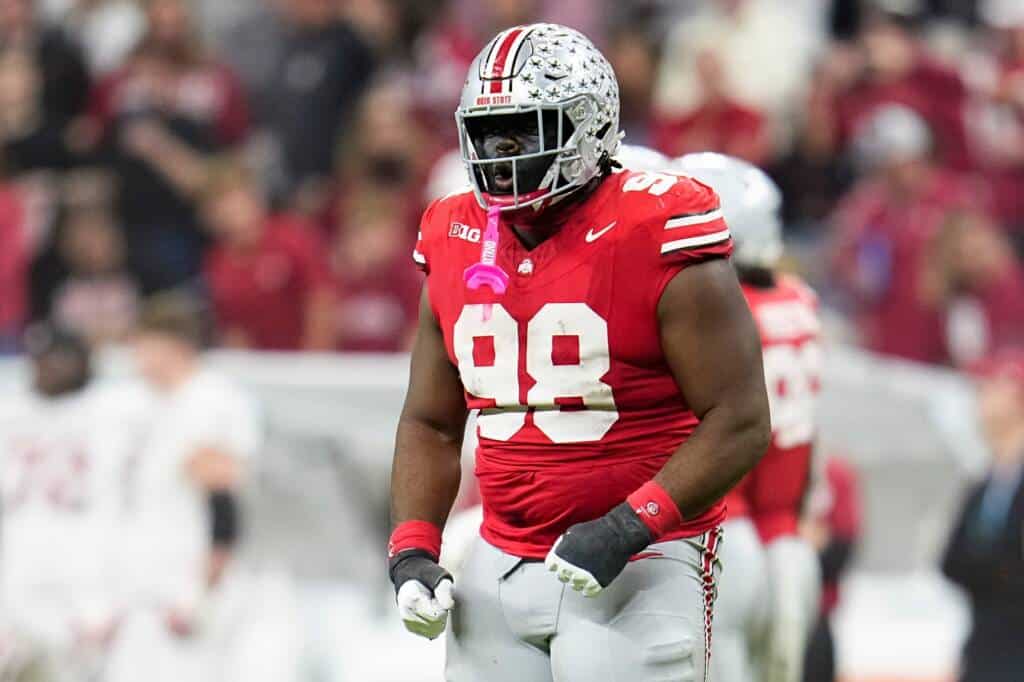
Ohio State’s Kayden McDonald looks like the best immediate starting-caliber run defender and would be a great option at 52, but could easily be drafted much earlier. Other top-100-talent options with balanced profiles may be available, but they may not solve the run issues immediately.
Iowa State’s Domonique Orange or Cincinnati’s Dontay Corleone are promising middle-round options who could sub in on rushing downs. Even as a rookie, T.J. Slaton, Green Bay’s last true run-stopping specialist, played 24% of defensive snaps. Still, it’s a risk to put all of your hopes on a rookie.
The most realistic option will be for Green Bay to draft an interior lineman and consider cap casualties in the coming days as they release veterans throughout training camp. It means the Packers might not have an answer until well after the draft, but it also provides avenues for acquisition without risking their coveted comp picks.
All of this means that Green Bay does still have options, even if they missed out on the top available free agents. There are players in the draft that could immediately affect the run, and there will be more veteran options that won’t count against the comp pick formula in the coming days and months. It’s still a glaring concern for Gannon’s new defense, but a draft-and-develop team like Green Bay can fill that void in different ways beyond classic free agency.