
Today, I’m taking a page from the Minnesota Vikings section of Zone Coverage and running a simulation to see how the Green Bay Packers would approach the 2026 draft if they based every pick solely on the consensus board rankings.
Every Packers fan knows the team’s biggest needs this offseason are at cornerback, along the offensive line, and along the defensive front. However, for this exercise, roster construction and immediate needs won’t dictate the process. Instead, we’ll work strictly off the consensus board, identifying which prospects align with Green Bay’s draft slots based purely on value relative to projection.
The objective is to measure how closely the board and Green Bay’s positioning intersect — isolating surplus value opportunities, tier breaks, and positional runs — without allowing teams’ needs to distort the evaluation. With the framework set, let’s move to the selections.
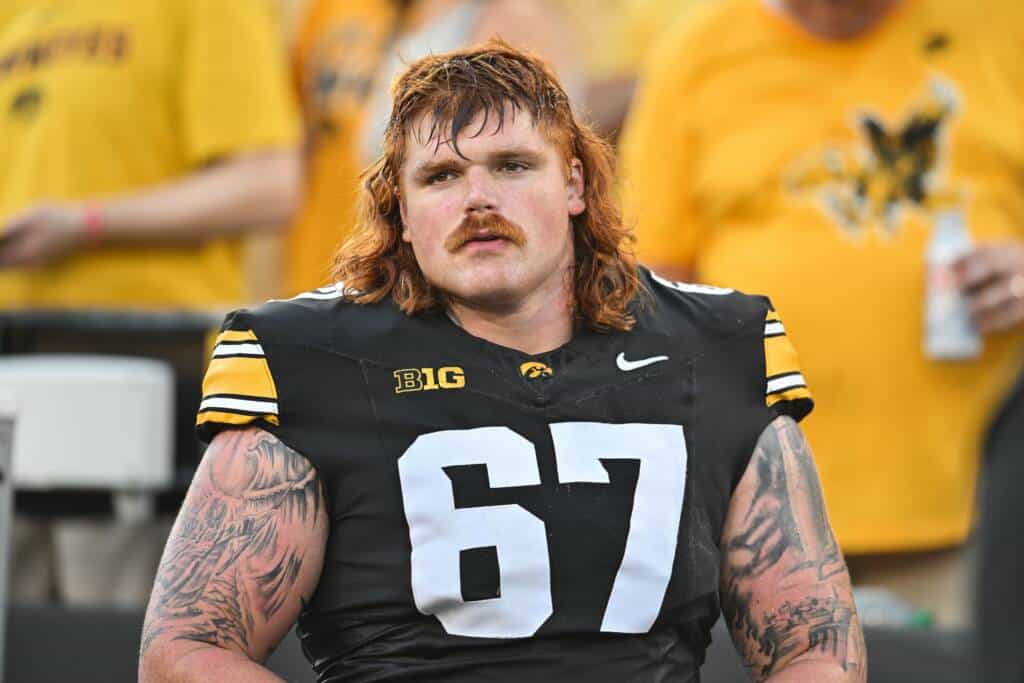
Round 2, Pick 52 — Gennings Dunker, Offensive Tackle, Iowa
Dunker actually checks some of the boxes Green Bay typically looks for in an offensive lineman. He’s listed at 315 lbs. and brings strong positional experience and versatility.
Most of his college career with the Iowa Hawkeyes came at right tackle, but he also logged snaps at guard, which adds to his potential value up front. Across 2,209 career blocking snaps, he was flagged just 11 times.
Dunker’s selection makes plenty of sense for the Packers. He may not be the most athletic tackle prospect in the class, which could limit his long-term ceiling as a tackle, but his profile projects well to a move inside at the next level.
Round 3, Pick 84 — Sam Hecht, Center, Kansas State
The Packers are expected to release Elgton Jenkins this offseason. Meanwhile, Sean Rhyan is slated to be a free agent in a few weeks. If both were to depart in the offseason, the most logical next option up front would be Jacob Monk. However, Green Bay hasn’t given him much playing time, and he might not be ready for a full-time role.
Hecht is a very athletic center, and that mobility was one of the pillars of Kansas State’s running game. His ability to climb to the second level and operate in space helped fuel the ground attack and kept the scheme multiple.
As a pass protector, he was efficient and steady. Last season, he allowed just eight pressures and zero sacks across 392 pass-blocking snaps. He also proved reliable in the run game, earning a 77.7 run-blocking grade.
Jenkins’ time with the Packers has come to an end, and it’s unclear if Rhyan will be back. If Green Bay decides to invest in a center with developmental upside, Hecht would be an interesting target.
Round 4, Pick 120 — Beau Stephens, Guard, Iowa
Stephens would be Green Bay’s second offensive lineman from Iowa in this year’s draft — and a full-on hat trick in the trenches with their first three selections. Investing heavily up front early in the draft is well within the organization’s philosophy under Gutekunst. Still, it seems unlikely that the Packers would draft three consecutive offensive linemen.
Stephens primarily stayed at guard throughout his college career, even though he has the size profile the Packers typically value up front. That said, the overall projection and role specificity don’t quite align with Green Bay’s usual preference for versatility.
Round 5, Pick 158 — Sam Roush, Tight End, Stanford
Tight end is a sneaky, under-the-radar need for the Packers, and Roush fits the profile of a player who could help in that area because of his blocking ability, which carries significant value in Green Bay’s system — especially considering that John FitzPatrick outsnapped Luke Musgrave at one point last season due to his in-line reliability.
As a receiver, Roush still needs development, particularly in reducing drops and becoming more consistent at the catch point. Still, even without much flash, he projects as the kind of tight end willing to handle the dirty work in the trenches and contribute to the run game.
Round 6, Pick 199 — Aamil Wagner, Offensive Tackle, Notre Dame
Wagner would make it five offensive linemen taken with the first six picks. Wagner was a two-year starter for Notre Dame and was voted a team captain. The leadership profile is there, but the overall experience level is still lighter than what Gutekunst typically prefers in early offensive line investments. Moreover, he played exclusively at right tackle, while Green Bay usually prioritizes linemen with multi-position flexibility across the front.
Round 7, Pick 236 — Eli Heidenreich, Wide Receiver, Navy
Heidenreich would qualify as a home-run selection for Green Bay, even if wide receiver is not viewed as a long-term weakness. Hendrick’s production profile is elite — his 3.94 career yards per route run is an absurdly efficient mark and signals a player who consistently creates separation and capitalizes on opportunities.
However, Heidenreich’s versatility is what makes him especially intriguing. He isn’t limited to lining up outside; he can take snaps out of the backfield, operate from the slot, and factor into the return game or coverage units on special teams. That kind of multipurpose skill set adds layers to an offense and expands what the coaching staff can do schematically.
Round 7, Pick 254 — Logan Taylor, Guard, Boston College
Taylor would be a very on-brand pick for the Packers. He has logged over 1,000 career snaps at both tackle and guard, highlighting the kind of positional flexibility Green Bay typically values. He also brings the size profile they look for up front.
He’d be the fifth offensive lineman the Packers take in this mock. However, he’s arguably the most intriguing of the group because that versatility gives him multiple pathways to a role.
Round 7, Pick 257 – Namdi Obiazor, Linebacker, TCU
Obiazor was a highly productive tackler during his time at TCU and consistently held up well against the run. He posted just an 8% missed tackle rate last season and an even better 6.3% mark in 2024.
However, coverage is not his strongest area, and in today’s NFL, linebackers need to offer real value in space to stay on the field for all three downs. He’ll attend the combine, which should give evaluators a clearer picture of his movement skills and overall athletic profile.