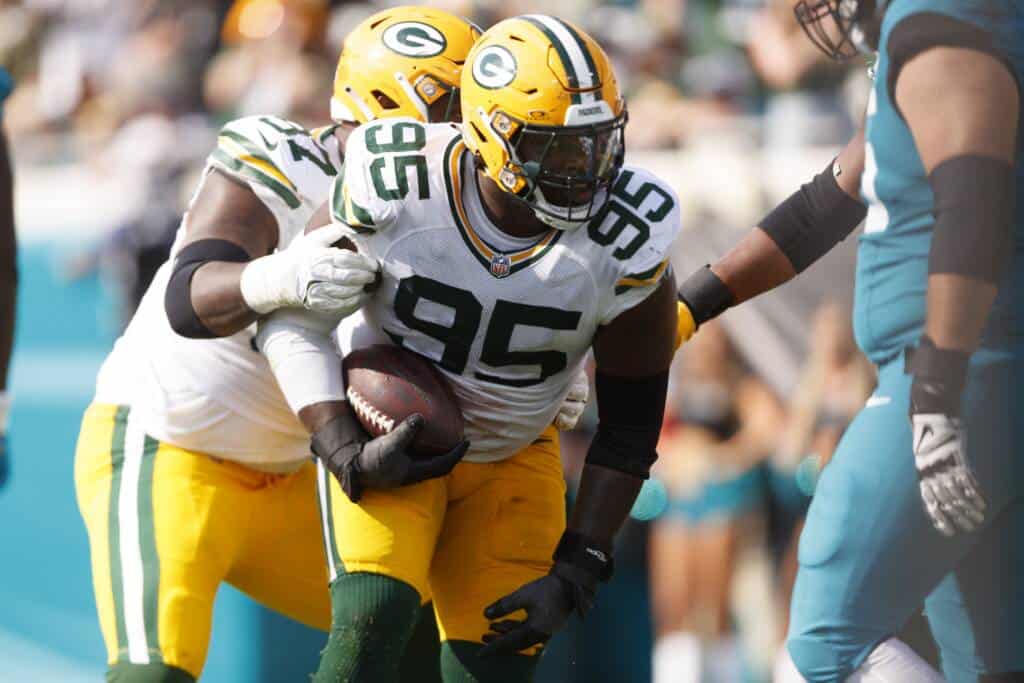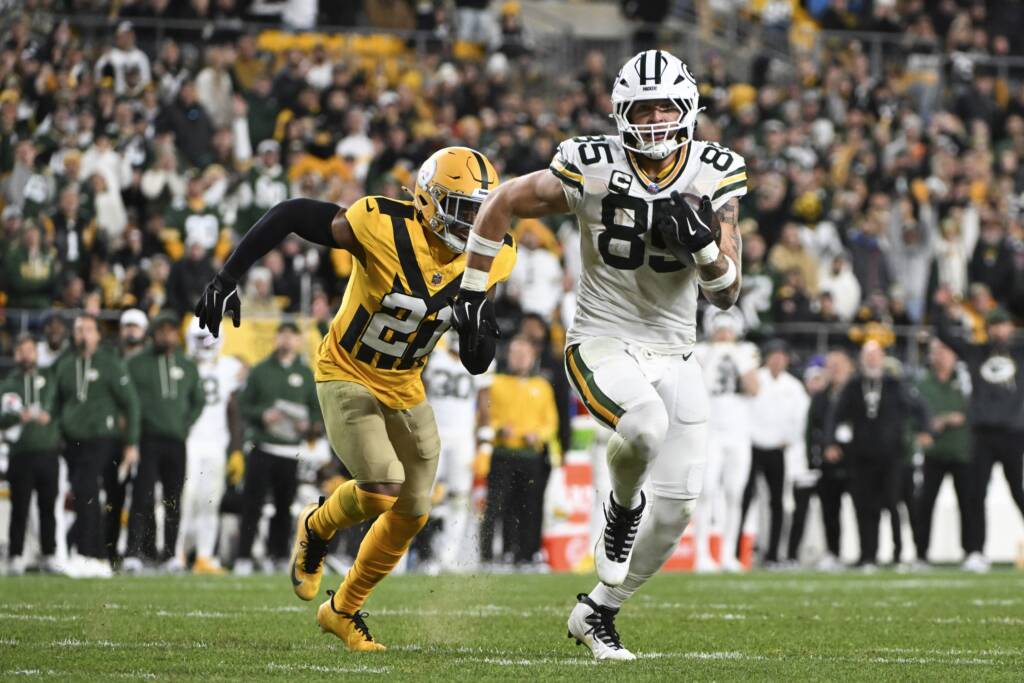

The Green Bay Packers have been busy taking care of their own this offseason, signing Christian Watson, Jayden Reed, Isaiah McDuffie, Sean Rhyan, and Devonte Wyatt to contract extensions. Tucker Kraft should be the next logical player in line. While there’s no doubt he will get paid, the question is what that contract will look like.
Only four tight ends earn at least $16.5 million per season: Kyle Pitts, T.J. Hockenson, Trey McBride, and George Kittle, who leads the position at $19.1 million per year. Kraft has done enough to put himself in that conversation, but will the Packers pay him like those other star tight ends?
The closest comparisons are the recent extensions Pitts and Brenton Strange signed. Pitts and the Atlanta Falcons agreed to a three-year, $54 million contract worth $18 million annually, while Strange signed a three-year deal worth up to $48 million with the Jacksonville Jaguars. Those contracts provide a solid framework for projecting Kraft’s next contract.
Before tearing his ACL, Tucker Kraft was on his way into an All-Pro campaign. He developed into one of the league’s most complete players at the position, impacting games as a receiver and one of football’s best blocking tight ends. Add in his ability to create explosive plays after the catch, and it’s easy to understand why Green Bay views him as a cornerstone of its offense.
Nobody inside 1265 Lombardi Avenue is shying away from that belief. Earlier this offseason, Matt LaFleur said that Kraft will remain a focal point of Green Bay’s offense once he’s back on the field.
“It’ll be great to have Tucker Kraft coming off his ACL injury,” he noted. “He’s been around quite a bit. Watching him train and rehab and go through that process, he’s gonna be a big focal point of our offense.”
However, the injury changes the equation slightly. While Kraft has done enough to earn a top-of-the-market contract, an ACL tear is significant enough that the Packers could be more cautious with the structure of the deal. Green Bay has a history of protecting itself through guarantees that vest over time and roster bonuses, and Kraft’s extension could follow that same blueprint.
That also fits Green Bay’s long-standing approach to extensions. Brian Gutekunst has consistently rewarded homegrown players without changing the market at their respective positions. The Packers also prefer contracts that protect the organization over the long haul. Rather than handing out large fully guaranteed salaries beyond the signing bonus, they typically rely on roster bonuses and guarantees that vest over time. It’s a structure they recently used with Christian Watson, Jayden Reed, and Devonte Wyatt.
The timing also works in Green Bay’s favor. Jordan Love‘s cap hit is set to increase over the next few seasons, making it likely the Packers will keep Kraft’s first-year cap hit relatively low before larger cap numbers kick in later in the deal.
Taking all of that into account, my projection is a four-year, $72 million contract, averaging $18 million per season. That would make Kraft one of the highest-paid tight ends in football without surpassing George Kittle at the top of the market.
The deal would include roughly $20 million as a signing bonus and $38 to $40 million in total guarantees, with most of those guarantees coming through the signing bonus and roster bonuses that vest over time rather than fully guaranteed base salaries.