
If you’re the type of football nerd who enjoys building out multiple roster scenarios — projecting cuts, trades, free-agent moves, signings, and draft paths for your favorite team — this article is for you.
StickToTheModel recently launched a new armchair GM-style planning tool that puts you in full control of the offseason. You can restructure player contracts, work through free agents with estimated market values, and run a detailed draft simulator that includes player and pick trades — all in one place.
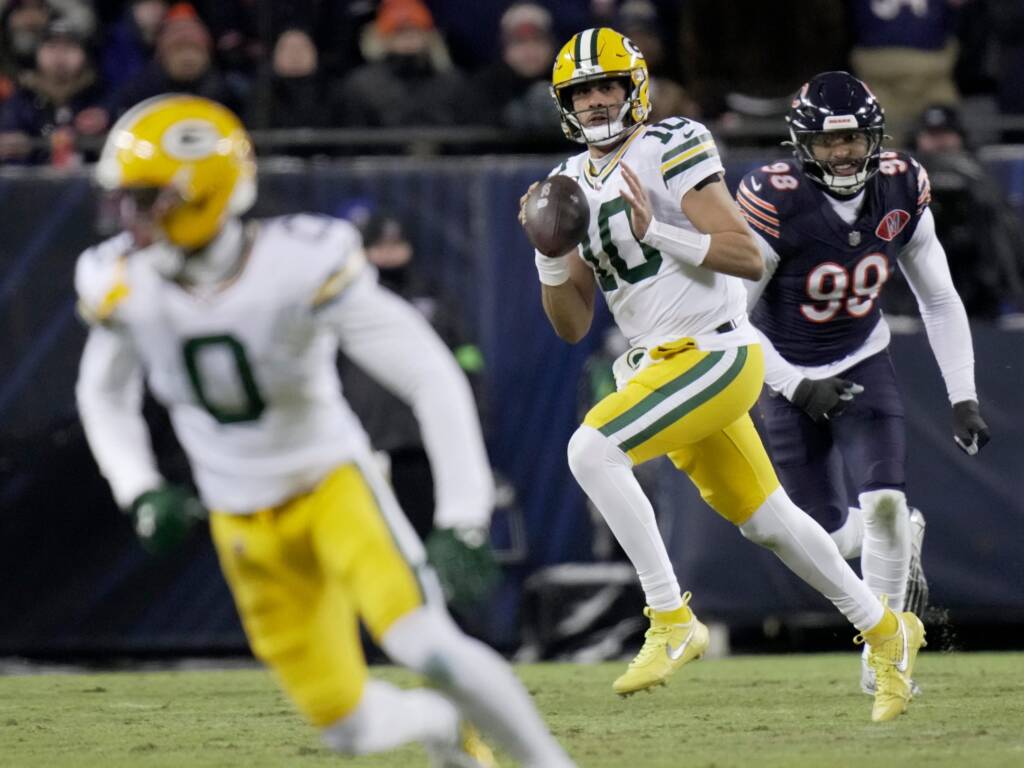
Today, we’re going to take over the Green Bay Packers and see if we can build a roster that should realistically be expected to compete for a Super Bowl title in 2026.
Cuts
First and foremost, the Packers are projected to be $1.4 million over the cap in this simulation, so the first step is creating enough space to get under the projected cap for the 2026 league year.
To make room, I released Elgton Jenkins, which cleared $19.5 million in cap space while leaving just $4.8 million in dead money. He will turn 31 in December and is coming off a significant lower-leg injury, which made this a difficult but defensible cap casualty.
I also released Rashan Gary with a post-June 1 designation, saving $18.8 million while spreading out $8.5 million in dead money over the next two seasons. The Packers usually don’t make many post-June 1 moves. They tend to move on from a player early and absorb whatever dead money comes with it.
Because of that tendency, this approach may not be the most realistic one. Still, considering the contract, performance, and overall roster direction, there’s a chance that Gary has already played his final down in Green Bay — and the smart move here might simply be to move on and let the younger players take on bigger roles.
Beyond Micah Parsons and Lukas Van Ness, the Packers have younger, cheaper alternatives such as Barryn Sorrell and Collin Oliver, who could absorb more playing time.
Restructures
There isn’t much Green Bay can realistically do in terms of restructures to create additional room. With that in mind, I restructured Jordan Love’s contract by adding a void year, which creates $7.4 million in cap space for 2026. His cap hit drops from $35.7 million to $28.3 million with this move, while pushing $7.4 million in future dead money if the Packers ever cut him — which, spoiler alert, isn’t going to happen.
Extensions
Christian Watson and Tucker Kraft should be a clear priority for the Green Bay Packers to pursue long-term extensions with as soon as possible. Kraft’s situation is more complicated because he’s coming off a torn ACL, so Green Bay may prefer to evaluate how he rebounds before committing to a multi-year deal. Watson, on the other hand, profiles as a more straightforward early-extension candidate if the goal is to lock in core offensive pieces ahead of further market inflation.
Watson signed a one-year, $13.25 million extension with the Packers in 2025, but both sides are still free to negotiate a new long-term deal this offseason. According to projections from StickToTheModel, his market value sits around $22.5 million per year.
In this simulation, I converted the short-term arrangement into a new three-year, $67.5 million extension, with $54 million guaranteed at signing. When you combine that with Watson’s already-existing contract year, it effectively keeps him tied to Green Bay through 2030 on a four-year contract worth about $74 million total.
Meanwhile, I gave Kraft a four-year, $66 million extension. That would place him among the five highest-paid tight ends in football, tied with T.J. Hockenson for the fourth-highest average per year at $16.5 million. It’s a fair deal based on his trajectory and role. Kraft was on pace for an All-Pro-level campaign before suffering his knee injury in Charlotte, and he will be one of the essential elements of Matt LaFleur’s offense for years to come.
RFA Tenders
Green Bay has eight candidates for the restricted free-agent tender this offseason, but in this simulation, I placed tenders on only three: Darian Kinnard, Josh Whyle, and Brenton Cox Jr. — all with the right-of-first-refusal (ROFR) tag. Altogether, those tenders account for roughly $10.5 million against the cap.
Re-Signings
The Packers have four core starters slated to hit free agency: Romeo Doubs, Sean Rhyan, Rasheed Walker, and Quay Walker. In this simulation, I let all four walk and accepted the likely return of future compensatory picks.
First, I re-signed Kingsley Enagbare to a two-year, $12.8 million deal, averaging $6.4 million per year. That figure is slightly above the projection from Spotrac, but still a solid value for a dependable rotational edge rusher who was arguably Green Bay’s second-best option off the edge last season.
Meanwhile, I re-signed Kristian Welch, Nick Niemann, and Zayne Anderson to $1.4 million one-year deals, keeping key special teams contributors in place. Chris Brooks also returned on a one-year, $1 million contract. After those moves, the Green Bay Packers sit with about $12.4 million in cap space available to use in free agency.
Free Agency
I added former Arizona Cardinals cornerback Darren Hall on a one-year, $1.4 million deal, with the idea that Jonathan Gannon could value bringing in a defender familiar with his scheme and terminology.
I also signed D.J. Reader to a one-year, $4.6 million contract, addressing a need to strengthen the interior defensive line and improve the rotation for the Green Bay Packers.
After these additions, I had about $6.4 million in cap space remaining, which I chose to keep untouched to preserve in-season flexibility.
Draft
- Round 2 — Pick 52
Blake Miller — IOL — Clemson - Round 3 — Pick 84
Logan Jones — C / IOL — Iowa - Round 4 — Pick 120
Tacario Davis — CB — Washington - Round 5 — Pick 158
Taylen Green — QB — Arkansas - Round 6 — Pick 200
Cole Brevard — DL — Texas - Round 7 — Pick 236
Owen Heinecke — LB — Oklahoma - Round 7 — Pick 254
Josh Moten — CB — Southern Miss - Round 7 — Pick 257
Eric O’Neill — EDGE — Rutgers
I’m a big fan of Blake Miller, Logan Jones, and Taylen Green as prospects overall, even though I’ll admit I reached a bit on Jones and Green based on value. Still, I like the fits and the developmental upside each brings to the roster.
Tacario Davis is a physical, press-style corner who matches the size and play-strength thresholds the Green Bay Packers typically look for at the position. Meanwhile, Josh Moten is undersized, but his athletic profile and movement skills make him an interesting late-round bet.
Up front, Cole Brevard and Eric O’Neill help reinforce the defensive line rotation with added depth. Meanwhile, Owen Heinecke provides another depth option for the linebacker corps and special teams units.
The StickToTheModel platform gave me a B+ grade for this offseason build. Their biggest critique focused on the franchise’s long-term outlook, which is fair — but also somewhat intentional. This plan leaned more toward maximizing the short-term window than preserving future flexibility. After all, the Green Bay Packers should be expected to compete for a title in 2026.