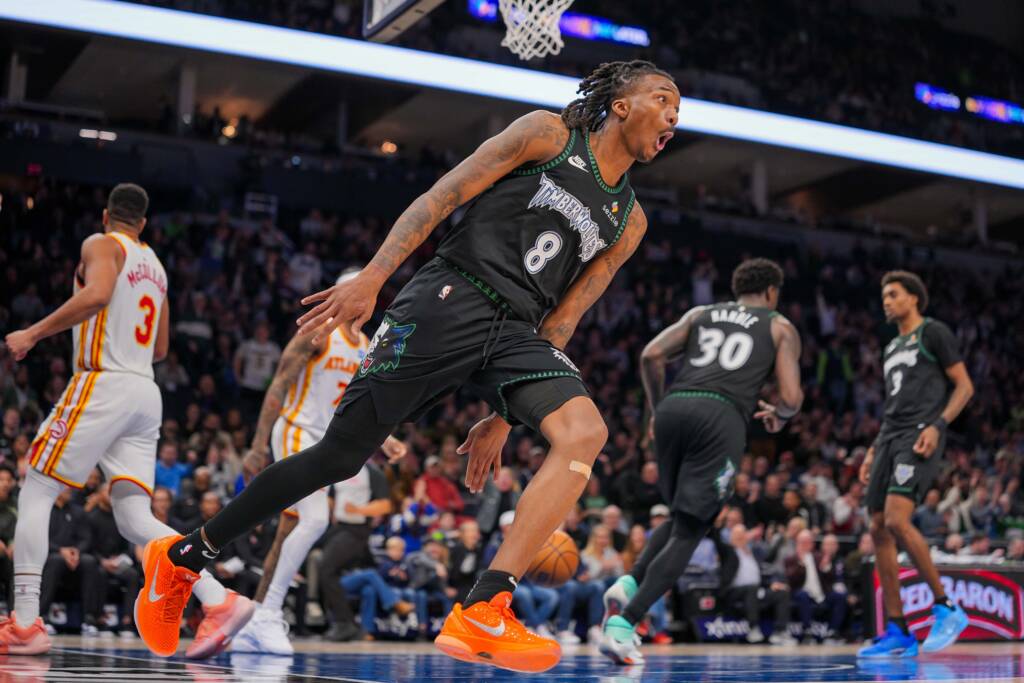

When they return from the All-Star break, the Minnesota Timberwolves will only have 26 games to attempt to secure their seeding in the playoffs. They are the sixth seed in the Western Conference, but they face a grueling schedule in the sprint to the end of the season.
However, at the 68% mark of the regular season, it is necessary to at least acknowledge that if the Wolves secure a good playoff seed, they will have a realistic chance of winning the championship.
When evaluating a team’s championship hopes, I focus on five statistical categories and their league rankings. Offensive rating, defensive rating, assist percentage, assist-to-turnover ratio, and true shooting percentage. The offensive and defensive ratings show where a team ranks overall in the league on offense and defense.
Assist percentage shows the percentage of made baskets that result from an assist, reflecting a team’s ball movement and connectivity on offense. The assist-to-turnover ratio grades a team’s execution and its propensity to commit turnovers. Finally, true shooting gives a single number that reflects a team’s shooting percentage, weighting three-pointers, two-pointers, and free throws.
You take any team’s ranking in those five categories and divide them by five, and you get one number that can reflect a team’s success in these categories against their peers in any given season. The method isn’t perfect, and there are always outliers, but when looking at teams that win the championship year after year, there are trends. At some point, if a team’s ranking is too high, it can be eliminated due to historical precedent.
Where do the Wolves sit this season?
- Offensive rating: 7th
- Defensive rating: 7th
- Assist percentage: 18th
- Assist/turnover ratio: 15th
- True shooting: 5th
- Average: 10.4
10.4 isn’t an encouraging number on its surface, but looking back to last season, Minnesota’s average at the end of the year was 10.8. That means that this season, when ranked against their peers, the Wolves are 0.4 better than last year.
While it may seem insignificant, this is where we need historical context. Let’s look back at past champions to see where their average rating ranks.
- 2024-25 Thunder: 7.4 average
- 2023-24 Celtics: 5.6
- 2022-23 Nuggets: 6.0
- 2021-22 Warriors: 7.0
- 2020-21 Bucks: 11.4
- 2019-20 Lakers: 10.4
- 2018-19 Raptors: 8.2
- 2017-18 Warriors: 3.4
- 2016-17 Warriors: 1.2
- 2015-16 Cavilers: 8.6
- 2014-15 Warriors: 1.6
- 2013-14 Spurs: 4.0
- 2012-13 Heat: 5.6
- 2011-12 Heat: 12.4
- 2010-11 Mavericks: 5.0
The data from past champions gives the Wolves some hope and also credits the system. The average ranking shows the consistency of past champions.
The 2010-11 Dallas Mavericks led the league in assist percentage and assist-to-turnover ratio. They also ranked in the top ten in offense, defense, and true shooting. The Mavs won the championship because of their ball movement.
Both Miami Heat teams ranked near the top in offense and true shooting, but significantly lower in assist percentage, reflecting their iso-heavy play. However, the Golden State Warriors’ dynasty, as shown in these rankings, demonstrates their dominance over the league.
In the more recent past, the Toronto Raptors were all-around solid, which propelled them to a ring. The 2020 Los Angeles Lakers and 2021 Milwaukee Bucks reflect the weirdness of the bubble and the shortened COVID season and are thus outliers.
Then, it goes right back to the low rankings. The Warriors, Boston Celtics, Denver Nuggets, and Oklahoma City Thunder were well-rounded teams that excelled in ball security, shooting, and offense or defense.
The results of the last 15 years show that championship-winning teams have an average ranking of 6.5. No team other than the Heat, Bucks, and Lakers has won the championship with an average ranking over 9.0.
Reflecting on Minnesota’s side of this and their 10.4 ranking. With 26 games remaining, they can improve their average in these categories. Individual statistics are less important at this point in the season, and wins matter more. The Wolves are talented enough to surge at the end of the season.
However, given how the Timberwolves have played until the All-Star break, they would be an anomaly if they win the championship.
They don’t have a super team like the Heat did in 2012, when they got healthy for the playoffs. They ran through the postseason, winning the ring in 23 total games. The Wolves won’t benefit from a month-long break before the playoffs, as the Lakers did in the bubble. Minnesota also won’t benefit from a shortened regular season or weird playoffs that had lower attendance when people still couldn’t attend games, as the Bucks did in 2021.
Based on their statistical makeup, the Timberwolves sit on the outside of a championship, looking in, with a chance to improve their odds before the season closes. Their offense and defense are both great but not necessarily elite, their ball movement is in the middle of the pack, and they show as a team that they can shoot well.
The Wolves still have time to improve, but based on how they played before the All-Star break, they would be an outlier if they were to win it all.