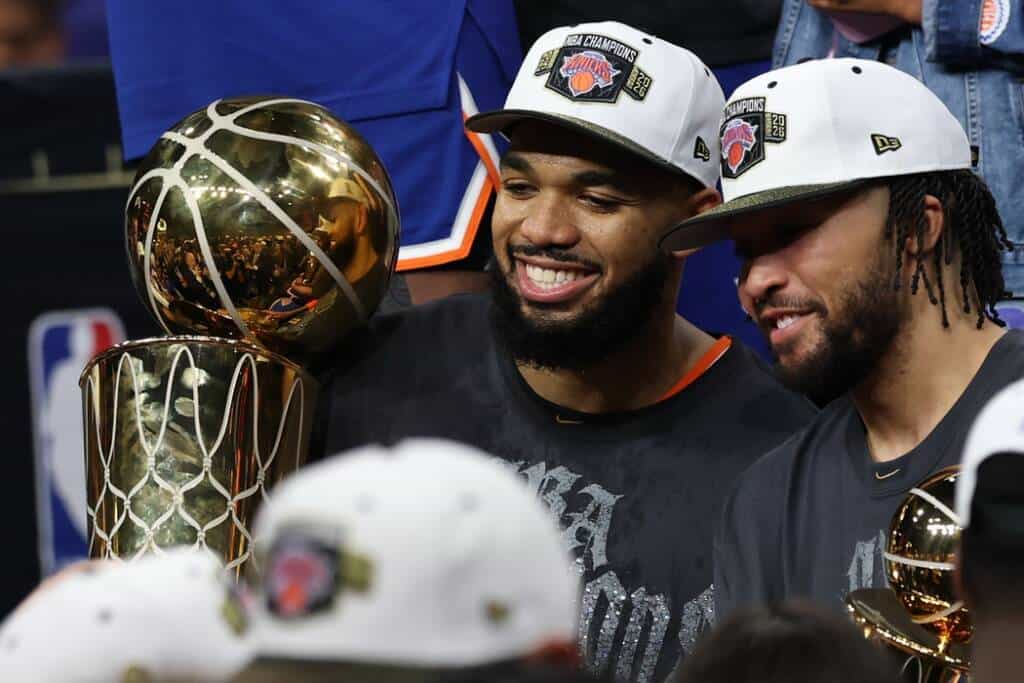

Jalen Brunson, with an NBA Championship hat covering his tightly braided hair and the NBA Finals MVP trophy — which would be his minutes later — sitting on a table in front of him, spoke with Inside the NBA’s Ernie Johnson after the New York Knicks beat the San Antonio Spurs 94-90 in Game 5 Saturday to crown themselves champions.
Brunson scored 45 points, 15 of which came in the fourth quarter, where the Knicks routinely had the upper hand throughout a playoff run that included 13 straight wins.
The Knicks were clutch. Now, they are in the history books. But they weren’t flawless.
“I don’t know, for some reason, I feel like the game for us starts 30 minutes later than it is supposed to,” Brunson said. “We didn’t show up at 8:30, we showed up at 9 o’clock.”
Does that sound familiar?
Slow, unfocused starts have been the Minnesota Timberwolves’ Achilles heel that they have been unable to overcome over the last two years — a glaring indication of a team that lacks maturity.
The Knicks were not always a mature team in the postseason, but they were when it mattered most. Second-half takeovers and late-game gems from Brunson aided New York’s championship run. Minnesota’s path to becoming the ninth different champion in as many years next season is by following in the Knicks’ footsteps.
There is proof that the Wolves can. During the fourth quarter in the regular season, Minnesota averaged the second-most points league-wide (29.5) this year, while shooting 48.8% from the floor and 36.5% from 3, which ranked No. 2 and No. 6 in the NBA, respectively.
Throughout the season, the Timberwolves orchestrated loud late-game moments that injected ear-piercing decibels into Target Center and sucked the life out of road crowds. The Wolves did that behind a remarkably clutch regular season by Anthony Edwards, who lives for those moments.
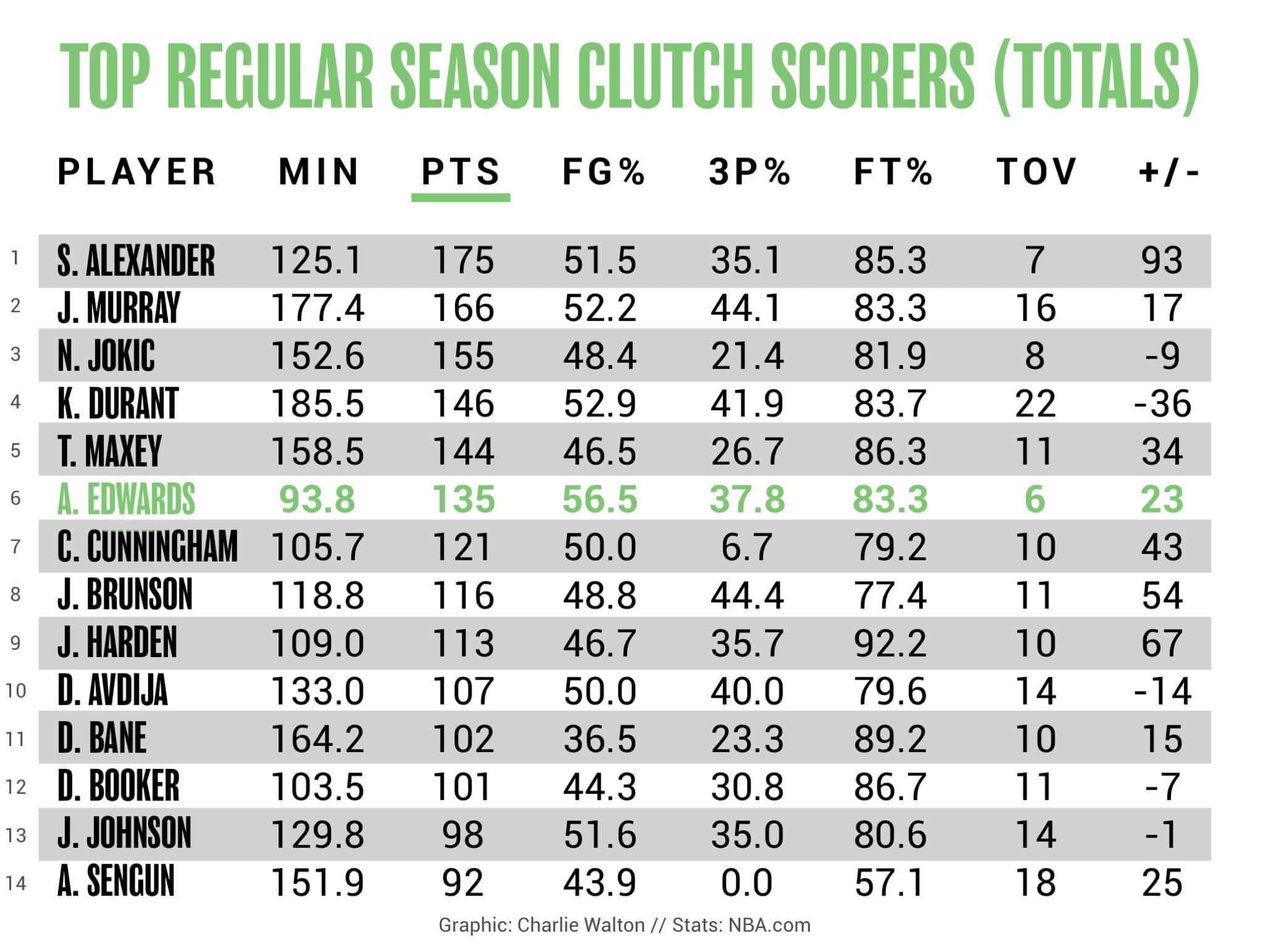
Edwards scored 135 clutch points in the regular season, the sixth most in the NBA, in 93.8 clutch minutes. Of the NBA’s top 14 clutch scorers, Edwards was the only one who played fewer than 100 minutes. He shot 56.5% from the floor in clutch situations, 37.8% from deep, and 83.3% from the free throw line while committing only six turnovers.
Edwards was undeniable in the clutch … until he wasn’t.
In the playoffs, Edwards shot 1 of 5 from the floor in 14.6 clutch minutes with a flawed roster around him and in the face of rugged, desperate defense. He played in five of Minnesota’s six clutch-time games. Rudy Gobert was Minnesota’s leader in clutch-time points (8). Donte DiVincenzo and Julius Randle scored seven. Edwards: two.
Part of Edwards’ lack of production in the final five minutes of close games resulted from his injuries. He battled through a nagging right knee injury and a left knee hyperextension and bone bruise, which he suffered in Game 4 of the first round against the Denver Nuggets.
Edwards missed two games, returning far ahead of schedule for Game 1 against the San Antonio Spurs. He scored 18 points in a 23-minute return on 8 of 13 shooting. He looked healthy as he moved around the court. However, in the fourth quarter, Edwards began to look fatigued as the Spurs doubled-teamed and blitzed him with multiple defenders at the half-court line, forcing the ball out of his hands.
Throughout Minnesota’s five-game series against the Spurs, Edwards continuously had trouble breaking San Antonio’s pressure — a defensive fortress patrolled by rugged wardens Stephon Castle, Dylan Harper, Devin Vassell, and Victor Wembanyama. It is a maximum security prison, much like the Oklahoma City Thunder’s lock-down facility. A prison that will be in Edwards’ way of the Finals for as long as the Wolves are in the Western Conference. He must break out of it, as Brunson did in the Finals.
Brunson scored 22 points in 17.7 clutch minutes throughout the Finals, the most clutch points by any player in the Finals since Dirk Nowitzki scored 26 in 2011. Brunson shot 8 of 21 from the floor. However, he dispersed all eight of those clutch-time makes throughout all five games, providing magical buckets that San Antonio could do nothing to stop.
His late-game shot-making was so consistent that some were calling him the Knicks’ Mariano Rivera — a Hall of Fame, 13-time All-Star closing pitcher for the New York Yankees.
In that case, Edwards needs to be the Wolves’ Jhoan Duran.
Brunson’s performance highlighted the importance of having a dependable closer. Within the NBA’s new Collective Bargaining Agreement, it’s impossible to build a perfect team. There is no roster with dynastic capabilities that takes almost 48 minutes of mature basketball to dethrone. Teams will all have holes.
The new CBA has made the Larry O’Brien Trophy more obtainable than ever. Playoff games will be increasingly contested. Even in blowouts, the team trailing will always be viewed as a threat to make a comeback, even when they are down by 29 points.
Teams that will have the most success moving forward will be the teams that can operate the best in the clutch — the ones that have a dependable closer. Edwards has been that player for the Timberwolves in the regular season, but a few things must happen before he can be that player for a Wolves team that wins a championship.
Ideally, Edwards will develop as a passer. He doesn’t need to become a great passer. Still, if he becomes a good passer — especially in clutch moments — who makes quicker decisions, it would help deter teams from aggressively double-teaming him. And when that double team inevitably comes, Edwards would benefit from being able to explode through it with a quick jolt of speed before the rest of the defense sets up.
Edwards also must have the stamina late in games to make that happen, so Tim Connelly must make moves that relieve the pressure on Edwards. Obtaining a starting-level point guard, such as Kyrie Irving or Dejounte Murray, would help. Getting more shooting alongside Edwards is also necessary, especially because Donte DiVincenzo — Minnesota’s best spot-up shooter next to Edwards — will miss most of next season with a ruptured Achilles tendon.
Chris Finch also needs to devise better, more rehearsed plans to break down trapping defenses late in the fourth quarter. That may mean pulling different levers and running more five-out offense down the stretch, which opened the middle of the floor for Brunson to attack and flip in mid-range shots, floaters, and layups.
Edwards and Brunson are two very different players. One is 6’5” and clearly not a point guard. The other is barely 6 feet tall and one of the few undersized true point guards left in the NBA. But much like Brunson was in these playoffs, Edwards can be a great scorer during a game’s most crucial moments.
Brunson and the Knicks were. And now, they are champions. New York’s offense was well-oiled and had the collective buy-in needed to be the last team standing. But even the Knicks — in a way very similar to the Wolves — weren’t always mature.
But they were at their best in the final 12 minutes and into clutch time because they leaned on their closer. They operated at a level the Timberwolves repeatedly reached in the regular season but struggled to maintain against heavy-hitting defense in the playoffs. Figuring out ways to improve that is crucial as the Wolves and Edwards, their closer, hope to chase New York’s championship with one of their own next season.