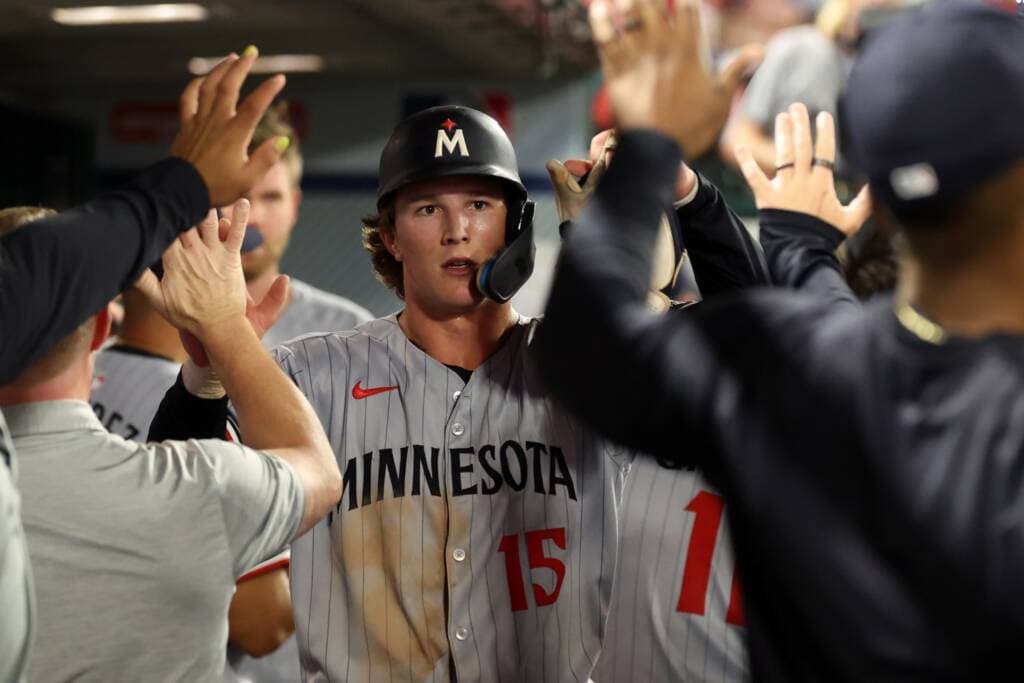
Late on Thursday night, the fans were growing restless at Target Field. Just as an analyst was informing the dozens of fans tuning in to the Minnesota Twins broadcast that baseball is baseball, and when you’re playing good baseball, it is indeed baseball. Meanwhile, the fans left in the ballpark banded together and began to chant, “Sell the team.”
The moment, spurned by the Pohlad’s family decision to pull the team off the market and remain principal owners of the franchise, galvanized Twins fans in a way they haven’t felt in decades. But a different kind of gathering was taking place just across the Mississippi River.
It was at a George W. Webb restaurant where the chain gives away free burgers if the Milwaukee Brewers win 12 straight games. The problem was that the Brewers hadn’t completed their 12th game, and a man in a smedium Prince Fielder was calling 9-1-1 because the chain wouldn’t honor his request.
It’s two baseball teams with two fan bases feeling a different kind of way. But while Twins fans may believe there isn’t to learn from a franchise that hasn’t been to the World Series since 1982, they may have the blueprint to survive a future with notoriously stingy owners.
Twins fans may never feel as alone as they do right now. The Pohlads stripped payroll at the trade deadline, trading 10 players off the 40-man roster. The announcement that they’re keeping the team makes it feel like there’s no way out. Even if they win, each player has an expiration date. Eventually, they’ll become too expensive for ownership, and they will either trade them or dump their salary, prompting many to head to their closets to retrieve their purple attire for the fall.
The Brewers were in the same situation. Owner Mark Attanasio has proudly boasted that his team is No. 1 in wins per dollar spent. While it’s quite the achievement, they haven’t hung any banners at American Family Field (or as it’s rightfully known, Miller Park). Even manager Pat Murphy alluded to the team not spending enough when the Twins took two of three games last May.
Of course, the two teams went in different directions from there. The Brewers snapped Minnesota’s 13-game win streak on May 18, and the Twins sank into the middle of the American League standings. In June, Milwaukee put together an 11-game winning streak and rattled off the latest 14-game winning streak that ended with Sunday’s loss to the Cincinnati Reds.
So what’s the difference? The Brewers find a way to win in the margins. They’ve mined talent with high upside out of Latin America and found a way to lock them into the long term. Their youngest player, Jackson Chourio, might be their best, and the Brewers got in early when they signed him to an eight-year, $82 million contract before the start of last season.
But that’s part of the equation. The Brewers don’t have many big stars, and Christian Yelich had the team’s largest contract. While Yelich is a former MVP, he’s not one of the most popular players in the league. Although Milwaukee hasn’t gotten much national media attention until recently, it utilizes the players it has by catering to their strengths.
One of those is using their speed and defense. The Brewers rank eighth in defensive runs saved over average this season, and their team sprint speed of 27.9 feet per second is second, according to Baseball Savant. It’s how players like Brice Turang, Joey Ortiz, and Isaac Collins have become cult heroes in Milwaukee, and there’s still more to their success.
Andy McCollough highlighted the success stories of pitcher Quinn Priester and first baseman Andrew Vaughn in The Athletic.
When Priester arrived in a trade with the Boston Red Sox during Spring Training, the Brewers gave him simple instructions to use his sinker down and away, spot his cutter for back-door strikes, and control the running game. A few months later, Priester is a core member of their starting rotation, going 11-2 with a 3.48 ERA in 23 appearances (18 starts).
Milwaukee acquired Vaughn from the Chicago White Sox in June and received a similar edict. Swing at strikes or get ready to head back to Triple-A. Vaughn listened, and his OPS in 30 games with the Brewers (1.019) is nearly double what it was in 48 games in Chicago (.531).
Add in a manager who’s literally a pancake-eating [baseball guy] and the Brewers have a strict formula for success. I’m not simply saying, Hey, do what the winning team is doing. Still, there are stark differences when you look at the Twins.
A player like Royce Lewis could benefit from Milwaukee’s approach. After admitting he didn’t look like himself in July, he sounded like a player who is focusing on too many things instead of receiving simple instructions. He’s one of many Twins players who seem to be swimming in all the information that’s available at the major league level and haven’t been able to replicate their production in the minor leagues.
There’s also a stylistic difference between the two teams. While the Brewers describe their style as giving their opponent “Nine innings of Hell,” you could use the same moniker in Minnesota for the way they treat their fans. Many of the details seem to go unnoticed, which is one reason why the Twins are likely planning fall golf outings instead of preparing for a playoff run.
It’s probably why Brewers fans are stuffing their face with free food and Twins fans are biting their tongues with how they feel about the team. If the Twins were seriously considering a stylistic shift at the deadline, they should have the Brewers in mind. It could paint a brighter future, even with the purse strings drawn as tight as possible.