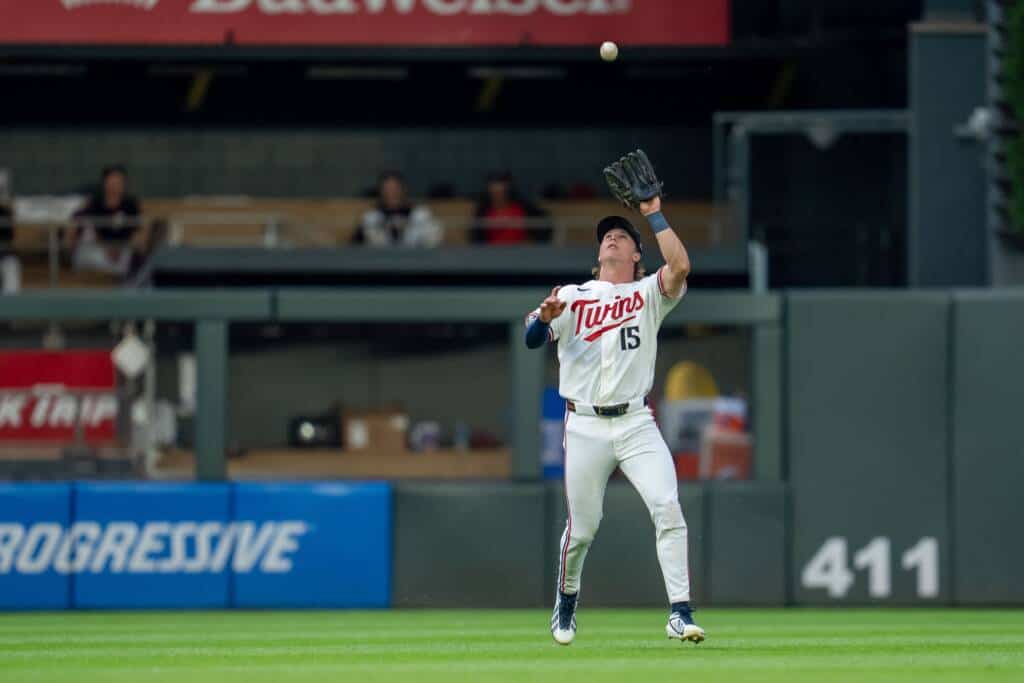
Twins Territory woke up still reeling in shock on Friday morning. They made eight trades, sending away nearly 40% of the active roster. Gone are fan favorites like Louis Varland and Brock Stewart. Meanwhile, the franchise cornerstone, Carlos Correa, is returning to Houston.
The Minnesota Twins have received some favorable prospects and major leaguers who will help prevent the 2025 season from being a complete collapse. They’ll also build hope for a better future in 2026.
Still, how many of these players will pan out to be long-term building blocks for a brighter future that Twins fans hope to see sooner rather than later?
Let’s grade out each of these trades based on prospect returns and how they do or don’t benefit the Twins in the short and long term.
Jhoan Duran to the Philles for RHP Mick Abel and C Edouardo Tait: Grade, A-
As painful as it was to see the Twins trade one of the best relievers in team history, Jhoan Duran netted the best return for the future at the trade deadline. The Philadelphia Phillies became one of only a few teams in recent years to part with two of their top prospects, whom MLB.com ranks among the top 100.
Few teams have been willing to part with top prospect talent in recent years, although the Juan Soto and Corbin Burnes trades are notable exceptions. However, Phillies President of Baseball Operations Dave Dombrowski has never been a prospect hoarder.
While the Twins didn’t make the wishcasting deal with the Los Angeles Dodgers many fans had hoped for involving catcher Dalton Rushing and RHP Jackson Ferris, this was still acceptable.
Abel has already made five starts in the majors and can reach up to 100 MPH on his fastball. The Twins assigned him to Triple-A St. Paul for the time being. Even if he doesn’t make it as a big league starter, his upside for being a dominant reliever that can fill even 75% of the player Duran was is there.
Tait (pronounced tia-ight) is now the Twins catcher of the future. He’s had plenty of upside in his performance in the lower levels of the minors as a hitter, having just recently been promoted to High-A before Minnesota acquired him. Tait is easily the best prospect the Twins acquired at the deadline. If he can live up to his hype, he could be in Minnesota’s late-season plans as early as 2027, making his MLB debut before he’s 22.
Willi Castro to the Cubs for RHPers Ryan Gallagher and Sam Armstrong: Grade, B+
Of all the players the Twins traded on expiring contracts, it’s not surprising that Castro netted them the best return. MLB.com ranked Gallagher as the Chicago Cubs’ eighth-best prospect before the Twins acquired him in the deal.
He’s pitched to a 3.43 ERA this season in 84 innings, along with 96 strikeouts and 20 walks between High-A South Bend and Double-A Knoxville. Gallagher shows similar upside to the likes of Andrew Morris and Simeon Woods Richardson, a strong minor league starter who could be an even stronger asset in the bullpen if he doesn’t fizzle out into the major league rotation.
Gallagher is the second-best pitching prospect the Twins acquired this deadline behind Abel, and will be a fun addition to Double-A Wichita’s rotation.
Armstrong is another run-of-the-mill arm who has had a decent season in Double-A. He’s pitched to a 4.62 ERA in 89 ⅔ innings, striking out 72 batters and walking 31. Armstrong is on a trajectory more likely to add him to the bullpen long term. Still, he has some high upside on his fastball that can keep him in the rotation throughout the minors.
Griffin Jax to the Rays for RHP Taj Bradley: Grade, B
Taj Bradley, one of the two one-for-one major leaguers the Twins made, will immediately slot into Minnesota’s starting rotation once activated. MLB.com once ranked Bradley as high as a top-20 prospect league-wide.
His MLB career has been decent so far with the Tampa Bay Rays, but he has yet to reach his full potential. Bradley had a 4.61 ERA, 1.28 WHIP, 4.20 FIP, 95 strikeouts, and 44 walks this season. The walk issue will be his main area of focus for improvement. He could also greatly benefit from making more starts at Target Field compared to Tampa’s minor league setup this season.
Bradley’s current MLB outlook has him ranked a little lower in this return, but he is under team control through 2030 and still only 24 years old. There’s plenty of time for the Twins to turn him around and make him a valuable starter. His addition prevents their need to rush Abel to the majors immediately to fill a rotation spot.
Harrison Bader to the Phillies for OF Hendry Mendez and RHP Geremy Villoria: Grade, B
Mendez and Villoria are about as good a return the Twins could have expected from dealing away a one-year contract like Bader’s. Mendez was the 16th-best prospect in the Phillies system per MLB.com, while Villoria was Philadelphia’s International Free Agent signing in January.
Mendez will be an intriguing Double-A prospect. He will fit right into the outfield spots the Twins opened when they promoted Gabriel Gonzalez and Kyler Fedko to Triple-A St. Paul. Mendez has performed well at the plate this season, putting up a .290/.374/.434 slash line with eight homers, 46 RBI, and 40 walks to 44 strikeouts at Double-A Reading.
If Mendez can maintain his performance with Double-A Wichtia, he could be an under-the-radar prospect who could sneak himself into Minnesota’s plans for next season. On the other hand, Villoria is just another 16-year-old in rookie ball. It’s too early to predict where his baseball career will take him.
Danny Coulombe to the Rangers for LHP Garrett Horn: Grade, C
The Twins only signed Coulombe to a $3 million deal this offseason. Still, despite being one of the best lefty relievers in baseball, he’s 35 and wasn’t going to merit a large return. Enter Horn, a 22-year-old who has pitched well in the low minors, and whom the Twins are promoting to High-A for the first time in his career.
Horn has a 2.92 ERA and 0.93 WHIP in 24 ⅔ innings this season between Rookie Ball and Low-A. The sample size is small but promising. Still, the lack of playing time this season doesn’t give a great evaluation of what Horn’s future could be beyond High-A.
Chris Paddack and Randy Dobnak to the Tigers for C/1B Enrique Jimenez: Grade, C
At the time, Enrique Jiminez looked like Minnesota’s answer to the lack of catching depth in the minors. Fortunately, he’s not their only solution after securing Tait from Philly, but Jimenez is joining Low-A for the first time as he joins the Twins’ farm system.
Jimenez has put up decent numbers in rookie ball this year, hitting six home runs, 32 RBI with a .779 OPS in 48 games. He’s gone 1-for-6 so far in two games with Low-A Fort Myers, but has also driven in a couple of RBI. His future outlook is hard to predict this early, but he will be an interesting prospect to follow for the last month of Fort Myers’ season.
Brock Stewart to the Dodgers for OF James Outman: Grade, C-
The second trade which the Twins traded a major leaguer for another, the Brock Stewart trade baffled many as to why the Twins were okay with this return. Outman is basically another version of DaShawn Keirsey Jr., just with more major-league experience.
A 28-year-old left-handed hitting outfielder with strong defense is the last thing they needed on their roster. Alas, the Twins pulled the trigger on the trade.
Outman has hit well in the minors but has been terrible in the majors over the last two years, going 24-for-175 (.137 batting average) in 75 games for the Dodgers. The Twins need more outfield depth after dealing Bader, and with Byron Buxton on the 10-day IL. Still, Outman adds to Minnesota’s lack of balance between right-handed and left-handed hitters in their outfield.
Hopefully, a change of scenery and more regular playing time will benefit Outman, but his par is hard to cross.
Louis Varland and Ty France to the Blue Jays for OF Alan Roden and LHP Kendry Rojas: Grade, C-
In perhaps the most surprising of all the trades the Twins made, they traded hometown hero Varland for near-major-league-ready prospects, which did not serve the fans well. The bullpen was already half-empty and had been depleted further by the time they completed this deal.
Minnesota could have built its bullpen around Varland. Still, Twins President of Baseball Operations Derek Falvey emphasized the great urgency teams feel to add relievers at the deadline more than any other point in the year.
“That was very difficult for all of us to make that trade and to make that decision because of how much he’s grown and developed here and become the pitcher that he’s become,” said Falvey. “[But] you’ve got to give something to get something. And we felt like those were two real prospects that would be a part of our future for a long period of time.”
So what do Roden and Rojas have to offer? Roden made his MLB debut earlier this season but hasn’t had much success. Another left-handed hitting outfielder, he’s put up a .204/.283/.306 slash line with one home run and eight RBI over 43 games.
Roden has fared much better in Triple-A this year with a .331/.423/.496 slash line with three homers and 18 RBI. The upside is more promising for Roden than Outman. Still, he joins a cluster of left-handed hitting outfielders that will make playing time a challenge for him to find in the majors for the rest of the season.
Rojas was ranked as Toronto’s fifth-best prospect per MLB.com. Just 22 years old and from Cuba, Roajs quickly rose through the minors this season, going from Rookie Ball to Triple-A. He’s posted a 3.46 ERA on the season with 62 strikeouts and just nine walks.
The Saints will use him as a starter. However, his only two Triple-A starts haven’t gone well. He’s allowed 10 hits and six runs in just five innings of work. Like many of the other pitching prospects the Twins landed this deadline, Rojas is another player who could turn into a top-end reliever if he doesn’t pan out as a starter.
But why do these two decent prospect returns give the trade such a low grade? Varland’s upside as a reliever and being under team control through 2030. It was the one piece the Twins should have held onto this deadline, and it has set their bullpen back considerably through the next season.
Carlos Correa to the Astros for LHP Matt Mikulski: Grade, F
Correa’s trade to Houston was a pure salary dump, but the player in return is just baffling. The Astros didn’t even offer up a prospect in the lower rankings of their top 30 list. Instead, they gave the Twins Mikulski, a 26-year-old left-hander whom they signed to a minor-league contract this year and never pitched above High-A.
He was in the San Francisco Giants system from 2021 to 2024, but his numbers on the season make this the worst return for the Twins. Mikulski has a 9.39 ERA in 15 ⅓ innings between High-A and Rookie ball. Even if he considers playing another season in the minors, it’s hard to see a future for Mikulski where he advances beyond Double-A.
Twins Trade Acquisition Overall Grade: C+
So, is Minnesota’s system better now with the trades they’ve made? Their farm system has improved. But the future of the major league club looks grim as rumors begin to mount about Pablo Lopez and Joe Ryan being dealt away this offseason.
They didn’t have any trade that was a complete blow away with who they got in return, and if anything, they didn’t get enough in return for most of the players they traded away.
The best thing fans can hope for is that these players return and live up to their hype in the minors, where they perform well, and then excel in the majors. They can also hope for a new ownership group to take over in September. Hopefully, they will have a baseline payroll of $160 million, rebuilding hopes of contention for the next year or two, rather than the next decade if the Pohlads remain in control.