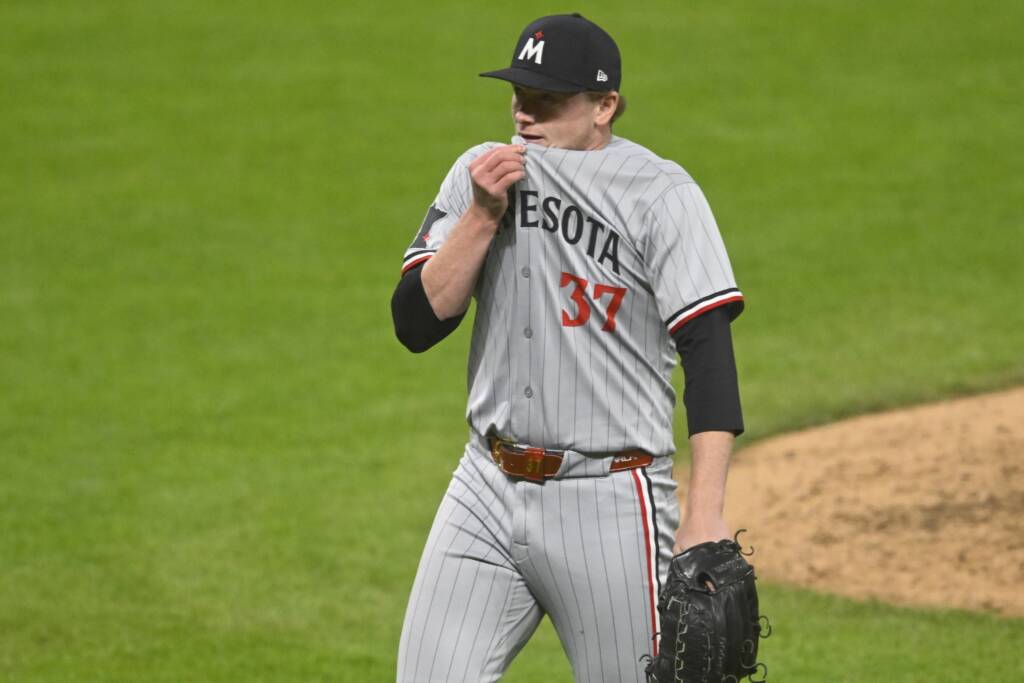

Things weren’t looking good when the Minnesota Twins opened the season with a 7-15 record. The bullpen wasn’t living up to FanGraphs’ projection as the best unit in baseball. With the starting pitching and offense struggling to find their respective footing, it felt like the season would be over before it started.
But things changed as the Twins ripped off a 13-game winning streak. While the wins piled up, everybody wondered what had changed.
It turns out, it was more than just chugging a few cans of Red Bull.
“I just let out a bark when the team needs to be fired up,” Twins reliever Louie Varland told Twins.tv’s Audra Martin last month. “Whether it’s a good play, whether things are going our way. We need a little pick-me-up. When in doubt, bark it out.”
After weeks of yelping, the Twins warned their opponents with a hearty bark. But even with the attitude shift, Varland hadn’t found his bite until he embraced his bullpen role this season.
No player personifies the dawg (that’s D-A-W-G) mentality than Varland. After coming up as a starter, Varland first dabbled in the bullpen during the 2023 run to the playoffs. While he made one last run as a starter in 2024, it didn’t go well. He posted a 0-6 record and a 7.61 ERA in 16 games (seven starts) in the majors.
Varland’s analytics highlighted his struggles. According to Baseball Savant, he had one of the league’s lowest chase rates at 23.7% and had underwhelming performances in whiff and strikeout rate (20.6%). Opposing hitters could also square up Varland, posting a 45% hard hit rate (batted balls hit at 95 mph or greater) and an average exit velocity at 90.6 mph.
However, other factors suggested Varland could be an effective reliever. His average fastball velocity of 96.1 mph was in the 82nd percentile last season, and his seven feet of pitching extension allowed him to get an extra push on the heater.
As he went through the order, Varland’s performance also highlighted that he should have a different role. While fans like to joke about Rocco Baldelli’s quick hook, Varland was Exhibit A for that rationale, allowing a .678 OPS against hitters the first time through the order, a .837 OPS the second time, and a 1.173 OPS the third time.
The Twins have developed more starting pitching depth than last season, allowing Varland to transition to the bullpen, which let the dog (or dawg) out of his cage.
Hitters are still squaring Varland up, posting a 54.4% hard-hit rate and 91.1 mph average exit velocity. Varland’s fastball velocity has jumped to 97.9 mph, increasing the effectiveness of his other pitches, generating a 34.4% chase rate and 27.5% whiff rate.
By using an improved fastball as his primary pitch, Varland threw his knuckle curve 31.9% of the time, which is holding opposing hitters to a .135 batting average and .216 slugging percentage.
The changes are apparent in his stats as Varland has a 2-3 record with a 2.73 ERA. He leads the majors with 29 appearances and has struck out 29 batters over 26.1 innings with a career-high 27.9% punchout rate.
But stats can be misleading, and Varland’s bite was apparent in Saturday’s 5-4 loss to the Seattle Mariners. With runners on the corners and nobody out, Varland replaced Bailey Ober and got Cal Raleigh and Julio Rodriguez to strike out before getting Randy Arozarena to fly out to get out of the jam.
Varland’s appearance is more impressive considering he generated five whiffs on 18 pitches while facing a hitter who blasted four home runs in the series and one of the brightest stars in the game.
It’s a positive development for a Twins bullpen that survived an early-season slump. Griffin Jax recovered from his slow start, but Jorge Alcala has fallen off since last year’s All-Star break. Therefore, Varland’s emergence as a high-leverage arm has turned the bullpen into a stable of rabid beasts waiting to be let off the chain.
“We just bring the dawg out of each other,” Varland said. “You can call us a dawg kennel. You can call us a dawg shelter. You can call us a dawg pound. We got a bunch of dawgs out there. That’s D-A-W-G.”
After many wondered about his potential as a starter, Varland has discovered how to sink his teeth into an opposing lineup, helping inspire his teammates to do the same.


