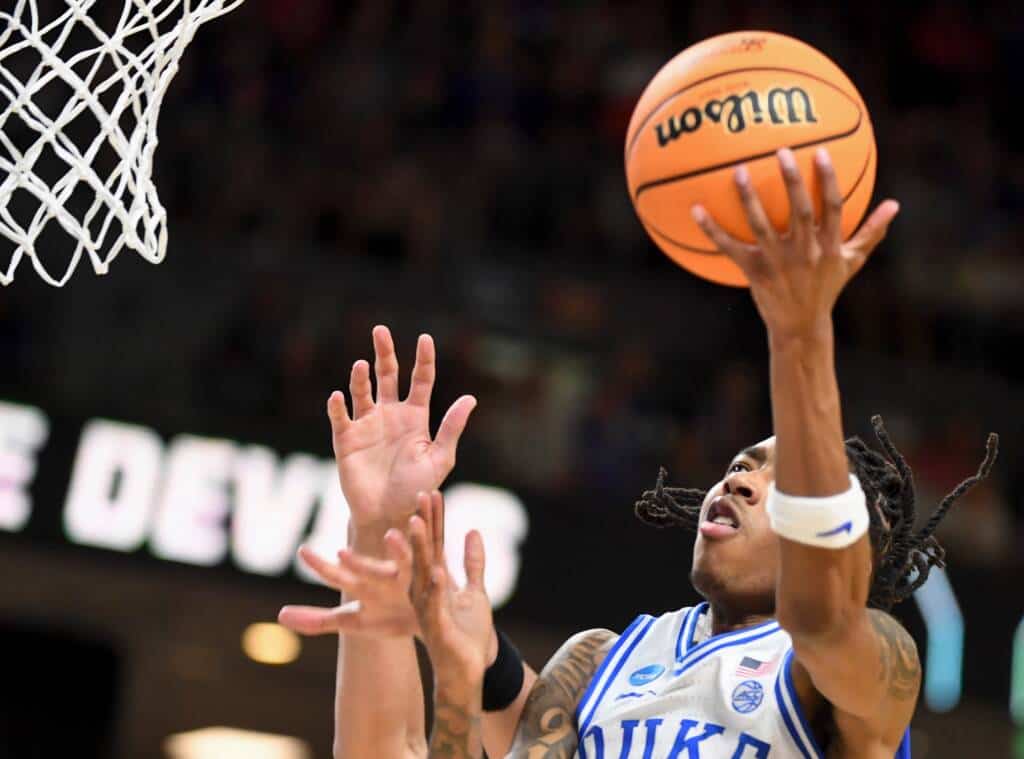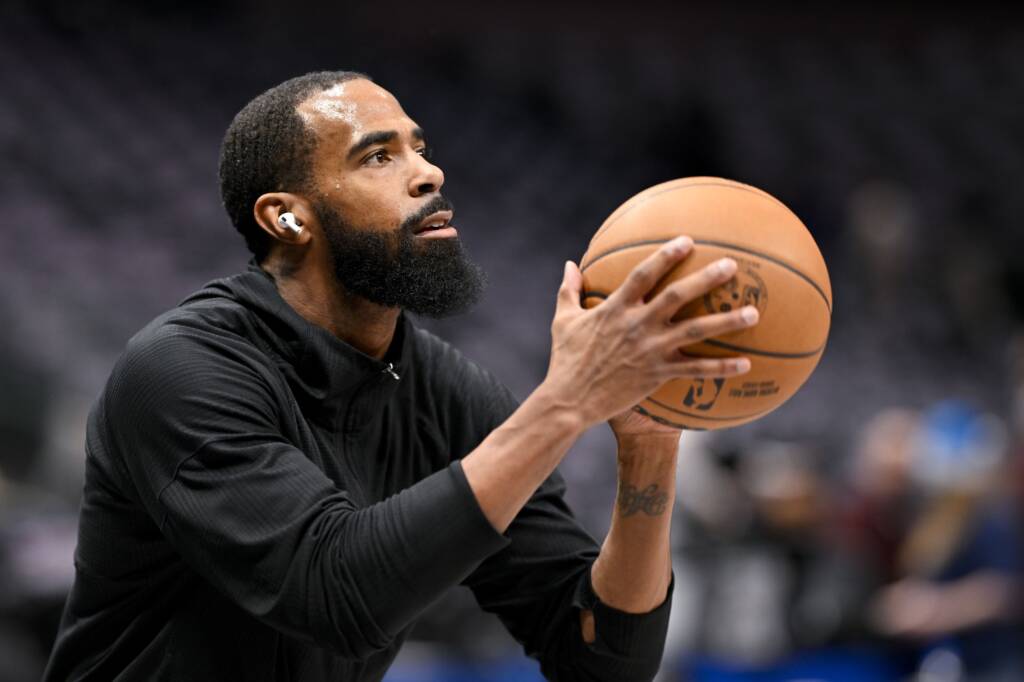

Before summer league last year, Jaylen Clark explained how much Mike Conley meant to him during his rookie season, which he missed due to a left Achilles injury.
“He’s like one of the best people I’ve ever met,” said Clark. “Just how to be an all-around good person. He showed me how that translates to his game.
“He’s a great guy for a group like us, Rob, T. Shannon, everybody.”
Pretty much every player on the team says similar things about Mike Conley. He’s the team’s mentor and Chris Finch’s right-hand man.
Last season, Conley was the X-factor the Minnesota Timberwolves needed to propel them to a Western Conference finals appearance. However, Conley appears to have regressed this season, costing the Wolves late in games. That has led the Wolves to a crossroads.
Conley is still a leader and a mentor, but his play does not match his importance in the locker room.
We can quantify Conley’s decline this season. His 8.1 points per game is the lowest of his 17-year career. The career-low coincides with Conley posting a career-low 36.7% field goal percentage. It’s the first time Conley posted a sub-42% field goal percentage. His decreased goal percentage is in part low due to Conley shooting 38.2% from three, his worst three-point percentage since 2019-20.
Conley’s fourth-quarter stats are also concerning. He only shoots 23.2% from the field and 20.8% from three. Conley is only making 18.8% of his threes above the break threes, where he regularly scored from during his career.
He’s only shooting .5% below his 38.7% career average from three. However, some of Conley’s best shooting attributes have been failing him. He’s only shooting 36.1% on layups and 1 of 19 from the mid-range (5.3%) this season. Last year, he made 65.6% of his layups and shot 32.6% from mid-range.
Conley’s shooting indicates he’s declining. However, Conley’s playmaking remains as brilliant as ever. He has a 4.04 assist-to-turnover ratio and an assist percentage of 25%. (Assist percentage is the percentage of team assists in which Conley is responsible for an assist.) His average plus/minus is still +2 per game, and Conley also carries a positive net rating of +3.3 per game.
His defense has also held up.
Last season, Conley matched up against guards 67.4% of the time on defense. In those guard matchups, he allowed them to shoot 42.4% from the field and 33.7% from three while getting credit for 31 steals.
However, this season, Conley is matched up on guards 69.9% of the time and holds guards to 43.8% shooting and 38.4% from three while grabbing 18 steals. While there is a decline, it’s not nearly as drastic as his shooting woes. Conley’s playmaking and defense have remained above average and could give him staying power in the rotation.
Conley’s drop in scoring and shooting has been startling but could have been anticipated. The shooting falloff could be related to a wrist injury he suffered in the Denver Nuggets series, which may have affected his off-season practice. In training camp, Conley admitted that the wrist injury prevented him from performing his normal off-season routines.
While the wrist injury could be affecting his shot, it might also be a symptom of age. Conley, 37, is the 11th-oldest player in the NBA this season. Few of the league’s best point guards of all time were productive at Conley’s age. In his age 37 season, Hall of Fame guard Jason Kidd only scored 7.9 points per game on 36.1% shooting, down from 10.3 points on 42.3% the year prior.
Other point guards that dominated the 2010s around the same age as Conley had all long retired. Deron Williams and John Wall retired at 32. Rajon Rondo at 35, and Tony Parker at 36. Conley is the last guard remaining from the 2007 draft class and one of only four players still playing.
Conley is entering uncharted territory. Chris Paul, Steve Nash, and John Stockton are the only comps for Conley playing at this stage of their career.
Paul and Stockton are the two outliers at the point guard position. Stockton remained incredibly efficient until he retired at age 40. Chris Paul also shows signs of decline but remains an elite floor general. That leaves Nash, who made an All-Star game in his year 37 season. However, the Phoenix Suns traded him to the Los Angeles Lakers the following summer, and he only played 65 games over the final two years of his career.
Conley is doing something unprecedented. There have only been a handful of effective point guards at his age. His shooting has fallen off. It could be related to an injury or due to age, but it has affected the Wolves in games, especially when his defense and playmaking remain fairly high.
Still, Conley is a team leader and beloved within the organization. Therefore, the Wolves staff has an impossible decision.
Where does Mike Conley stand in the rotation?