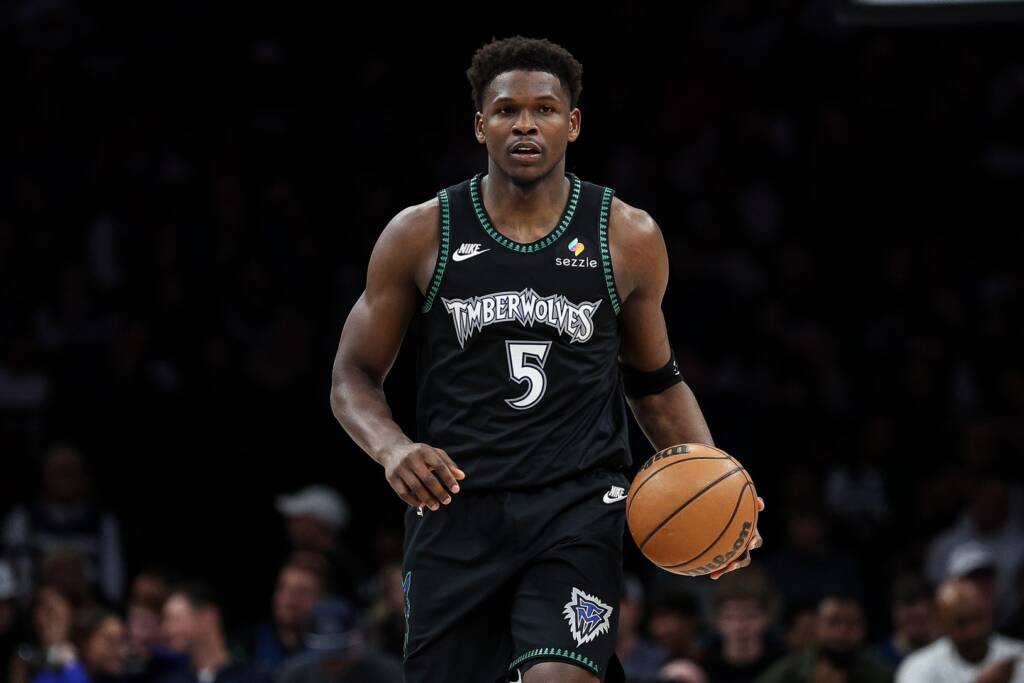

Anthony Edwards has been scoring with a vengeance of late.
In a two-week, six-game span between the November 21 matchup against the Phoenix Suns and the December 2 game against the Pelicans. Edwards has averaged 38.3 points per game while shooting 55.6% from the field and 48.4% from three-point range. More specifically, Edwards has shot 26 of 33 (78.8%) at the rim, 19 of 32 (59.4%) on non-rim paint shots, and 29 of 56 (51.8%) on above-the-break threes.
The numbers are gaudy, but Edwards’ scoring has been a necessity for the Timberwolves, who went 3-3 across this six-game stretch.
The Timberwolves are 14-8, but it has been a tumultuous beginning to the season. Of Minnesota’s 14 wins, 12 have come against teams below .500. The team has been difficult to decipher. Still, it’s hard to imagine how they would look without the scoring acumen Edwards has displayed to begin the season.
As Anthony Edwards continues to develop, the Wolves seem to be living and dying by Edwards’s offensive production. The expectations Minnesota puts on Edwards’ shoulders are lofty for a recently turned 24-year-old. Still, the context of Edwards’ Timberwolves rosters throughout his career shows how placing him in high-leverage situations can jump-start his individual progression.
Year after year, the unique circumstances on Minnesota’s roster around Edwards have allowed him to have a ridiculously linear development pathway through five seasons. Edwards has had an offensively talented supporting cast that has helped him reach the playoffs over the past four seasons, but it hasn’t been perfectly tailored to his skill set.
Anthony Edwards’ dominant hierarchical takeover as the engine of Minnesota’s offense shift began when Karl-Anthony Towns was still with the Timberwolves. Part of Minnesota’s decision to trade Towns was due to the looming second apron and his massive contract.
The latter was that the front office had the utmost confidence that Edwards could become meaningfully more productive offensively with more freedom.
However, Edwards’ sudden change in elite game-to-game output did not occur overnight.
Edwards has had to showcase that he is the alpha, and he has done exactly that.
Towns had plateaued towards his final seasons with the Timberwolves. They had also just acquired Rudy Gobert from the Utah Jazz, which ultimately changed their identity and limited the team’s offensive ceiling. Therefore, it was clear that Edwards would become the offensive focal point after trading for Gobert.
Julius Randle has done a great job at offering more of a change of pace than Towns alongside Edwards. Even though Randle handles some of the offensive load, the Wolves need Edwards to play well offensively every night to win.
Edwards’ biggest initial leap came when he turned his raw scoring abilities into efficient winning basketball. However, when the Wolves traded Towns for Randle, Edwards would have more opportunities to create above the break, and he capitalized on them.
With the newfound opportunity, Edwards shot a career-high 39.5% from three on 10.3 attempts per game in his first season without Towns, eclipsing his prior career-highs of 8.4 and 36.9%. It looked like it could have been an outlier season for Edwards. However, 18 games into this season, he’s shooting 41.8% on 8.5 attempts against tougher defensive coverages and with more attention his way.
Anthony Edwards’ three-point shot diet has not only increased in volume, but opponents are doing whatever they can to pressure him at the line.
Part of the reason why Edwards’ three-point shooting uptick has been so impressive is because of the less-than-ideal spacing he has to work with offensively. The most frequently discussed talking point when the Timberwolves acquired Rudy Gobert was that it would cap Minnesota’s spacing. Gobert is a fantastic screener, but there is still only so much he can do when that is his primary strength.
Edwards and Gobert have little offensive rapport outside of ball screens. Still, Edwards’ passing vision and court-mapping have improved exponentially since Gobert arrived in Minnesota.
Working with a more congested half-court offensive unit, Edwards has ultimately become a better playmaker and passer. Edwards has had to drive into tight windows because defenders are comfortable helping off of Gobert, and his passing lanes are limited as he attacks the heart of the defense.
With Edwards’ newfound comfort as a playmaker and shooter, opponents know that the best game plan is to take Edwards away and force others to beat them.
Last season’s Western Conference Finals matchup with the eventual NBA champion Oklahoma City Thunder epitomized the defensive coverages that opponents have fully bought into using against Edwards.
Oklahoma City blitzed Anthony Edwards relentlessly on ball screens and ultimately shut down the Timberwolves’ offense. The Thunder had a historic defense, but Minnesota’s opponents have increasingly relied on Oklahoma City’s game plan as their primary strategy for slowing down Edwards this season.
Much of it comes down to how opponents defend Edwards as the ball handler when he receives a ball screen. Opponents continue to put their screen defender at the level of the screen or sell out to slow Edwards by putting two defenders on the ball.
Opponents are also rarely going to show Edwards drop coverage if Gobert is setting the screen. The defensive game plan becomes simpler and easier to execute when the objective is to force Edwards to either pass the ball to a teammate or make Gobert a decision-maker.
The change in ball screen coverage ultimately forces Edwards to adjust.
If he tries to outdribble the edge-of-the-screen defender, he may lose control of his handle and turn the ball over. If he sits back and remains patient, he invites the trap in and ultimately must move the ball. To counter, he can find a small window and let it fly from three, or also completely reject the screen.
Much of this is due to the paradox Rudy Gobert creates for the Timberwolves. Gobert is an elite floor-raiser and single-handedly maintains a top-ten defense. However, his inability to provide much alongside Edwards on offense has now trickled into the regular-season offense, and it has affected them in certain playoff matchups.
The Timberwolves have found counters by allowing Edwards to operate in more isolation possessions or freeing him up off of pindown screens. Even with the change in usage to avoid the pressure that is sent his way on Gobert’s ball screens, Edwards still sees increased gap help on his isolation possessions.
Additionally, Minnesota’s offense has slightly slowed down after Nickeil Alexander-Walker left for Atlanta in the offseason, and younger prospects Rob Dillingham and TJ Shannon have needed more time to develop. Therefore, Edwards’ scoring has become even more critical to Minnesota’s success night-to-night.
While it can be frustrating to watch Edwards face difficult defensive coverages, he’s proven he can score against them. Each facet of Edwards’ core development into superstardom is unique. Still, the root of his development, centered on his offensive context and circumstances, suggests that Edwards can emerge from this regular season as an even better player and scorer.
Anthony Edwards is scoring 38.3 points per game over this small sample against the defensive pressure he faces, and the reliance on Minnesota’s offense on him should showcase that enough. It has just become a matter of continuing to grow the sample size.