
Coming into the season, the Lynx were a tough team to project. Their conference finals loss to the Phoenix Mercury was a disappointment after they spent most of the season as championship favorites. To add another challenge, the team knew they would struggle to work around the unique incoming off-season.
It was evident that the Lynx would need to seek out frontcourt help. Some of their best free agents were going to be out of their budget, and they could only protect so many players in the expansion draft.
The domino effect of the unique off-season circumstances ultimately forced the Lynx to take a budget-friendly route, signing veterans Nia Coffey, the former Hopkins alum and Minnesota familial hoops royalty, and Natasha Howard, who spent her third and fourth seasons with the franchise in 2016 and 2017.
Thus far, their impact has been greater than anyone could have predicted.
Minnesota lost a ton of size when last season’s co-Defensive Player of the Year, Alanna Smith, and their productive bench player, Jessica Shepard, signed with the Dallas Wings.
That exodus continued in the expansion draft, when the Portland Fire selected Bridget Carleton with the franchise’s first pick, taking away additional positional size from the Lynx. Later, the Toronto Tempo took Maria Kliundikova.
Collectively, the Lynx lost Smith 6’4”, Shepard 6’4”, Kliundikova 6’4”, and Carleton 6’2”.
On top of the loss of talent and the 2025 team’s top four tallest players, Napheesa Collier was set to miss extended time due to her ankle surgeries.
The front court needed a revamp, but the direction was uncertain given Collier’s delayed return, and since Dorka Juhasz, fresh off becoming the youngest EuroLeague MVP, was also set to miss time due to a mid-foot sprain.
Rumors swirled around Nneka Ogwumike amidst the infamous “balloon gate,” when a local balloon company leaked her visit to the team. However, the Lynx brass elected to land two veteran options returning to Minneapolis.
Coffey and Howard initially looked like holdovers who allowed the franchise to continue playing within Cheryl Reeve’s 5-out offensive principles. They would also give them enough of a veteran punch to hold on while the franchise awaited the return of Juhasz and Collier. Still, their impact has been instrumental to the Lynx’s historic start.
Through the team’s first 10 games, Coffey and Howard have been exceptionally efficient. The frontcourt pairing has fully acclimated to the Lynx’s offensive system. They have thrived by playing within the flow of the offense, adapting their skill sets to the play design, and being smart with their shot selection.
It’s still a small sample size, with the season nearing its quarter mark. However, Howard is poised to overtake her previous career efficiency highs despite being in her 13th season in the WNBA.
- 62.5% shooting from the field thus far eclipses her prior career high of 57.4% in 2016 with the Lynx, by +5.1%.
- 62.5% shooting is also +13.7% better than Howard’s career average of 48.8%
- 62.5% effective field-goal percentage (eFG%), driven by her two-point field goal focus, eclipses her prior career-high of 57.7%, also in 2016 with the Lynx, for a differential of +4.8%.
- 62.5% eFG% is a +11.6% difference from Howard’s career average of 50.9%.
- 62.5% true shooting percentage (TS%) is also a career-high, a +1% differential from her 2018 Most Improved Player season with the Seattle Storm.
- Howard’s 62.5% TS% is set to eclipse her career-average of 58.1% by +4.4%.
Howard’s shot profile, courtesy of HerHoopsStats, highlights the significant difference in her efficiency and usage. Through Howard’s last four seasons, she has had a heavy diet of mid-range shots and non-rim paint shots. She topped out on this usage while in Dallas in 2023 and 2024, and still leaned on it in 2025 with Indiana and 2022 with New York.
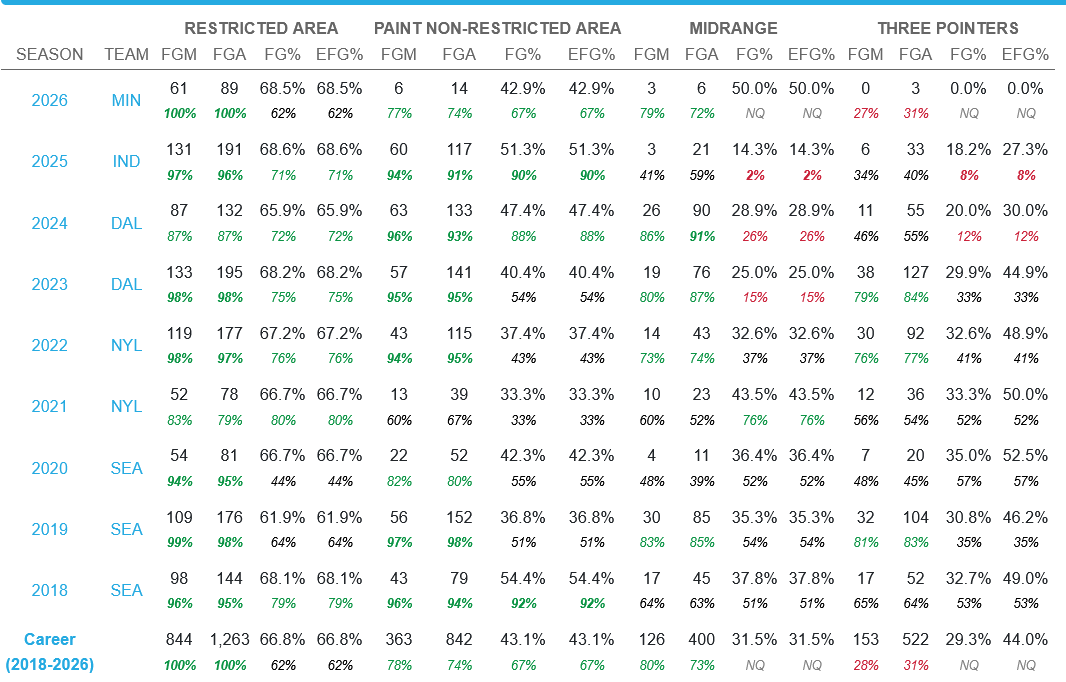
The biggest change has come with her attempting most of her shots at the rim. Howard is on pace to shatter her prior FGA numbers and FGA rates. This season, 79.5% of Howard’s field goals have come at the rim.
Howard touts the same TS%, 2P%, and eFG% due to her reliance on 2P field goals, but it has been fruitful. Therefore, there is no reason for her to pivot away from what has worked.
Nia Coffey has similarly had a career renaissance by making tweaks to her game and fitting into Cheryl Reeve’s masterful offensive scheme. Howard has seen offensive efficiency increases, but Coffey’s have been colossal.
Again, a ten-game sample is small. Still, the data and eye test have showcased that much of this is sustainable for Coffey, even with her three-point shooting expected to regress.
Coffey is shooting an outlier 45.2% from three to begin the season, eclipsing her previous mark of 41.7% with Vegas. However, she’s a career 36.1% three-point shooter and has three previous full seasons of shooting over 40% from three.
Coffey’s efficiency numbers will likely drop as her three-point shooting does, but there is still far too much evidence to support her offensive transformation.
- Coffey’s 52.2% field goal shooting flies high above her previous career-high mark of 43.2% in 2023 with the Atlanta Dream, a +9% difference.
- 52.2% is also a +13.8% increase over her career average of 38.4.
- 63% 2P field goal percentage tops her previous full-season career-high of 47.7% in 2025 with the Phoenix Mercury and currently sits at a difference of +15.3%.
- 63% is a +22.9% increase from her career average of 40.1%
- 65.9% eFG% sits +16.4% better than her previous career-high of 53.4% in 2021 with the Las Vegas Aces.
- 65.9% is a +20.1% difference from her career average of 45.8%.
Coffey’s
- 65.9% is a +20.1% difference from her career average of 45.8%.
- 66.3% TS% is +14.4% better than her previous career-high of 55.7% with the Las Vegas Aces in 2021.
- 66.3% is also +17.5% better than Coffey’s career average of 48.8%.
The Lynx will have important decisions to make when Dorka Juhasz and Napheesa Collier eventually return in the coming weeks. It could push one or both Coffey and Howard out of starting roles, but it has provided the Lynx with a perfect sample size to ease their returning frontcourt back in.
Minnesota was expected to struggle by pushing Coffey and Howard into prominent roles to begin the season. Still, the duo has met those lofty expectations and provided more production than anyone could have projected. Coffey and Howard stepped into vital starting spots, but also had to work around the ACL injury to promising rookie Emma Cechova, on top of Ola Kosu also dealing with a head/face injury.
The Lynx signed Teaira McCowan to help the frontcourt out, but Coffey and Howard have continued to play their best basketball even with the frontcourt stretched as thin as it could get.
Not only have the frontcourt duo played core minutes, but the Lynx have also run out to an 8-2 start as they get through what was expected to be a retooling phase.
Time will tell how the Lynx will distribute minutes once the team is healthy this month. Still, even with all the career efficiency marks for Howard and Coffey, it is both easy and realistic to project continued success for the veterans. If they could play at such a high level, with a heavy minute load and a relatively depleted roster, nothing should stop them from continuing to play at a high level and with supreme efficiency when Juhasz and Collier return.