
In the minds of Minnesota Vikings fans, quarterback J.J. McCarthy has occasionally been the savior of the franchise and also the worst player to ever touch a football, sometimes even in the same game. His first two years have been anything but certain in terms of his long-term projection as Minnesota’s starter, but it’s essentially impossible to know which quarterbacks will pan out and which won’t.
Or is it?
The good folks over at Jets X-Factor created a simple yet startlingly accurate predictor of NFL success among first-round quarterbacks. It uses three key statistical thresholds from the quarterbacks’ college production to identify studs and duds at the NFL level. And, interestingly enough, there’s actually a fairly decent correlation to quarterbacks who meet more of those thresholds having more success in the NFL. Uninterestingly, to Vikings fans at least, McCarthy hits none of the three.
The analysis first identified “successful quarterbacks” based on their career passer rating, adjusted EPA per play, and overall Pro Football Focus grade. The quarterbacks were then judged on three statistics from their final collegiate seasons: deep-pass rate, scramble rate, and turnover-worthy throw rate. It’s an odd bunch of metrics, right? But those three stats had the highest individual correlations to success in the NFL. And while those metrics individually don’t identify top NFL talent especially well, when combined, they do.
Ultimately, quarterbacks who met the thresholds for all three metrics, like having at least a 15% deep-throw rate, a 3% turnover-worthy throw rate, and a 7% scramble rate, were obvious NFL stars such as Patrick Mahomes, Lamar Jackson, and Josh Allen, among others. Quarterbacks who met only two or even one of the thresholds were typically solid starters to high-end backups.
Finally, five quarterbacks drafted in the last decade met none of those thresholds in college. Names like Paxton Lynch and Dwayne Haskins grace this list, as well as our dear friend J.J. McCarthy.
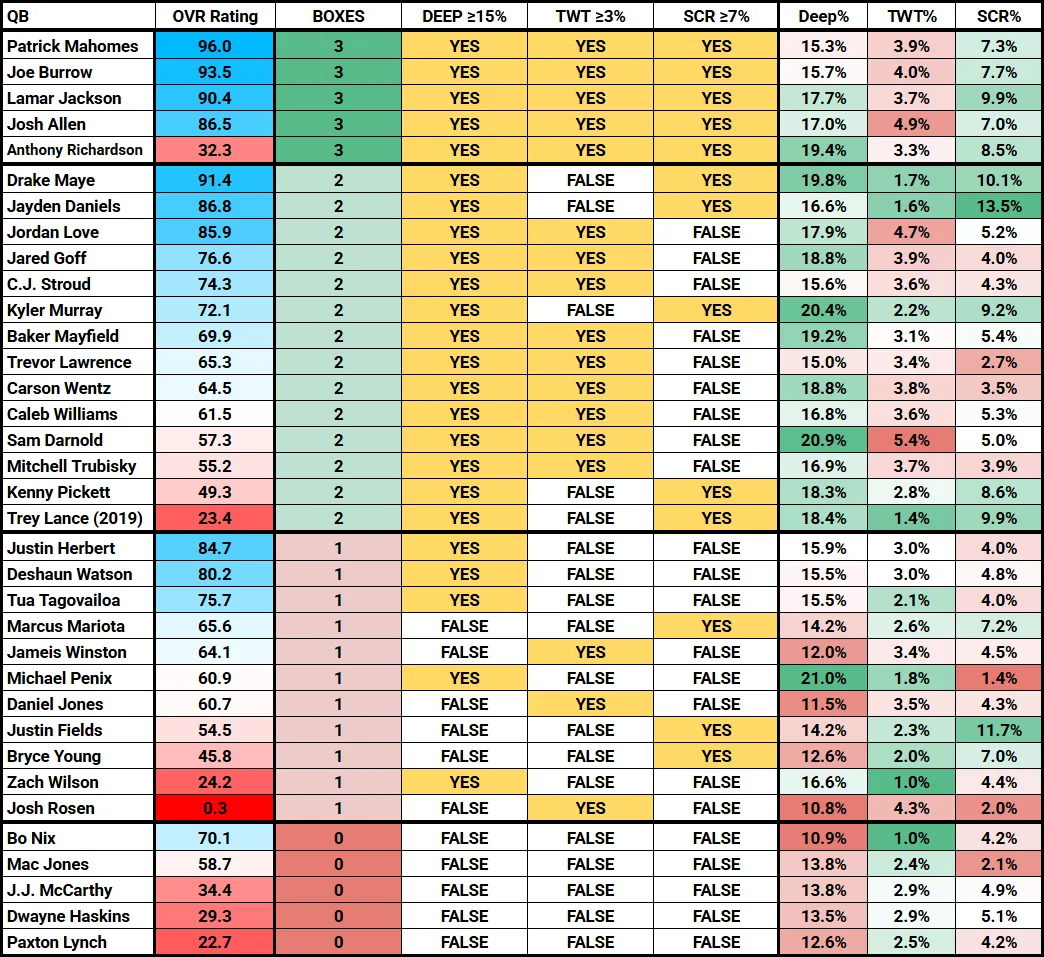
Table via Jets X-Factor
McCarthy came close to checking the turnover-worthy throw box in college, and has blacked out the entire box in the pros. And while it’s strange to use more turnovers as a talent predictor, it helps to show that a quarterback isn’t just a Checkdown Charlie and can push the ball down the field. Of course, he needs to limit the bad interceptions going forward in the NFL, but a completely opposite, scared-and-nervous signal-caller feels even worse.
Some potentially positive developments: McCarthy scrambled 5.8% of the time this past season, compared to his 4.9% rate during his last season at Michigan. He has also thrown deep a lot more in the NFL, with an average depth of target of 9.5, tied with MVP candidates Drake Maye and Matthew Stafford. So, progress?
McCarthy’s legs, and sometimes too strong an arm, are what give fans hope that he can develop. But his poor mechanics and questionable decision-making raise as many questions as they answer.
McCarthy has been particularly difficult to judge because of his erratic play. He looks unstoppable one day (see the fourth quarter in Week 1 against the Chicago Bears) and like a bust the next (see just six days later against the Atlanta Falcons). There hasn’t been much consistency, either good or bad, and it often feels like he’s toeing a delicate line between breaking out as a star or crumbling into the next Paxton Lynch or Zach Wilson.
While no stat or metric will ever be perfect at finding the future Patrick Mahomes, they can get teams closer. Of course, there will be outliers in the data, as future Kevin O’Connell reclamation project Anthony Richardson hit all three metrics in this exercise and has yet to sniff even being labeled as a quality backup. Coaching, effort, scheme, surrounding talent, and more can help or hinder any player.
As the offseason approaches, the Vikings will almost surely bring in competition for the young quarterback, and how he responds in Year 3 will likely be the most accurate representation of his true potential yet. Still, McCarthy would be a one-of-one if he were to reach Pro Bowl or All-Pro levels based on our new metrics.
So the odds may be stacked against McCarthy more than we thought. The metrics, combined with his play and injury history, certainly don’t paint a perfect picture. Still, he’s only 22 years old. Josh Allen didn’t become Josh Allen until 24. Sam Darnold didn’t have his breakout with the Vikings until he was 27.
There are plenty of reasons to doubt McCarthy, but there’s also a reason Minnesota made him a first-round pick. All of this to say some numbers on a screen will never define McCarthy. Still, if it wasn’t clear before that he’ll need to overcome plenty of deficiencies, it is now.