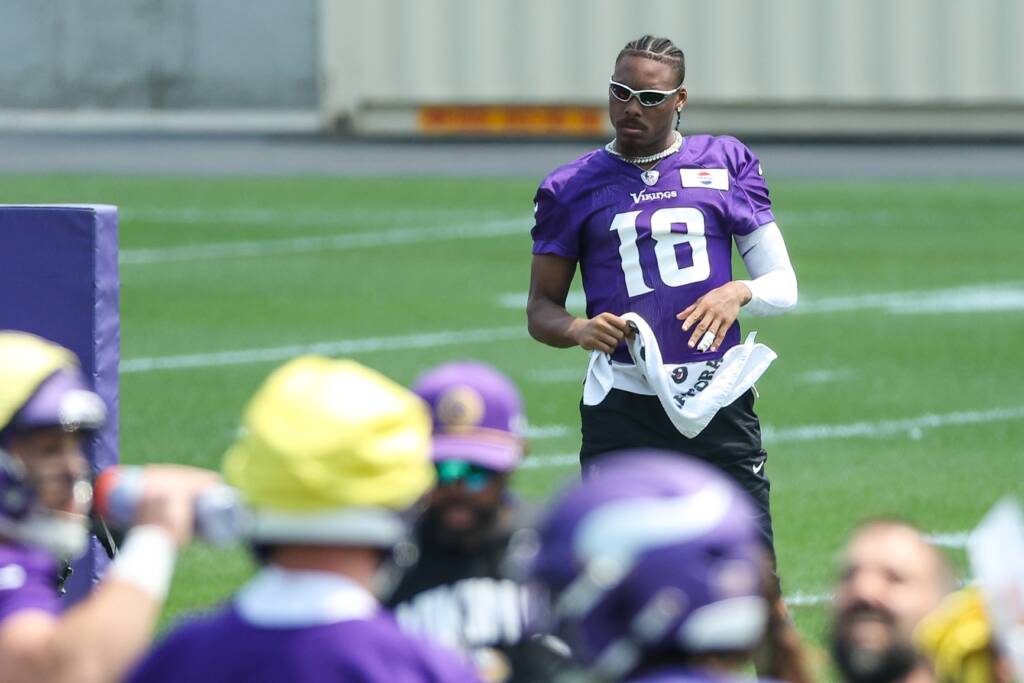

When it comes to roster building, I’ll admit that I have a natural preference for how to structure things. Pay the guys what they’re truly worth, whatever it takes, and fill in the gaps later. I was rehashing the Minnesota Vikings’ decision to trade Jonathan Greenard with a friend this week, and it sparked a broader conversation about roster construction.
Far too often, as football fans, we get consumed with the economics of the NFL, like it’s my own pocketbook going towards Justin Jefferson’s signing bonus, and it can become too trendy to chase cap savings and draft picks over legitimately great talents. Remember when the Tennessee Titans traded A.J. Brown for a first-round pick to the Philadelphia Eagles rather than give him a contract extension? They then, one-for-one, replaced him with Treylon Burks with that pick, a player with upside who even led some to compare him to Brown. That was the first time the following meme ever crossed my Twitter feed, and has remained seared in my brain ever since.
Occasionally the opposite can come true: Justin Jefferson more or less replaced Stefon Diggs one-for-one, and exceeded our wildest expectations. But the point is, more often than not, fans would be better off prioritizing building around good players over cap savings or attempts to get marginally younger at certain positions.
Frankly, this is where criticisms of the Jonathan Greenard trade ring especially true. It’s hard to imagine whatever combination of Jakobe Thomas (picked 98th overall), next year’s third-round pick, and the modest cap savings equaling the impact Greenard had for this football team.
But if I take a step back to take it all in, it may be an attempt to address a larger issue here. It’ll be hard to convince me the Vikings shouldn’t have retained a player of Greenard’s caliber. Still, the larger reality with Minnesota’s roster is that it has good players.
By and large, the Vikings have prioritized keeping those good players in the building rather than letting them walk, and have been aggressive in obtaining new ones via free agency. The problem is they’ve done so at the expense of their depth, or presenting a completely finished product across their starting 22.
It’s hard not to look at the Vikings’ roster and see a “stars and scrubs” approach to roster building at first glance. Go with me through the exercise of stacking up the Vikings’ roster, and see if the first-blush impression truly bears weight.
My hypothesis is that we’ll find a few elite talents on this roster, several very good Pro Bowl-level players, and then a wide swath of guys who are role players at best and replacement-level at worst. And there’s only so much the top-end guys can do to compensate for the weakest links on the squad. But it’s worth taking the time to evaluate these players, because it may challenge our first impressions.
At the top of the roster are the bona fide superstars: Justin Jefferson and Christian Darrisaw. They are the crème de la crème, and are in elite company at their positions across the NFL. What they can do when they’re healthy and put in a position to succeed can completely change the math on offense, be it Jefferson’s gravitational pull for the opposing secondary or Darrisaw’s ability to take the opposition’s best pass rusher on an island to allow the rest of the line to slide and combo block much easier assignments. These two are force multipliers that are worth every penny.
Then there’s our next tier of standout talents at their position. On offense, I’d identify Jordan Addison, T.J. Hockenson, and Brian O’Neill as the fringe Pro-Bowl talents, with Josh Metellus, Byron Murphy, and Andrew Van Ginkel, as their defensive counterparts. There’s a collection of guys just below them where there’s hope they could reach this level in the future, or were at this level in the recent past before they began their decline. Still, they could be plus starters.
On offense, I’d say look at Aaron Jones and Donovan Jackson; and on defense, tab guys like Dallas Turner, Blake Cashman, and Jalen Redmond for that category. They aren’t at the Pro Bowl level currently, but could be with a step forward or a burst of youth that turns back the clock.
Next are our role players, who, in general, are flawed in one way or another but can serve as valuable pieces in some form or fashion. In this category, you’d hope that most of this incoming rookie class can eventually find their way into this conversation. Still, it’s especially littered with veterans who’ve carved out their niche.
Jordan Mason, Will Fries, and Jauan Jennings are the top-of-the-line role players on offense, with a few defensive fan favorites in Eric Wilson or Isaiah Rodgers on defense. These are players capable of standing out in the right situation, but with holes in their game.
Then there are the weak links. Replacement level. Guys who are, and should be, fighting for every scrap of playing time or roster security they can get. On offense this feels limited to Blake Brandel/Michael Jurgens at center and a collection of candidates for WR4, RB3, and TE3. Nearly the rest of the offense feels fairly settled.
On defense, there’s the massive gaggle of Tyrion Ingram-Dawkins, Levi Drake Rodriguez, and Taki Taimani fighting for the opportunities up front, and then a similar free-for-all in the backend at safety between Jay Ward, Theo Jackson, and rookie Jakobe Thomas. Note that regardless of how any of these position battles shake out, it’ll take an unexpected breakout to make you feel any semblance of confidence in these positions.
Looking at that breakdown, a few things stand out to me. There aren’t many positions, particularly on offense, where I’m feeling any comfort whatsoever about sustaining an injury. The tackle depth is better than it was last season when they felt desperate enough to trot out an injured Christian Darrisaw repeatedly, but the second team offensive line makes me nervous once again. The depth at receiver beyond the top three is also dicey. Still, any combination of Jefferson, Addison, or Jennings could carry the burden of one of the three missing if need be, particularly if Jefferson is still in the equation.
On defense, however, it feels like the Legion of Pretty Good. There may not be a single true superstar on defense, but there are several very good players who collectively play together as a unit. If I have a criticism of this unit, it’s that, particularly without Greenard, there’s not a single high-end player to construct their pass-rush plan around.
Unlike the offense, which has two “change the math” players in Jefferson and Darrisaw who can completely alter how opposing defenses play them, the Vikings’ defense simply doesn’t have a single isolated threat of that caliber. In this kind of setup, the emphasis on the weak links in the system is even harsher, as they may be more difficult to compensate for. The roster’s deficiencies, particularly in the secondary and the rotation on the defensive front, could really rear their ugly heads if opposing offenses can exploit them.
I went into the exercise expecting to find a “stars and scrubs” roster. However, I think that’s a misevaluation, particularly on defense, and the true deficiencies lie beyond their frontline players. This roster feels like an injury or two away from being in real trouble at several positions. Still, it feels capable of winning a playoff game if injury luck and the uncertainty at quarterback break in their favor for once.


