
The Minnesota Vikings were masters of giving up big plays last season. From pick-sixes on offense, to chunk plays on defense, to huge returns given up to a certain team from Chicago, Minnesota was far better at taking haymakers than throwing them. Explosive plays are absolute game changers in the NFL, so it shouldn’t come as too much of a surprise that this year’s Super Bowl matchup features two of the best at creating them.
Both the New England Patriots and Seattle Seahawks ranked in the top five of explosive plays on offense this season, and it’s no coincidence that they had top-three scoring offenses in the league as well. Meanwhile, Minnesota ranked in the bottom seven in both areas. At first glance, this may seem like a J.J. McCarthy problem, but there’s much more going on here than just uneven quarterback play.
McCarthy was one of the best quarterbacks in the NFL in big-time throws, tying MVP candidate Matthew Stafford with a 7.8% rate. The stat is an attempt to measure accuracy, arm strength, and fearlessness on passes, and McCarthy displayed all three on numerous occasions when he wasn’t lasering a ball eight feet over Justin Jefferson’s head. So while there’s no question McCarthy needs to improve down-to-down, he has playmaking ability that all top offenses possess.
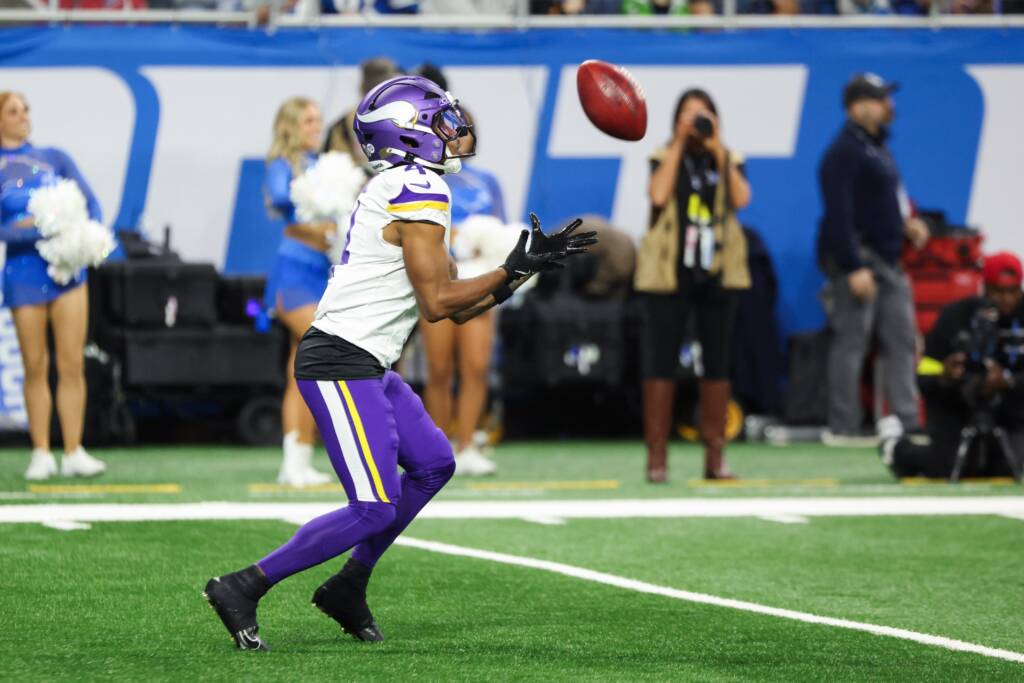
The Vikings also have one of the league’s better return men in Myles Price, who enjoyed a nice season of cardio after getting most every long return brought back by penalty. So although Price officially didn’t have any return scores — his long was just 61 yards — he’s proven he can affect games much like Rashid Shaheed, who notched three return touchdowns for Seattle this season.
Minnesota’s biggest issue in generating explosive, game-winning plays this past season was in the run game. The first and third longest runs of the year were by a receiver and a quarterback, while Jordan Mason and Aaron Jones plowed forward for four yards and a cloud of dust.
The Vikings brought in Mason for the modest price of a fifth-round pick, and he delivered some strong runs. But while his respectable 4.8 yards per carry average and six touchdowns were notable, his long on the year was just 24 yards. Jones wasn’t much better at just 31 yards, and defenses just weren’t scared of a home-run threat in the Minnesota backfield.
For Seattle and New England, running backs Kenneth Walker, Rhamondre Stevenson, and TreVeyon Henderson were elite at generating big plays. Among running backs, Walker was second in the NFL in touches that went for at least 20 yards, and Stevenson was No. 1 at a whopping 7.4%. And for backs with at least 100 touches, only Jahmyr Gibbs generated 40-plus-yard plays at a higher rate than Henderson. Minnesota’s offense lacked this part of the game entirely.
Before they decided to turn things on late in the year, Minnesota might have been on track to land Notre Dame running back Jeremiyah Love in the draft. Love offered home-run potential and had 37 runs of at least 10 yards this past season with the Fighting Irish. He’ll almost certainly be gone by pick 18, leaving the Vikings with their problems still unsolved.
Maybe there’s another back they target in the draft, or they decide to go after Breece Hall in free agency. Perhaps they even implement Price as a gadget player. But what New England and Seattle have made obvious is the need for dynamic playmakers. Minnesota already has chain movers – hello, Jordan Mason! hello, Jordan Addison! – but they lack that game-breaking ability they had with Dalvin Cook, Percy Harvin, Cordarrelle Patterson, and so many others over the years who can turn the game on its head with one play.
Play calling, McCarthy’s abilities, and a porous offensive line can all validly be called into question when dissecting Minnesota’s offensive woes. Consistency is incredibly important, but equally so are dynamic playmakers. The Vikings have good football players beyond Justin Jefferson. Still, is T.J. Hockenson ever going to take over a game? Will Aaron Jones or Jordan Mason turn a toss into an 80-yard touchdown? Likely not, and that’s why the offense in 2026 will remain average unless something changes.
The Patriots and Seahawks made efforts to search out the big plays, and it’s led them to the final game of the season. The Vikings, on the other hand, have seemingly focused their efforts on a more well-rounded approach. That’s not a bad thing, but this Super Bowl matchup should serve as a huge, blinking neon sign to add a little spice to the offensive mix.
The money is tight, and the draft pick isn’t high, but the Vikings have got to find a way to add some juice to the offense. While quarterback will continue to be a big question, Minnesota’s other biggest priority should be finding a man or a scheme that breaks the game wide open.