
The Minnesota Vikings have always been an offensive-minded team since Kevin O’Connell took over as head coach. He has a playbook full of explosive passing plays, as evidenced by Minnesota’s top-three mark in completed air yards from 2022 to 2024.
That mark dropped to 25th this year as the Vikings dealt with inconsistency and inaccuracy at quarterback, prompting O’Connell to pivot his strategy. He wasn’t able to unleash long-developing route concepts as he has in the past, and that might carry over into next season, depending on what they do at quarterback.
With so many questions surrounding the offense, it might be time for the Vikings to find a new identity, and the Super Bowl champion Seahawks could provide a nice blueprint.
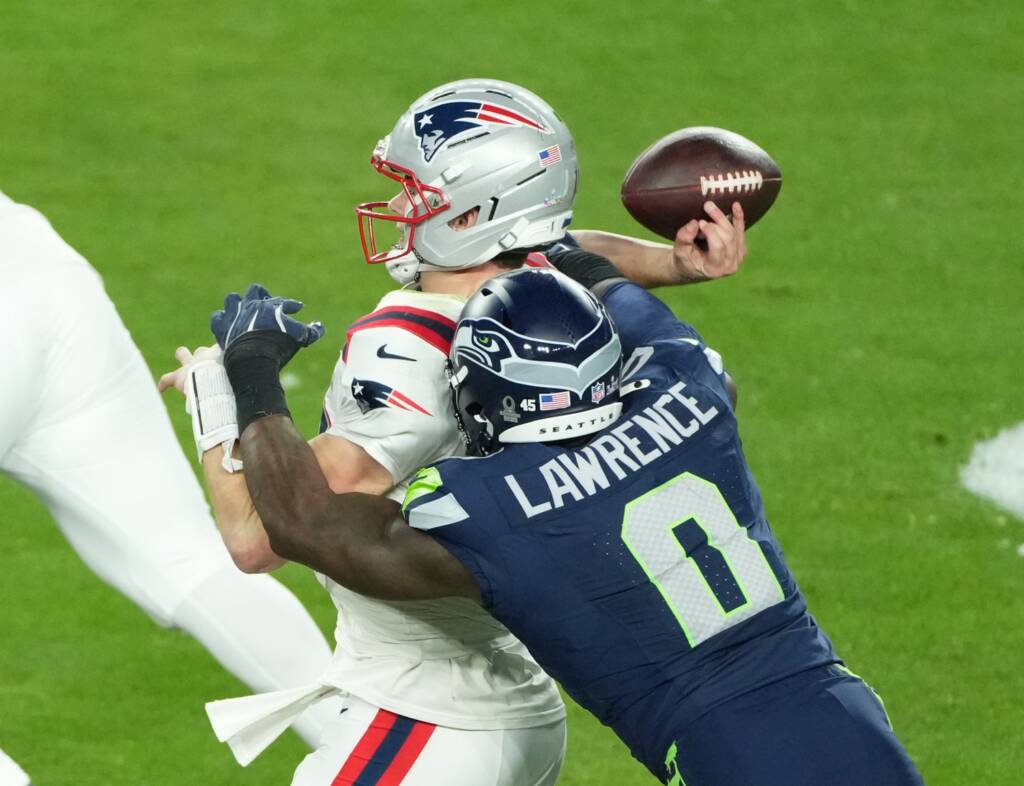
Seattle dominated the New England Patriots, winning 29-13 despite the Seattle offense scoring only one touchdown. It was a microcosm of their season, where their No. 1-ranked defense pressured the QB (six sacks) and forced turnovers (three) so the offense could get the running game going (141 yards) and set themselves up for easy points (five field goals).
It was similar to what the Philadelphia Eagles did in last year’s Super Bowl, where their top-ranked defense sacked Patrick Mahomes six times and forced two interceptions, including one pick-six, to help run out a 34-0 lead by the end of the third quarter. It’s been proven time and time again that the adage is true: Defense wins championships.
The Vikings already have this infrastructure in place. Defensive coordinator Brian Flores blitzes at the highest mark in the league (44.3% of dropbacks), so they’ll get to the opposing quarterback more often than not. Minnesota’s defense was tied for 10th in takeaways this year, but tied for first last year, so they’re capable of creating turnovers. The Vikings already have one of the best kickers in the league in Will Reichard, so they can score as long as they are in field goal range.
In their five-game win streak to end the year, the Vikings followed this formula. They created 10 turnovers over their final stretch, picking up at least two sacks in each game. Over their final three games, they recorded 14 sacks while kicking three field goals in each game. That shows Minnesota can win this way, and the Seahawks showed they can use it to become world champions.
However, the Vikings still need a capable offense. Teams ultimately have to score points to win. Both the Seahawks of this year and the Eagles of last year had top-10 scoring offenses to pair with top-two scoring defenses, which is usually a good recipe for success. That was Minnesota’s reality a season ago; the defense ranked fifth, and the offense ranked ninth.
So, why didn’t they make a Super Bowl? It all falls on the run game. Since O’Connell took over, the Vikings have never finished above 19th in the NFL in rushing yards and never had a rushing-success rate above 40%. In 2024, the Eagles led the league in rushing yards and rush EPA, both of which were decisive factors in their Super Bowl run.
O’Connell is not known for his run schemes, but there were times this year where he was forced to abandon what he knows in favor of what will give his team the best chance to win. For the most part, it worked out. The Vikings had their highest rushing-success rate of the O’Connell era (43.7%) and tied for 10th in the league in yards per attempt (4.5), another high mark in O’Connell’s tenure.
Pairing a good running game with a strong defense is Football 101, and it might need to be the direction the Vikings go with their current quarterback situation. It’s what the last two Super Bowl winners have done, and it’s likely the direction the rest of the league is going in the near future.
Fans will lament losing Sam Darnold and what he could’ve done for the offense this season, but Darnold wouldn’t have pushed this team to the Super Bowl. The Seahawks built their team around him, utilizing their talented defensive front and their two-headed backfield to play to Darnold’s strengths and minimize his weaknesses. O’Connell and the Vikings likely would’ve had him throwing 30 to 40 times a game again, and a result similar to last year’s Wild Card loss would’ve transpired.
If the Vikings can keep their momentum on the ground going into next season, they can change their identity for the better. They have a head coach who’s willing to adapt when needed, a defensive coordinator who was in charge of the lowest scoring Super Bowl in history, and a roster that is capable of hanging with every team.
It’s not rocket science. If you win the turnover battle, put pressure on the opposing QB, and put your offense in positions to score, you’re going to win more often than not. It’s become a staple of O’Connell’s tenure to feature high-flying, explosive plays. Still, for the Vikings to play in February, they might need to go back to the basics.