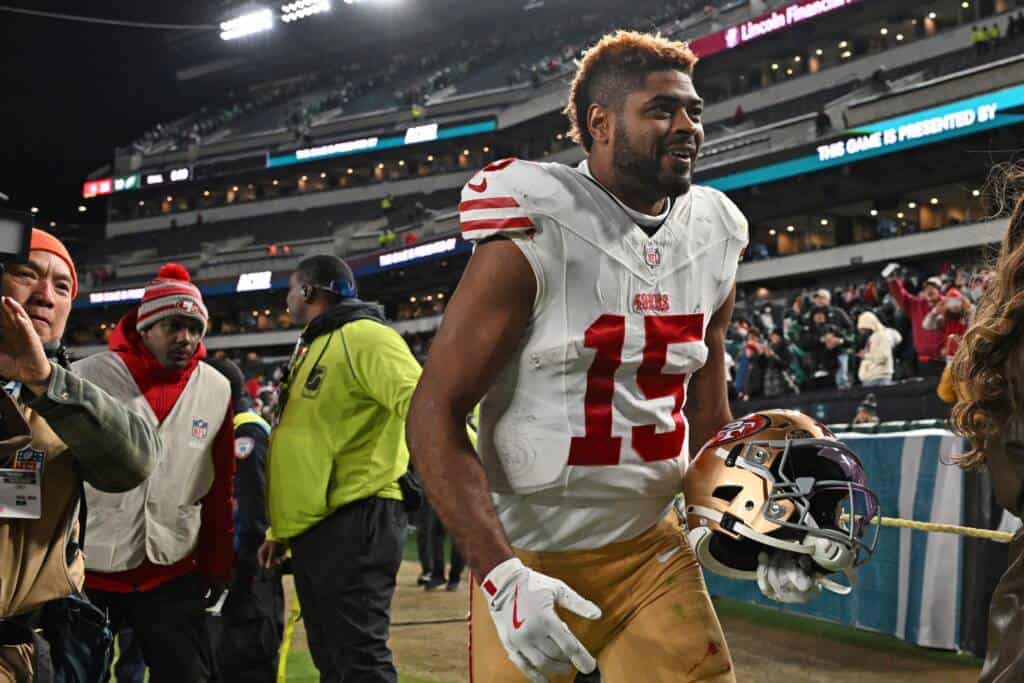

The Minnesota Vikings solved one of their most glaring issues on Thursday night when they reportedly signed wide receiver Jauan Jennings. According to ESPN’s Adam Schefter, Jennings and the Vikings reached an agreement on a one-year deal worth $8 million, with the chance to make $13 million in incentives.
Justin Jefferson and Jordan Addison are locked in as starters. However, Jalen Nailor signed with the Las Vegas Raiders during free agency, creating a void behind them. But while Jauan Jennings was a solution, he also wanted to leverage his value to get a payday.
Ultimately, Jennings was willing to meet the Vikings halfway, and Minnesota made the best out of being backed into a corner.
As anyone who grew up with a “Three Deep” poster will tell you, the No. 3 receiver position is more important than you think. According to Sumer Sports, the Vikings ranked 10th in the NFL by using 11-personnel (one running back, one tight end, and three receivers) on 63.84% of their snaps last season. That number could have been higher if Kevin O’Connell hadn’t simplified his offense to accommodate J.J. McCarthy late in the season.
While Nailor did yeoman’s work in the role last year, the Vikings also wanted a chance for more production at a lower price than the three-year, $35 million deal he signed with the Raiders. Other mid-tier receivers, including Alec Pierce, Romeo Doubs, and Wan’Dale Robinson, got big paydays in free agency. Therefore, Jennings’ market value continued to rise, with Spotrac estimating $22.6 million per season.
That could have been part of the reason why Jennings didn’t sign after spending two nights in Minnesota last week. SI’s Albert Breer speculated that he was looking “to get paid like a No. 2 receiver,” even with the resumé of a No. 3.
However, if you look at Minnesota’s other options, Jennings had even more leverage. While the Vikings could convince plenty of receivers to play with Justin Jefferson and catch passes from Kyler Murray (or J.J. McCarthy), that situation can also draw the wrong crowd with receivers past their prime.
DeAndre Hopkins had offered his services to the Vikings and had previously played with Murray when they were teammates with the Arizona Cardinals. But their best season was 2020, and Hopkins is entering his age-34 season. A rough 2025 with the Baltimore Ravens (22 catches for 330 yards) also made it seem like a rebound was coming.
Deebo Samuel was another interesting name. But while he may have won some Vikings fans a fantasy football championship in the past, Kyle Shanahan used him in San Francisco like Addison would drive a rental car. Samuel was more productive than Jennings, but that could have raised his asking price. With all the wear-and-tear, it’s likely why the Vikings also passed on him.
Then, there was Stefon Diggs. He was productive in his lone season with the New England Patriots, catching 85 passes for 1,013 yards and four touchdowns. Still, the Vikings had already been down that road before. The same nostalgia hit as bringing Adam Thielen back would have made it fun. But it also could have been with the same disappointing production, with the added chance of off-the-field troubles.
But while the back of his football card was attractive with 55 catches for 643 yards and nine touchdowns in 15 games last year, it also wouldn’t have fallen in line with Minnesota’s motivation this offseason.
One year after being among the higher-spending teams in free agency, Minnesota cut spending to the point that some thought the Wilf family would sell the team. Paying over $20 million per season for a No. 3 receiver would be a weird look just weeks after refusing to give Jonathan Greenard $25 million per year.
It would also be a lack of anticipatory planning that the Vikings are trying to establish. If all goes well, Addison will be in line for the type of contract Jennings was looking for next offseason. Even further down the line, the Vikings could approach Jefferson for another big contract extension that will likely reset the market.
Jauan Jennings could have played more hardball to get the money he felt he deserved here, and he waited a week before signing his deal. But this is where the two sides met halfway: If Jennings is disappointing, $8 million is a solid price considering the other options out there. If he has a strong season, the Vikings would be paying for production rather than a projection, which was one of the biggest issues with Minnesota’s free-agent spending spree.
Ultimately, the Vikings don’t have to hope that 2025 third-round pick Tai Felton shows up in the best shape of his life and has a star turn. And Jennings doesn’t have to leave more money on the table to come to Minnesota.
Either outcome seems like a good one, and both got the most out of a difficult situation.