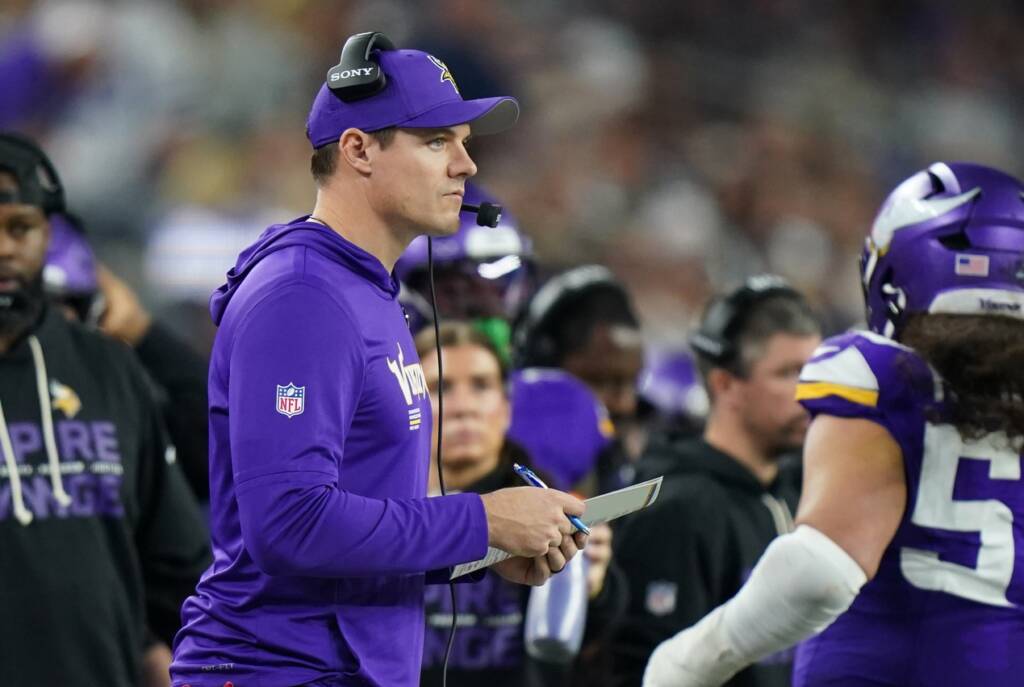

Two weeks ago, the Minnesota Vikings made their first significant leadership change in the Kevin O’Connell era, firing general manager Kwesi Adofo-Mensah on January 30. The timing was more shocking than the move itself, because the Vikings fired him 26 days after their season ended.
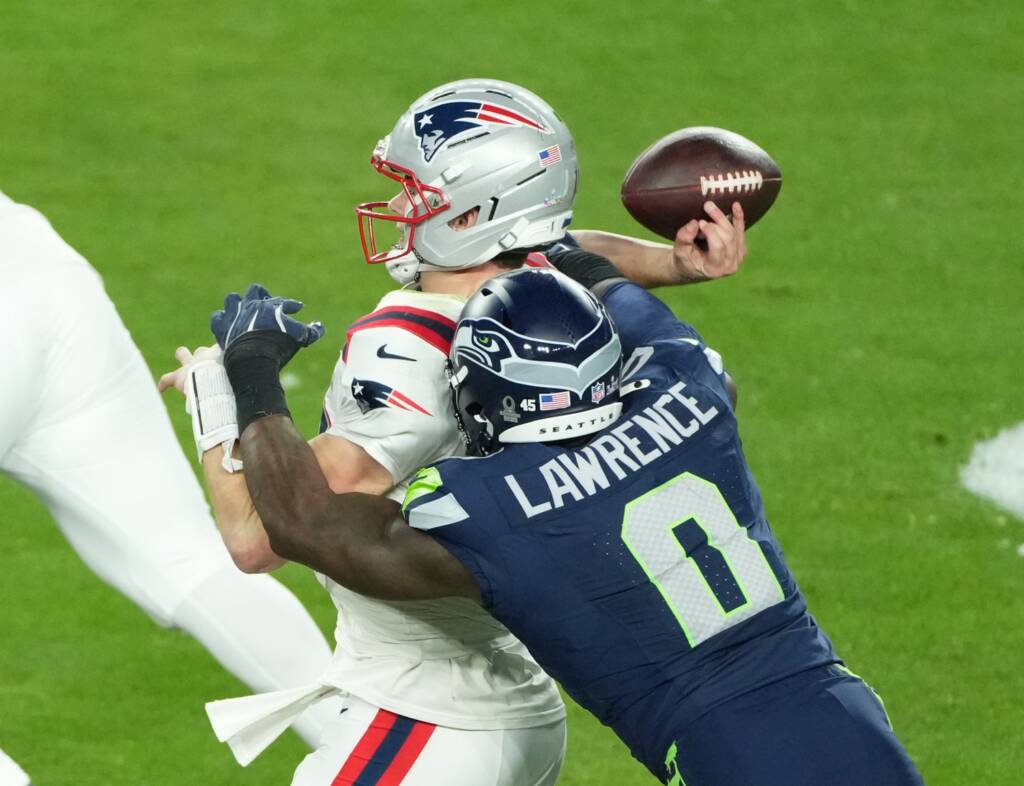
Five days prior, Sam Darnold had helped lead the Seattle Seahawks to the Super Bowl. On the surface, that appeared to be the reason for Adofo-Mensah’s dismissal.
Darnold’s Super Bowl run may have amplified the optics, but the roots of Adofo-Mensah’s dismissal ran deeper.
Adofo-Mensah’s drafts didn’t yield the results required to build a consistent contender. Trading back 20 spots and selecting Lewis Cine in 2022 didn’t land the Vikings a future first-round pick. The safety only played 10 defensive snaps in two seasons.
Guard Ed Ingram, cornerback Andrew Booth, Jr., and linebacker Brian Asamoah were also among the top 66 picks in 2022. Only Ingram eventually carved out a full-time role, but the Vikings benched him midway through 2024 for inconsistency.
Missing those four players and plenty of other picks since then has left Minnesota with several holes on its roster. That also played a role in a roster that wasn’t able to carry J.J. McCarthy as much as the team hoped when they made him their starting quarterback last year.
Rob Brzezinski is Minnesota’s vice president of football operations and will serve as its general manager through the NFL draft. That could give O’Connell and the coaching staff more power.
So what’s the best way for the team to address the draft if they have a different general manager for the first time since O’Connell arrived?
Adofo-Mensah’s background in analytics is part of the reason the Vikings hired him. There is a place for that in the game. Still, could it have allowed Adofo-Mensah, who didn’t have a traditional football background, to outsmart himself?
Arif Hasan has helped build the Consensus Big Board for years. His Big Board aggregates and weights rankings from the most-respected draft analysts to create a more refined snapshot of how the scouting community values each prospect.
As he stated when presenting his board in 2022:
The consensus of these experts does a better job predicting which picks will pan out than individual experts. Among those 80-plus analysts, the board has ranked in the top 10 in predicting draft order each of the last three years, which no individual expert can claim.
That suggests leaning into a consensus board could help teams find value in their own picks while better predicting how the draft will unfold.
Arif’s Big Board highlights the issue with Minnesota’s Cine pick. The Vikings entered the draft with pick No. 12 in 2022. They traded 20 spots down for Cine even though fellow safety Kyle Hamilton, ranked fourth on Arif’s Big Board, was still available.
Instead, Minnesota traded down to add draft capital rather than taking advantage of the value a prospect like Hamilton offered. Passing on Hamilton wasn’t just a debate about value, it was a philosophical choice. Minnesota chose to lean into its own model and trade flexibility rather than trust the broader scouting consensus.
To be fair, Cine was ranked 33rd on the board when Minnesota picked at 32. They also took Booth, ranked 22nd, with pick 42.
The Vikings were seeking value with those picks. Still, the fact that they took Cine first with Booth, who ranked higher on Arif’s board, suggests Minnesota wasn’t leaning heavily on consensus.
Arif explains that teams around the league use his Big Board “to set expectations for where players will go in the draft, allowing them to maneuver around the draft board more effectively.”
If the Cine and Booth picks worked out, Adofo-Mensah would look like a genius. Instead, he may have outsmarted himself, especially considering the Vikings enter the offseason needing help at safety.
While Arif’s board has a proven track record and is widely respected inside league circles, the principle behind it — aggregating a wide range of evaluations to smooth out individual bias — can still be applied using other consensus models. The goal isn’t to copy one analyst’s rankings. It’s about trusting the market signal generated when dozens of evaluators independently reach similar conclusions.
This year, the NFL Mock Draft Database has used rankings from 93 big boards, 604 first-round mocks, and 688 team-specific mocks to craft its own Big Board.
Today, we will run a full seven-round mock, aligning the Vikings with the player at the corresponding ranking. So in 2022, Minnesota would have selected wide receiver Drake London, the 12th-ranked player on Arif’s Big Board, at pick No. 12.
After doing so, we’ll determine if blindly drafting “best player available,” per the Big Board, helped the Vikings still address their needs.
What If the Vikings Just Use the Consensus Board This Year?
- Round 1 (Pick 18): Kenyon Sadiq, TE, Oregon
- Round 2 (Pick 49): Omar Cooper, Jr., WR, Indiana
- Round 3 (Pick 82): Eli Stowers, TE, Vanderbilt
- Round 3 (Pick 97): Treydan Stukes, CB, Arizona
- Round 5 (Pick 161): Cole Payton, QB, North Dakota State
- Round 6 (Pick 194): Bishop Fitzgerald, S, USC
- Round 7 (Pick 234): Zavion Thomas, WR, LSU
- Round 7 (Pick 240): Le’Veon Moss, RB, Texas A&M
Analysis
There are a few ways to look at this. First, drafting two tight ends with the first three picks is probably unwise and unlikely. Minnesota used multiple tight ends on 28.4% of plays, 22nd in the league, per Sharp Football Analysis.
However, T.J. Hockenson doesn’t have any guaranteed money left on his deal and has a cap number of $21.3 million in 2026. If the Vikings deemed him expendable, they could use Josh Oliver as TE1 as the rookies get up to speed.
Oliver has a $9.9 cap number in 2026 and has an out in his contract in 2027. Sadiq and Stowers would present a cheaper option at the position in the future, without being expected to get up to speed with the offense immediately.
The other selections do address other needs. Minnesota’s short- and long-term future at receiver is uncertain, with Jalen Nailor set to be a free agent and Jordan Addison’s multiple off-field issues. Drafting a receiver high may not be at the forefront of everyone’s minds, but it could be essential in O’Connell’s pass-heavy scheme.
Minnesota addresses its needs at cornerback, giving it depth behind Byron Murphy, Jr. and Isaiah Rodgers.
Payton stands 6’2⅜” and 229 lbs. and provides an intriguing athletic prospect at quarterback. Of course, the Vikings still need a veteran to provide immediate competition for McCarthy.
Finally, the Vikings need to get younger and cheaper at running back. Moss could become a starter, but Aaron Jones and Jordan Mason occupy $20.34 million of Minnesota’s cap. That’s much too high for a team that is built around the passing game.
Minnesota’s lack of depth in the trenches stands out. Passing Stowers at pick 82 and selecting Penn State edge rusher Dani Dennis-Sutton, ranked 83rd, would help add depth to the defense.
Meanwhile, Payton is sandwiched between three offensive linemen above and below him on the board. Quarterback is a unique position to address in the draft, and the Vikings could deem another young quarterback as a wasted pick when there is urgency to return to the playoffs.
Still, this exercise shows that needs can be addressed simply by selecting the best available player. Every team’s board is different, but they can better forecast the moves around them by leaning on a Consensus Big Board.
New leadership brings new philosophy. The question isn’t whether Minnesota should use consensus — it’s whether they’ve learned what happens when they ignore it.