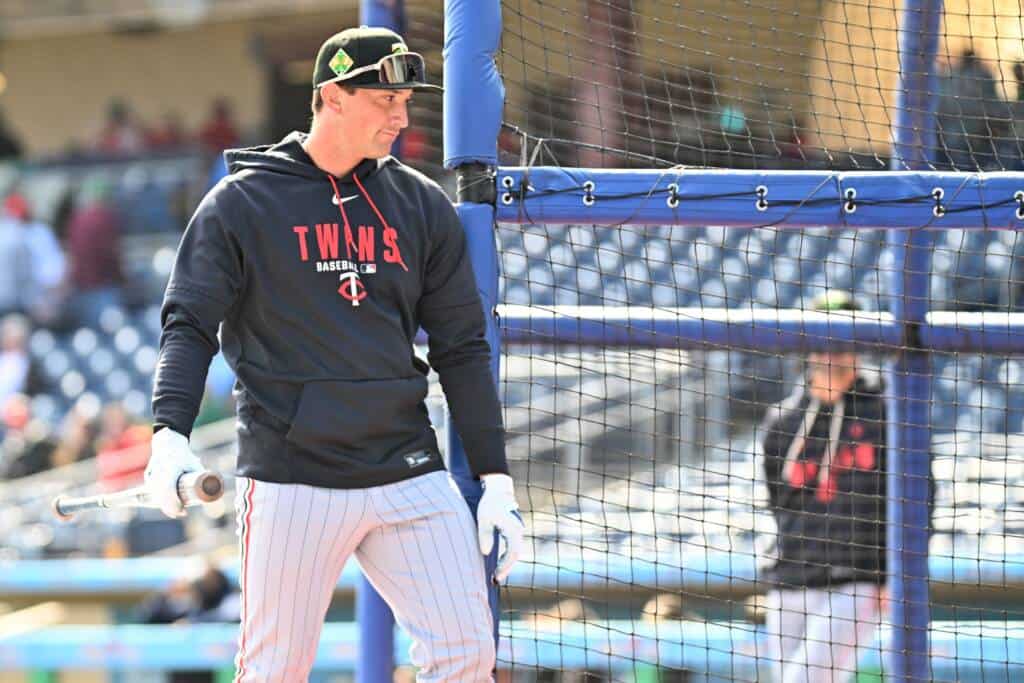

Brooks Lee is entering the 2026 season as the Minnesota Twins’ starting shortstop. The 2022 first-round pick out of Cal Poly became the everyday starter at the position after the Twins dealt Carlos Correa back to the Houston Astros at last summer’s trade deadline. Even as Lee enters the season as the guy at shortstop, he may already be playing for his job long-term.
Shortstop is one of the most challenging positions to play defensively in baseball. Lee did a serviceable job at the position in his 64 starts and 77 games at shortstop last season with a -1 outs above average and 6 errors in 2025. Lee’s range at shortstop is limited, so he emphasized this offseason training to improve lateral quickness and get stronger. Lee has impressed Minnesota coaches and opposing scouts in spring training. However, we probably can’t assume it will completely transform his defensive ability.
Brooks Lee should make a bigger impact after improving his defense in the offseason. Still, Lee ultimately will need to show his potential at the plate if he wants to remain involved with the Twins as a core player. In two big-league seasons, Lee has hit .232/.279/.357, with 19 home runs, and a 75 wRC+ (100 is league average) over 189 big league games.
The results have been underwhelming, especially for a prospect in Lee who the Twins drafted as a high-floor, low-ceiling prospect. Shortstop prospects Kaelen Culpepper and Merrick Houston will likely reach the big leagues in the next couple of seasons. If Lee doesn’t produce in 2026, the Twins will quickly have options at short.
However, there’s precedent for a Twins shortstop to hold onto the job because of his hitting ability. Jorge Polanco is a recent example of a Twins shortstop succeeding in his role despite being a limited fielder. Polanco created a path for Lee to become a successful shortstop, even if the fielding isn’t consistent, by being highly productive with the bat.
Jorge Polanco played 7 of his 11 seasons with the Twins as a shortstop, and produced -32 OAA and 73 errors in 501 games at the position. Polanco eventually moved to second base, but he was able to hold his position so long because he was a good hitter. Polanco slashed .269/.334/.446 with a .780 OPS and 112 home runs, 447 RBI, and a 111 OPS+ as a hitter over his 832 games throughout his 10 seasons with the Twins.
Brooks Lee hit .836 OPS in the minor leagues from 2022 to 2024, indicating that he has the potential to hit as a big leaguer. Lee should follow Planco’s path to becoming a good hitter. Ultimately, Lee must improve on his exit velocity. Through Lee’s career, he has an 87.8 MPH average exit velocity, lower than the 88.8 MPH league average.
The issue with his contact ability stems from his discipline at the plate. Lee’s 16.7 percent strikeout rate is better than the 22.2 percent league average. Still, he could improve his walk rate. A 5.9 percent walk rate is worse than the 8.4 percent league average clip.
Those numbers are similar to Jorge Polanco, who had a 19 percent strikeout rate and an 8.7 percent walk rate. Polanco found the better pitches to elevate with his 18.3 degree average launch angle, whereas Lee’s 13 degree average launch angle. Lee must keep more pitches in that line drive range to create base hits.
Brooks Lee must improve his pitch selection if he wants to hit at a productive level like Polanco. He has a 23.1 percent whiff rate that’s better than the 25 percent league average. While that’s undoubtedly positive, it highlights an issue with Lee’s approach. Lee makes plenty of contact, but it’s not all created equal.
A 50.4 percent swing rate is higher than the 47.3 percent league average. But with that much free swinging, including a 32.7 career chase rate, teams decided to throw less competitive pitches Lee’s way. Opposing pitchers threw in the strike zone 51.8 percent of the time in 2024. By his second season, teams attacked Lee less, throwing 48.8 percent of pitches in the zone last year. If Lee can spit on more pitches, he can find more competitive throws to attack. That would go a long way to improving his exit velocity.
Jorge Polanco didn’t consistently crush baseballs. His 87.5 MPH average exit velocity with the Twins was also below league average. However, he was really discerning at the dish. Teams also don’t pound the zone against Polanco, throwing at a 48.4 percent zone rate. However, Polanco did a better job of choosing pitches to offer at with a 46.7 percent swing rate and a 26.3 percent chase rate over his career.
Smacking fastballs has been one of Brooks Lee’s strengths. He had a +8 rating against the heater in 2025. The problem is his work on off-speed pitches with a -7 rating against changeups and a -9 rating against sliders.
Polanco built his career on being polished with a +3 rating against all three pitches a year ago. Lee can improve by being more deliberate at the plate and selecting more competitive pitches to drive. By doing so, he would improve his 5.3 percent barrel rate, which is nearly 2 percent below the 7.2 percent league average. Polanco recorded a 7.4 percent barrel rate.
Maybe a position change is inevitable for Lee, as it was for Polanco. But his hitting ability is ultimately what will allow him to fulfill his draft status with the Twins. Polanco showcased a polished approach by being deliberate at the plate and finding the right time to strike. A calmer approach at the plate and better execution of his pitch can make the necessary improvements to be the pure contact hitter the organization hoped he could be.
Lee can improve, but he must do so sooner rather than later. Culpepper is climbing the organization’s ranks with his bat. Experts also tout Houston as a more polished shortstop defensively.
Brooks Lee will be Minnesota’s shortstop for the season opener in Baltimore. He has shown flashes of his potential, but hasn’t put it together yet. Infield prospects like Culpepper and Houston are getting closer to the majors.
Still, Lee has a wide-open path to playing time for now. But after two underwhelming seasons in the majors, he needs to prove quickly that he can be the polished bat he showed in the minor leagues. Still, whether Lee sticks at shortstop will mainly depend on his bat, as was the case with Jorge Polanco for most of his time in Minnesota.


