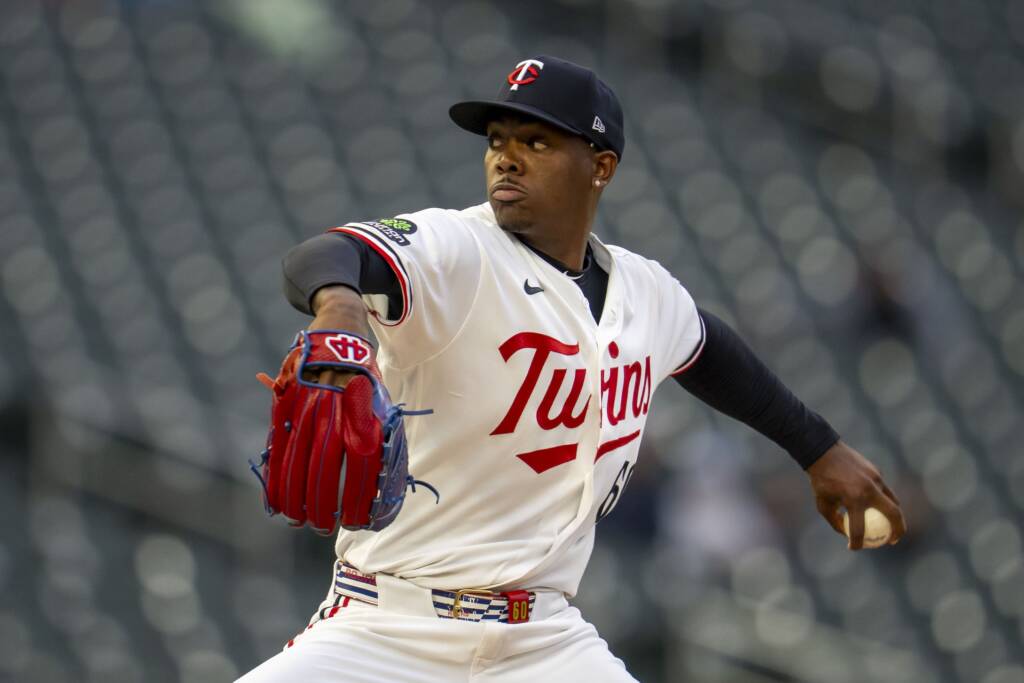

Despite some shortcomings after the Minnesota Twins traded for him last year, Kendry Rojas has proven to be an effectively wild reliever in the majors this season.
Kendry Rojas has been effective in his first five major league games, with a 1.26 ERA, 3.42 FIP, .220 opponents’ average, and 14 strikeouts over 14 ⅓ innings. However, he’s also been wild, with a 1.46 WHIP, which is high due to his 16.4% walk rate in a small sample size.
That’s a significant improvement, given how he fared with the St. Paul Saints last year. After coming over in the Louis Varland trade, he posted a 6.59 ERA, a .386 BABIP, 19.3% strikeout rate, 15.9% walk rate, with 25 runs allowed in 27 ⅓ innings. However, the version of Rojas that has shown up on the major-league squad is what they were hoping for when they dealt Varland to the Toronto Blue Jays at last year’s trade deadline.
The highlight of his year so far was his first career start against the Houston Astros on May 18. Rojas was elite, pitching four scoreless innings, allowing just four base runners on two hits, a hit batter, and a walk, while striking out three on 46 pitches.
“The mentality is the same,” Rojas said via pitching coach Luis Ramirez on his start after coming out of the bullpen for the first three outings of his career. “I just have to prepare a little differently because I was just starting the game. I felt good, and I felt comfortable starting because this is something that I’ve done before.”
“I thought he did a really good job navigating,” Twins manager Derek Shelton said. “He threw strikes; everything was sharp. We didn’t know what we were going to get out of him. And the fact that we got four out of him… that was really impressive.”
Out of his four pitches, Rojas’s fastball has played the best in the majors. He’s held hitters to a .118 opponents’ average in 21 plate appearances on the heater, while averaging 96 MPH.
Rojas’ next-best pitch is the slider, which has been an effective off-speed pitch throughout his entire pro career. He’s showing signs of success with his slider in a small MLB sample, recording four strikeouts on it and allowing just one double in 20 plate appearances.
However, Rojas has been inconsistent in locating the fastball, leading to 10 walks this season. When the pitch makes its location, it’s devastating to opposing hitters. Still, command is the next thing Rojas must work on with Minnesota’s pitching coaches.
“I just needed to continue to work,” said Rojas. “It makes me feel good that I can get swings and misses on my fastball. I just need to continue to work on my locations and that kind of stuff.”
“Kid’s got really good stuff, super efficient today,” said Twins catcher Ryan Jeffers following the Twins’ 6-3 win over the Astros, in which Rojas started. “Worked himself into some trouble early, but super efficient, so props to him for kind of settling in there. I think hopefully we can build some volume there and maybe let him go a little longer.”
As things stand, Rojas is continuing on the plan of pitching every four days, and up to either four innings or 65 pitches, whichever comes first. In his last outing against the Boston Red Sox on May 23, Rojas pitched three innings on 45 pitches, allowing one hit and one walk, while striking out three.
“He’s got good velo, he’s got two fastball types, he’s got the sink and the four,” said Twins pitching coach Pete Maki, referring to the sinker and four-seam fastball. “He’s very useful; it’s useful to both-handed hitters. He threw a lot of strikes with the split and the slider, and if he’s doing that, he’ll continue to have outings like that.”
The Twins have had Rojas on a limited workload plan all season. They want to keep him stretched out in case they need to make him a starter at any point during the year. But they also believe that a shorter workload for the foreseeable future, facing the order just one or one and a half times through, will help him ease into better command with his stuff.
“We were not going to go any farther than four innings,” said Shelton. “He hasn’t done more than that. He had probably more pitches, but it was probably more the ups.”
Rojas’ future may be in the bullpen for the long term. Still, he’s been an effective weapon for the Twins, whether they continue to stretch him out in long relief or eventually move him into a shorter, high-leverage role.
But no matter how you look at it, the version of Kendry Rojas that’s pitched in the majors this season has meaningfully improved since he arrived at the Twins last August, offering reason to believe he can be an impact pitcher for years to come.

