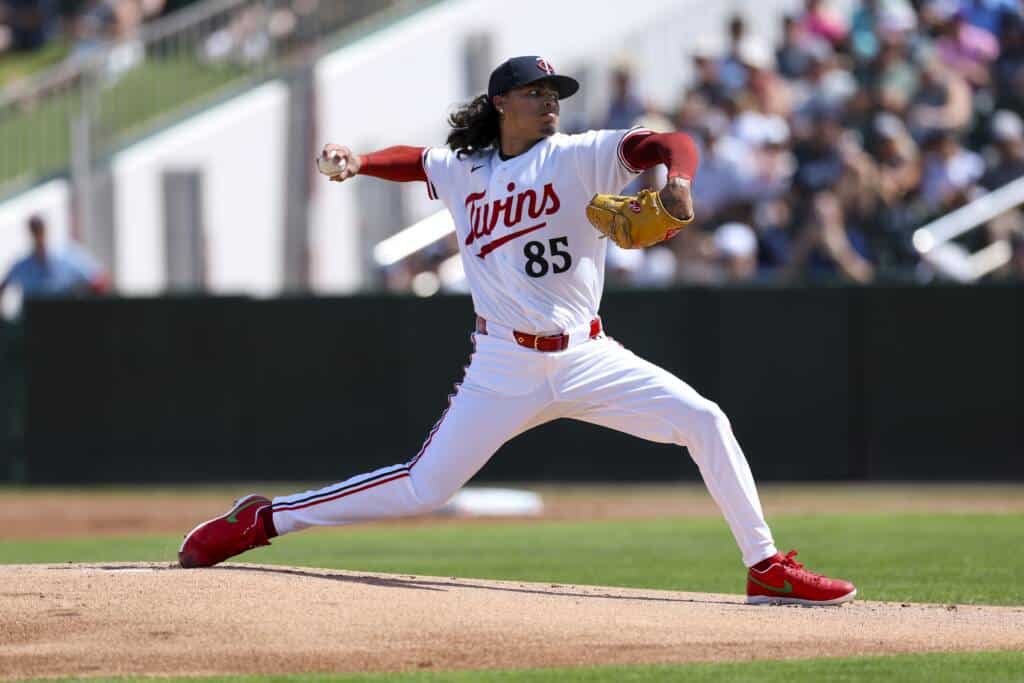

Daniel Zebulon “Zebby” Matthews was ready for his return to the majors. He just hadn’t been pitching like it.
During Spring Training, Zebby Matthews’ name appeared in the midst of the strangely long list of possible starters for the Twins’ 2026 rotation. He only appeared three times in February and March, allowing seven runs in 11 innings. He struck out nine and, perhaps most importantly, kept the ball in the yard. Management optioned him to AAA-St. Paul on March 20 — a week before each team’s final cuts.
Matthews’ name did not appear on any injury report. He made his starts in St. Paul, but for the most part, the data reinforced the decision to option him out of Spring Training. His line at AAA:
| ERA | IP | SO | BB | WHIP |
| 4.72 | 34.1 | 33 | 11 | 1.51 |
Concerns about his development continued through April, and when the bubble broke on the early-season roster, his call-up to pitch the finale against the Miami Marlins didn’t surprise as much as Matt Wallner’s metrically appropriate option to the Saints. Zebby appeared in the transaction notes, started the interleague game against the divisionally unfamiliar Marlins, and enjoyed his best performance of the year — at either level.
His first two starts for the Twins seemed too much to hope for after such pedestrian numbers for the Saints. Aside from allowing a first-inning home run to Isaac Paredes, he only surrendered a total of eight hits in 13 innings. His 11-to-1 strikeout-to-walk clip is likely unsustainable, but still on another level of quality compared to the 3-to-1 ratio he carried out of AAA.
His command still presents unwelcome opportunities to opposing batters, but Zebby has battled through tough innings of his own making, retired his hitters, and kept his club in position to win the games he starts.
Matthews’ early-season quality is a refreshing, if not comforting, promise of the starter depth the Twins possessed coming into the year. In sharp contrast to the wild action of the bullpen staff and the late-inning excitement they provide, Derek Shelton has options with regard to starters. That’s especially impressive for a staff with so much youth, who currently rank sixth in innings pitched by starters in the American League (282.2).
Zebby’s spot in the rotation came up on Monday, a suddenly crucial game on the schedule as the Twins and Chicago White Sox sit one game apart in the AL Central, both in possession of a Wild Card spot.
Analyst Trevor Plouffe credited Matthews’ improved fortunes to a lower arm angle (37 degrees, down from 42 and 40 in 2024 and 2025, respectively) and a much-improved curveball. The next batter, Munetaka Murakami, crushed a generous inside fastball over the right field fence. In the second, after a four-pitch walk to Tristan Peters, Drew Romo turned on another inside fastball that got just too much of the plate.
Neither pitch was too bad, nor too badly off the mark. We can perhaps credit Murakami, who leads the AL in home runs, with getting the better of Zebby Matthews. The pitch to Romo was clearly a mistake, or a misread on the White Sox’s early approach at the plate.
After the second home run, Plouffe commented that the “game plan [was] clearly to pitch the lefties hard-in”. Matthews’ velocity was good-great, even, starting north of 97 mph. However, in the first two innings, Zebby was too slow to adjust to the feedback from the hitters. He and the Twins paid for it early; the three earned runs were enough to cost the Twins the game on a day the bats would not awaken.
But that was it for the White Sox’s production against Matthews. While he battled early, he cruised late, easing through the middle innings to earn his third consecutive major-league quality start. Nearly unhittable after the second, Matthews spun his dazzling new curveball, moved his slider in and out, and found sparing, effective uses for his fastball. He struck out both Romo and Murakami — the latter with a back-breaking curveball — and didn’t walk another batter.
Even after his poorest start of 2026, his numbers now read thus:
| ERA | IP | SO | BB | WHIP |
| 2.37 | 19.0 | 17 | 2 | 0.84 |
Every major statistical category — and most of the small ones — is demonstrably better than his performance in the minors. In two of his three starts, he’s allowed home runs to put his team behind, and he’ll have to work on getting a better read on opponents’ early swings and not follow the letter of the law when it’s inadvisable to do so.
But most impressive and most promising are the adjustments Zebby Matthews made on large and small scales. He underperformed at AAA, but did not let his call-up to the majors intimidate him. He’s surrendered home runs in the first inning of his last two starts; then, seemingly unaware of the deficit, he’s found deep quality pitches and kept the scoreline close late into each game. He’s put up zeroes when he’s had to, when he’s had no room for error, and proven he deserves a spot in the rotation the Twins called upon him to bolster.