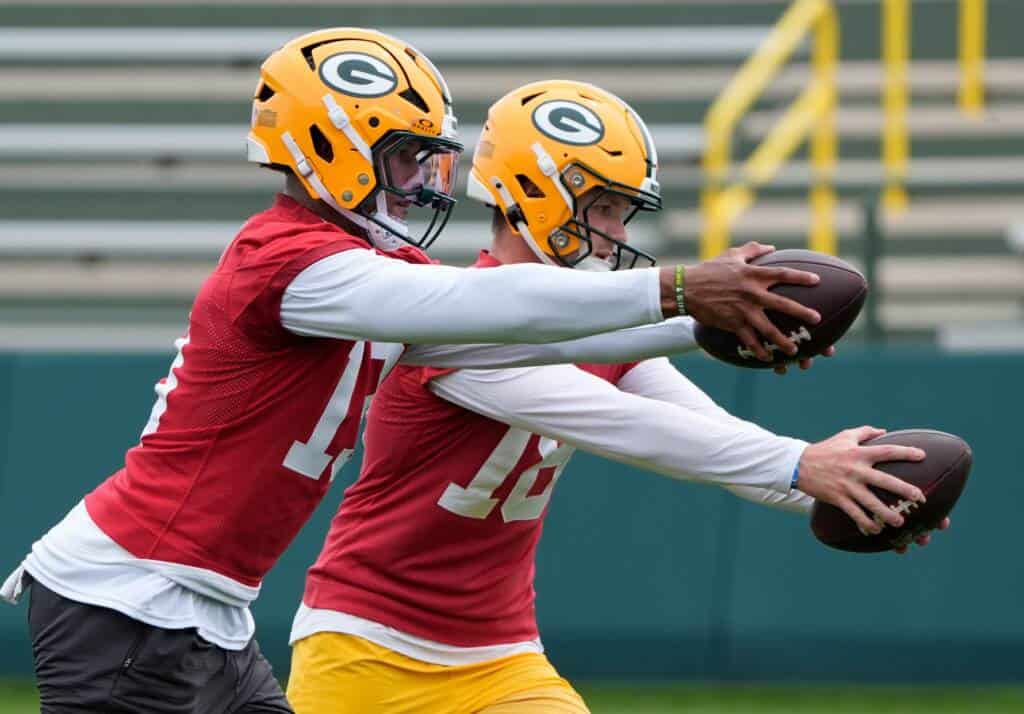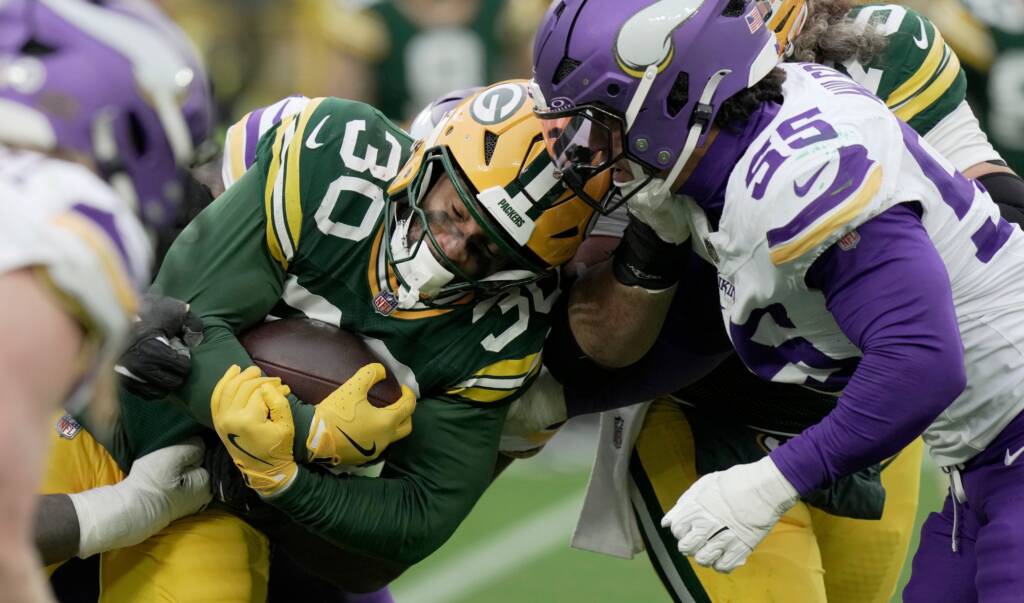

The eventual outcome and the timeline of this grim Josh Jacobs situation remain unclear. For now, from a football perspective, the Green Bay Packers have to be considering every possibility, including whether they have enough running back talent behind Jacobs to cover any protracted absence or even his full departure from the team.
If Jacobs misses time due to suspension and the Packers don’t make an outside move, MarShawn Lloyd would be the next man up. The obvious problem here — ongoing, overlapping health issues have sidelined him for all but one game in two full seasons — only adds to the uncertainty. This is almost certainly the last chance for Lloyd to prove his worth in Green Bay, but it’s a vastly riskier proposition to roll the dice on him as an RB1. Lloyd only adds to the uncertainty.
Behind Lloyd is Chris Brooks. Brooks has been serviceable for the Packers, which netted him a two-year contract with Green Bay in March. However, he’s best utilized as a situational back who can show his strength as a pass-blocking running back on obvious passing downs. That’s a big reason why Green Bay kept him around for two more years.
Using Brooks substantially more than that would be less than ideal. Brooks thrives in certain situations, but expecting him to level up and take on the role of a true No. 2 back would be too much.
Brooks had just 27 carries in 17 games for the Packers last season. In his three-year career and across 41 games, Brooks has just 82 rushing attempts, and 13 of those came in a throwaway game in Week 18 last season against the Minnesota Vikings.
It’s not impossible to believe that Brooks could thrive in a bigger role, but it’s also not likely. It’s pretty apparent he’s best deployed as a situational back playing a few snaps here and there each week.
Behind that, it gets even murkier.
Pierre Strong Jr. and Damien Martinez are the two main names to know.
The New England Patriots selected Strong in the fourth round of the 2022 draft, but he never made a lasting impression in Foxborough. However, Strong was occasionally a rotation piece with the Cleveland Browns in 2023 and 2024. In 2023, he logged 63 carries in 17 games. It is worth noting that Strong did not play at all in 2025 after being cut by the Browns last August and placed on an injury designation.
Martinez was the Seattle Seahawks’ seventh-round pick last year but was part of the final roster cuts at the end of the summer. The Seahawks brought Martinez back to the practice squad and released him again in mid-September.
Green Bay swooped in and signed Martinez to their practice squad in December. There’s potentially more intrigue around Martinez, mostly because Strong has already had more chances in the NFL, whereas there’s more potential for a pleasant surprise from Martinez. The odds on that bet aren’t great, though.
Jaden Nixon is one other player to keep in mind. An undrafted free agent addition following this April’s draft, Nixon is an explosive running back with home-run capability. He was also a dynamic kick returner. Although the Packers signed Skyy Moore to handle returning duties, Nixon’s ability to thrive in special teams gives him at least a shot to try and carve out a roster spot as a running back.
While it’d be pretty surprising to see Nixon make the roster and then have a big role in the backfield this season, remember that Emanuel Wilson was an undrafted free agent whom the Denver Broncos initially took a shot on before he settled in as Green Bay’s No. 2 running back the last couple of seasons. The Packers would love to keep Wilson in the mix after the news about Jacobs.
All the caveats and bet-hedging about the players mentioned above lead to a pretty clear conclusion. If Josh Jacobs misses any significant time in 2026 or is completely off the roster, Green Bay will have a very difficult time finding any consistent production in the ground game with these in-house solutions. They’d have to bet on players almost entirely reversing their trajectories, either in terms of health history or expected production.
It’s still nearly impossible to assess the full scope of the problem. However, the solution will have to be more creative than the standard next-man-up approach.