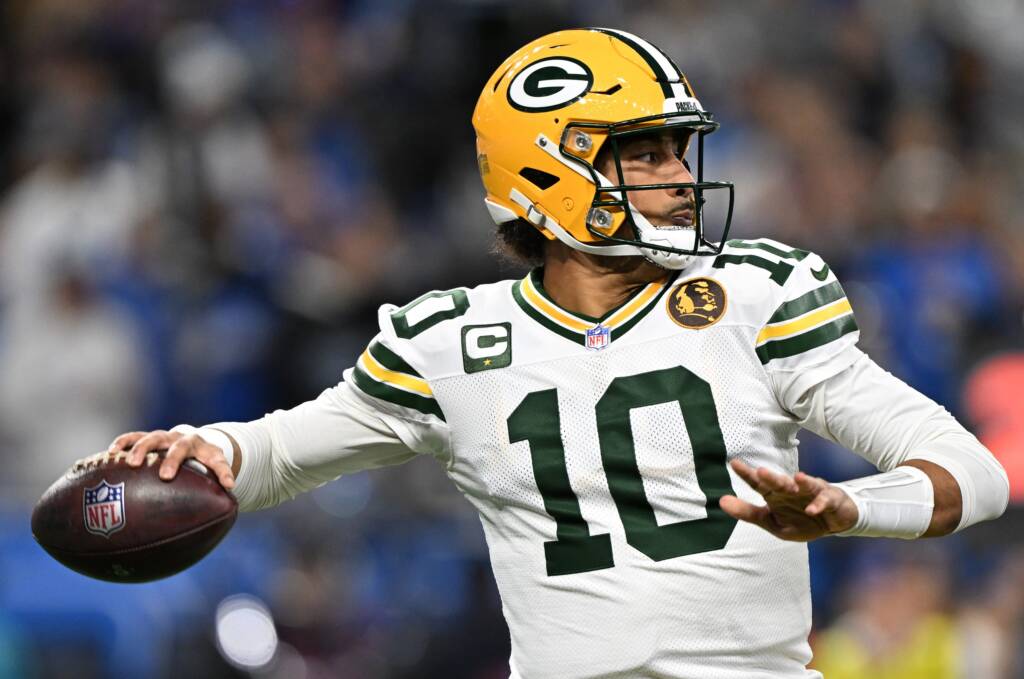

Almost every advanced metric suggests that Green Bay Packers’ QB Jordan Love is much closer to the top-five quarterback conversation than the top-10 one. However, compared to some of the league’s other elite passers, his passing volume still lags, and that needs to change.
Jordan Love finished last season ranked just 18th in pass attempts, while Matthew Stafford paced the league with 716 throws. If Love had been given that kind of workload and maintained the same level of efficiency, his season totals would have exploded to roughly 5,500 passing yards, 40 touchdowns, and only eight interceptions.
Interestingly, NFL data scientist Sam Hoppen of ESPN Bet shared a chart showing that Jordan Love was the NFL’s most efficient quarterback in expected passing situations through the first month of the season.
The volume simply does not match the level of play. Love ranked only 17th in pass attempts in 2024 despite being one of the league’s most efficient quarterbacks. Over the last two seasons, he ranks second in both EPA per play and adjusted EPA per play, sixth in air yards, and 10th in both success rate and completion percentage over expected. At worst, he has performed like a top-10 quarterback during that span, with several metrics placing him much closer to the elite tier.
One way to further contextualize that efficiency is through the EPA+CPOE composite at rbsdm.com, a metric that blends expected points added with completion percentage over expected to produce a single efficiency score. In 2025, Love ranked third in the NFL in that category, trailing only Drake Maye and Brock Purdy, and was one of just 14 quarterbacks league-wide to clear the .100 threshold.
However, the separation appears again in usage. Among quarterbacks who reached that same efficiency tier, Love ranked just eighth in pass attempts, averaging only 29.2 throws per game. By comparison, Patrick Mahomes, Dak Prescott, and Matthew Stafford were all consistently above 35 attempts per game.
What explains that outcome is Green Bay’s offensive approach, particularly its early-down philosophy. Last season, the Packers were among the league’s least aggressive teams on early downs through the air, consistently opting to call runs on first and second down more than 50% of the time.
That’s hard to justify for two main reasons. First, Green Bay’s run game wasn’t very efficient, ranking 18th in EPA per rush. Second, Love has already shown he can handle a larger passing workload while maintaining high efficiency.
In his first season as a starter, Love finished sixth in pass attempts. He ranked fifth in EPA per play and sixth in adjusted EPA per play, doing so with a new and still-developing group of pass catchers around him.
He’s a much more mature QB now, and giving him a larger share of the responsibility would likely elevate the entire offense by easing pressure on the run game rather than forcing it to carry so much of the early-down structure. Even so, Green Bay has continued to lean heavily on the run on early downs, even though the results haven’t consistently backed up that decision.
The Packers are paying him $55 million per year, so at some point the solution is simply to put the ball in his hands and let him run the offense. He should be the focal point of the unit, and with that level of investment and trust, he should be throwing more, not less. Because when Green Bay gives him that responsibility, the results are usually positive, and the offense tends to operate at a higher level.