
The Minnesota Timberwolves needed more three-point shooting, and that is what they got in Duke’s Isaiah Evans with the 33rd pick on Wednesday.
There is still fallout from Minnesota’s Julius Randle salary dump, and it will take some time to fully grasp its impact. However, the Timberwolves were still able to pick up what many thought was fringe first-round value with Evans despite trading back five selections.
Background
Isaiah Evans will turn 21 this December. He is a former RSCI (Recruiting Services Consensus Index) five-star prospect and was a part of Duke’s historic freshman class that featured Cooper Flagg, Khaman Maluach, Kon Knueppel, and Pat Ngongba II. Evans was also a McDonald’s All-American.
Evans has a thin frame. He weighed 186 lbs at this year’s combine and is wiry, similar to Bones Hyland. Still, he has good length, standing 6’6.75” in shoes and has a 6’8.75” wingspan.
Evans didn’t play much in his freshman season. He saw just 13.8 minutes per game and 3 starts over 36 games. It took him some time to make a consistent impact.
However, towards the middle of February and into early March, Evans showed flashes of brilliance. In ACC conference play, he averaged 17.3 points per game on 53.1% from three on 8 attempts per game over a four-game span.
After his freshman season, Evans tested the NBA waters. Ultimately, it was an easy decision for Evans to return to Duke and play alongside Cameron Boozer.
Evans lived up to expectations in his sophomore season. He started all 38 games, played 28.2 minutes per game, and boosted his points per game average from 6.8 to 15.0 while maintaining his role as a three-point threat.

Evans’s Strengths
Isaiah Evans’s three-point shooting versatility made him an enticing prospect. While playing under Jon Scheyer, Evans operated off pindown actions, design sets such as Spain PnR flares, and simple freelance handoffs or flare-outs to get three-point opportunities. One of my favorites was how they schemed Evans in as a screener.
Evans was able to serve as a ghost screener to flare off defenders or as a pick-and-pop option off Cameron Boozer.
Evans’ ability to get shots up on wonky angles, slightly off balance, and while on the move is his superpower. He’s not afraid to get shots up from three, and he did that at a historic rate. Among players drafted, Evans is one of five players to post 15 or more 3PA per 100 possessions. Ranking alongside current players such as Steph Curry, Trae Young, and Isaiah Joe.
Inside the arc, Evans tended to prefer to get to mid-range jumpers over rim finishes. Some of it was based on the action itself. Evans often came off pindowns and curled them, which is a smart screen read. Other times, Evans countered aggressive closeouts by taking a couple of creation dribbles to get to a jumper.
Even with the struggles and physical shortcomings, Evans shot 68.9% at the rim in his sophomore season. He can find success around the rim, but he will just need to pick his spots wisely. He already has some solid creation chops for his archetype.
There are good wrinkles within Evans’ IQ based on his three-point scoring acumen. When Duke was looking to run him off a handoff, he occasionally would reject it and go backdoor to get a pass from either Ngongba or Boozer.
The Timberwolves don’t have the big man passing talent that Duke had relative to their opponents, but they do have the screeners. It is very easy to see how Evans can fit into the floppy sets and pindowns Chris Finch has run for Malik Beasley and Donte DiVincenzo.
Areas For Improvement
The first clear development area for Isaiah Evans is to bulk up as much as he can comfortably. Evans can use his length to his advantage defensively without being a negative. However, if he doesn’t add more muscle, opponents will hunt him and push him around.
Evans showcased flashes off the ball as a quick decision-maker, but to be more dynamic at the NBA level, he will need to refine his attack on closeouts. Evans showed impressive flashes on-ball, whether it was attacking off the catch to get into a step-back, mid-range pull-up, or methodical drive. He just needs to be able to deal with the physicality of the NBA.
If teams are going to aggressively shut down Evans’ three-point threat, or even blitz him off of pindowns, he must become a better passer. The goal would be for Evans to be able to flow into two-man games, similar to how Donte DiVincenzo does for the Timberwolves. However, similar to DiVincenzo, the limited handle and wiggle will ultimately prevent Evans from finding early success.
Evans career AST rate at Duke was 7.8%. That just is not going to cut it.
Evans’ NBA Comp
Isaiah Joe is the best comparison for Isaiah Evans. Evans is 2.25 inches taller and 16 lbs. Heavier than Joe, according to his combine measurements. However, their rate-based college statistics and advanced numbers are similar.
- Joe and Evans were both three-point bombers, attempting over 15 three-pointers per 100 possessions and three-point attempt rates over 70%.
- Both players were averse to turning the ball over. Evans’ career turnover rate was 10.7%, while Joe’s was 11.8%. They both struggled to generate assists, but Joe had a slight advantage at 10.8% to Evans 7.8%.
- Neither player rebounded very well, with sub 10% defensive rebound rates.
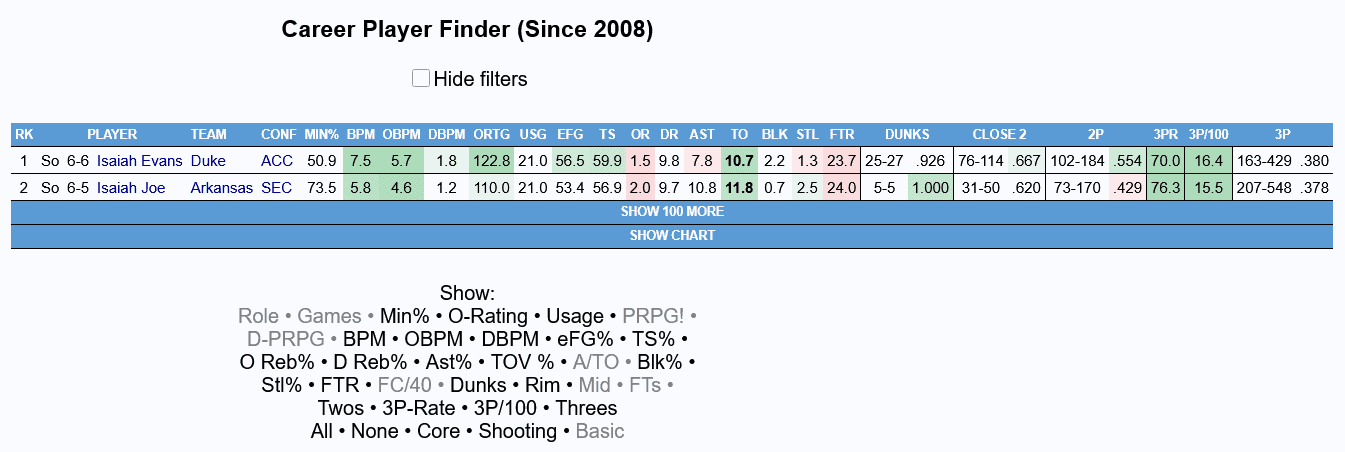
Despite playing 396 more minutes than Evans and attempting 105 more field goals, Joe struggled to get to the rim as often as Evans. Evans shot 66.7% at the rim on his 114 attempts, while Joe shot 62% on 50 attempts. He also had 25 dunks while Joe had 5.
Evans also had a significant lean-in block rate due to his longer wingspan.
The Verdict
The Timberwolves were able to manage their cap situation, create a lane for more when they salary dumped Randle to move to 33, and still add LaMelo Ball and a highly touted prospect with proven shooting. Evans isn’t perfect and still has to figure out a lot in his game beyond being a three-point threat.
Isaiah Evans still must develop into an NBA player, but his archetype is something the Timberwolves have desperately needed in their young core. Even if he’s going to have some struggles, and even with Chris Finch trusting veterans more than rookies, Evans should at least have the chance to prove himself in spot minutes this season.