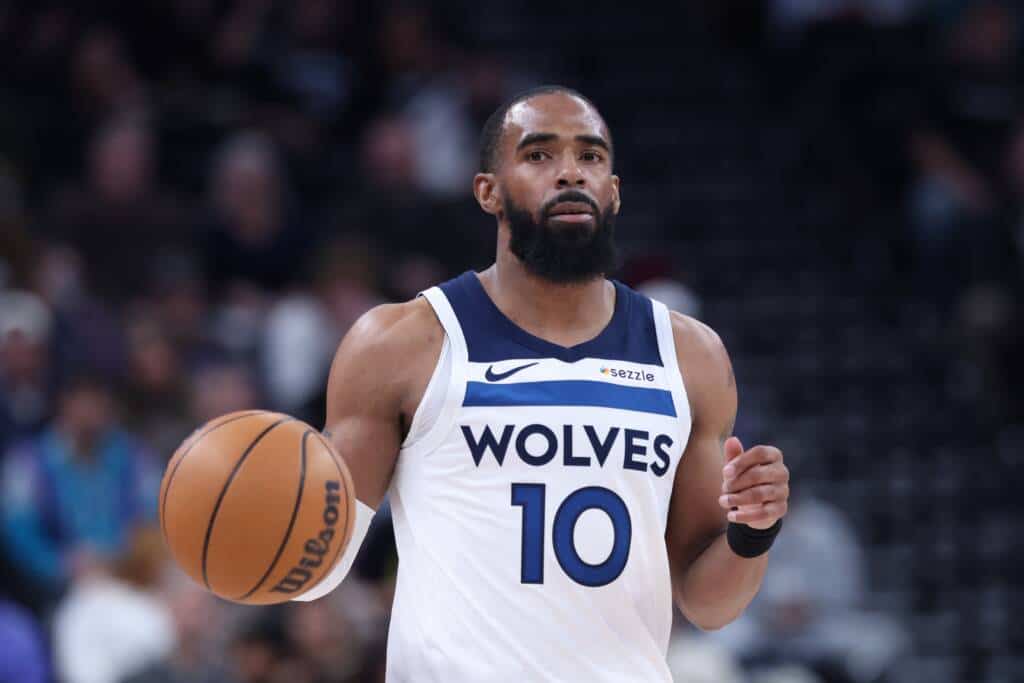

Mike Conley didn’t mince words at his exit interview when asked if the Minnesota Timberwolves could benefit from having a true point guard next to Anthony Edwards.
“I definitely do think it will help a lot,” he said. “Especially with Ant, maximizing the guys on this team, Jaden, somebody that can set them up without them having to work so hard to make the plays that they make.”
The 2025-26 season will be remembered for many reasons, some good and some bad, but a key decision made during the season was to adopt a point guard-by-committee approach. The decision offered the Wolves insight into Edwards’ ability to manage the point but also likely confirmed Conley’s exit-interview statement.
The Wolves need a point guard.
Point guard by committee
Rehashing the 2025-26 point guard season is difficult, to say the least. For large swaths of the season, forward Julius Randle was essentially the point guard, having most of the offense out of the post and relying on him to make the offensive decisions. Donte DiVincenzo was the point guard on the depth chart. However, other than bringing the ball up and occasionally running pick-and-rolls, he was effectively the point guard in name only.
That led to Edwards and Conley taking on most of the lead ball-handling role. For Conley, it was functional. However, at age 38, it was never feasible for him to play the role more than a dozen minutes a game. For Edwards, it was an experience that led to a lot of isolation play and plenty of turnovers. Edwards averaged just 3.7 assists per game and 2.9 turnovers during the season. He also finished the year with a 17.4 assist percentage, which finished ninth on the team.
Finding a point guard is a lot easier said than done, though. Gone are the days when every team had multiple true point guards. Decades ago, playing point guard meant involving the team, keeping the offense moving, and running the game. However, in the current NBA, point guards look different. They can score the ball in bunches and come in all shapes and sizes.
In a conversation earlier this season, Conley explained why basketball intelligence is so important to playing point guard.
It’s an understanding of the game that’s a little bit deeper than just playing really fast. It’s an understanding of feel, like Donte has made 2 in a row, let’s get him his third shot, or Ant hasn’t had a shot in 5 possessions, let’s get Ant a shot. Or how can I get him an easy bucket?
Or decision making. You got a 3-on-1 fast break, and you got one guy who’s cold, and you need him to get hot, and you got another guy who has made a couple, you go, ‘Hey let me try and get an easy one for the guy who hasn’t made a shot.’
If you have a high IQ, you can kind of see the play develop, you know what’s going to happen, and you can start talking your way in and out of situations.
That seems to be what the Wolves are missing. Maybe not a point guard in the traditional sense: a 6’2” floor general who runs the offense. Instead, more of an intelligent player who can move the offense and keep Minnesota’s moodiness at bay.
The Ayo Dosunmu Case
Dosunmu didn’t have long with the Wolves after being acquired at the deadline, appearing in just 24 regular-season games. During that time, he was asked to be the primary ball handler, often alongside Edwards when Randle was off the court, with mixed success. His 2.33 assist-to-turnover ratio would finish fifth on the team among the top ten rotation players.
He finished fifth on the team in terms of assist ratio when he was on the court, with 18.3% of his possessions ending in an assist. For reference, that is the same as Derrick White, and 0.4 higher than Jamal Murray.
While Dosunmu’s point guard game was unconventional, it’s hard to argue that it wasn’t effective. He consistently put pressure on the rim and hit an impressive 41.4% of his threes during his time in Minnesota. If the choice is to pair Dosunmu next to Edwards as the lead guard, it would be a bet that the decision-making side of his game improves with a full offseason with the team and a consistent role. Which Dosunmu is theoretically capable of doing.
When given more of a playmaking role, Dosunmu has proven to be a good decision-maker throughout his career. In 2024-25, he posted a career-best 3.01 assist-to-turnover ratio, with a 27.4% assist ratio. Considering his rookie season, 2.37 shows significant growth over his career. With another year in Finch’s system, if Dosunmu is the point guard of the future, the hope would have to be for a similar jump.
Other outside names will be floated all offseason, from Kyrie Irving on the high end to Tyus Jones, who costs less. But ultimately, it might be a good idea to see what Dosunmu can do with the point guard role.