
After years of futility, the Minnesota Timberwolves have consistently made longer playoff runs. The Wolves made back-to-back conference finals and have won five playoff series in the last three seasons. It has been a massive jump in success. Previously, their only other two series wins in franchise history came in the 2003-04 season.
We’re in the Golden Era of Timberwolves Basketball.
However, the Wolves consistently have had offensive shortcomings during their playoff runs. The most prevalent issue has been the team’s inability to generate consistent offense when opponents double-team Anthony Edwards.
The lack of offense haunted them in both of their conference finals losses to the Dallas Mavericks and the Oklahoma City Thunder, and it caught up to them against the San Antonio Spurs this season.
The core question raised by the issue is difficult. Is it a roster shortcoming? Is it the coaching staff’s fault? What about the individual players?
The answer is some combination of all three.
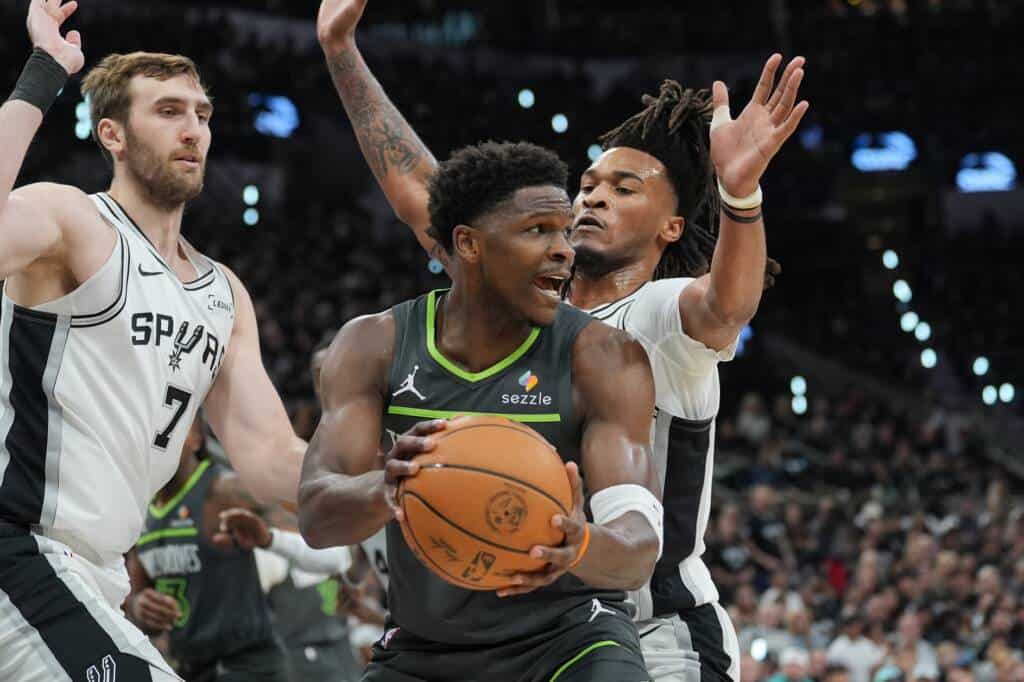
A core reason the Wolves struggle against opponents who double-team Anthony Edwards is that it forces others to make plays. Any way that opponents can force the “smart play” to be Edwards getting the ball out of his hands immediately as he sees pressure, the result is going to lean into the defense being at an advantage.
The Spurs put Edwards into this difficult situation again. He had to either play fast and try to create for himself, fully manipulating multiple defenders, or he had to synergize with others. The issue has been the lack of consistency in that possession battle.
Victor Wembanyama is a defensive scheme cheat code for the Spurs. His rim deterrence and rim protection prowess have allowed the rest of San Antonio’s defenders to play extremely aggressively on the ball within the gaps.
The coaching staff did a good job mixing in different actions to get Edwards off-ball, whether that was pindowns, using Edwards as a flare out on ghost screens, or using him on Chicago actions out of the corner to give him momentum. None of it has worked out consistently.
Some of Minnesota’s schematics have worked, but Edwards’ urgency has wavered. Edwards is occasionally tentative in the face of incoming pressure and can speed up his dribble to avoid it. Other times, Edwards is too slow and lackadaisical in bringing the ball up the court. Edwards has not had much help, but he still will not avoid criticism.
Minnesota has enough talent to maintain a consistent offense throughout the regular season. However, once the playoffs arrive and defensive coverages change, it becomes clear that the Timberwolves rely too heavily on minutes from Rudy Gobert and Julius Randle.
Chris Finch has used Naz Reid as the team’s skeleton key, staggering the minutes with Randle and Gobert. Still, when two of the team’s highest-paid veteran starters need to be separated when the games matter most, it highlights a significant issue.
The issue concerns the team’s overall shooting talent, offensive footprint, and the front court’s lingering shortcomings.
Gobert relies on others to set him up offensively. He has made strides as a short-roll playmaker and in handoffs. These two areas of growth have given Gobert a more consistent role beyond being a play finisher. It has allowed him to still be useful as a screener while still making the defense react, but there are limits to his offensive prowess.
Gobert has improved immensely in these two facets of his offense, but it still hasn’t been enough to generate a winning offense. When opponents have completely sold out on other Timberwolves players, forcing them to rely on Gobert rather than allowing him to complement specific coverages, the offense has suffered.
The Spurs have a game-changing advantage with Victor Wembanyama protecting the rim, which allowed San Antonio to completely sag off of Gobert’s handoff actions and guard the more prominent threats. It has only placed more stress on the Timberwolves players who are trying to gain the advantage in the first place.
On Gobert’s play-finishing and short-roll opportunities off-ball screens, the Spurs were also able to focus all of their attention on the most valuable threats, whether that is Edwards on the ball or other players on the perimeter.
Consequently, the Timberwolves found themselves in an insurmountable rut in their half-court flow. There are counters, but the Gobert paradox has again been a prominent factor. The Wolves needed Gobert on the court for his rim protection and defensive prowess within the roster build. Still, his offense is not good enough to overcome in the right matchups.
For Julius Randle, much of it has come down to his shot diet and processing speeds. Randle loves working in the short to mid-range and prefers a methodical approach to his touches.
However, due to Randle’s playstyle, he can sometimes be a tough player to scheme into the offense when opponents blitz Edwards. The Wolves are wasting Randle’s talents if he sits on the perimeter as a spot-up player.
The Wolves were able to put Randle in the center of the zone on occasion, but they haven’t fully utilized his skill set. Part of that falls on the coaching staff for not putting Randle in the right spots. However, some of it also falls on Randle for showing off-ball apathy and failing to move.
Minnesota doesn’t have the optimal roster to handle the increased pressure on Edwards. Rudy Gobert makes offense difficult the farther you get in the playoffs. Mike Conley has always been Edwards most reliable release valve. However, as Conley has aged, he doesn’t have as dynamic an impact on the team.
As the Timberwolves begin to clarify their roster plans, many questions remain about their frontcourt. Anthony Edwards has the clear ability to be the franchise’s No. 1 option as they build to their championship pedigree. The offense has just had far too many holes over the last three playoff runs.
It’s hard to decode what the Timberwolves and Tim Connelly’s plans are for the future this offseason. Something will need to change. It is just a matter of what moves they make.
The Timberwolves have done a great job of putting talent around Anthony Edwards. However, as their playoff runs have been disappointing, it’s clear the franchise could do a better job of optimizing Edwards’s offensive talent.