
Kyle Anderson wasn’t surprised by the Minnesota Timberwolves’ Game 1 win over the San Antonio Spurs on Monday. Anderson didn’t play, but from the bench, he saw a talented team playing at the high level they are capable of.
“The team we got here, we’re not a [49]-win team,” Anderson said during shootaround ahead of Game 2 on Wednesday. “We’re a lot better than that. Honestly speaking, we shouldn’t be a six seed. We should have a lot better record than that. These guys are always going to rise up and be ready to play in the playoffs.”
In the regular season, the Timberwolves rose above their 49-33 finish in the standings. Still, they finished sixth in the Western Conference because they couldn’t consistently maintain that high level of play.
Poor execution and inconsistent energy levels led to complete-game blunders in the regular season, leaving the Wolves bound to the sixth seed. Far too often, the Wolves played right into their opponents’ hands — doing all the things their opponents knew they couldn’t do. And that is exactly what led them to a 133-95 loss against San Antonio in Game 2.
“They just kicked our butt in every aspect of the game tonight,” Chris Finch said after their game. “Offensively, defensively, it didn’t matter. They took it to us, and we didn’t really respond very well.”
Finch offered similar statements in the regular season. But players reassured him and the coaching staff that things would be different in the playoffs. Once those high-stakes games roll around, Finch wouldn’t have to worry about his team acknowledging the moment and executing at a level high enough to have them competing for a championship.
That’s what they told him, at least. However, during Game 1 against the Denver Nuggets on April 18, the Wolves looked exactly like the flawed team they were in the regular season. Denver won 116-105, and Finch called his players liars.
Finch’s lecture activated Minnesota’s anticipated playoff mode, giving them the right to put asterisks next to their deflating regular-season losses. They outplayed the Nuggets over the next five games with an effort and execution level that crescendoed in Monday’s win over the Spurs.
But 48 hours after a victory that featured determined offense and execution under pressure, that performance — which the Wolves maintained consistently for roughly two weeks — flatlined lower than even a 49-win team’s level.
“I just told them we got punked,” Finch said.
Victor Wembanyama swatted 12 of Minnesota’s shots in Game 1. The Timberwolves thought at least four of them were goaltends. But they didn’t let any of that deter them from getting to the rim. The Wolves remained a force on offense, taking 35 shots at the rim and making 19.
But in Game 2, the Wolves took 19 shots at the rim and were tentative on offense from the jump, settling frequently for contested jumpshots.
“We’ve got to go somewhere,” Finch said regarding the offense. “We are kind of dribbling and going nowhere. We’ve got to be able to punch gaps and play downhill. That’s what we like to do. That’s when we are at our best.”
When the Timberwolves aren’t doing that, they tend to slide and play their worst basketball. When the Wolves aren’t purposeful on offense, they settle for jumpshots. When they miss, they create transition opportunities for the opponent. That’s where complete game blunders emerged in the regular season.
San Antonio scored 29 fastbreak points on Monday. Finch believes that when the Wolves give up too many transition buckets, it is due to offensive woes — missed shots, poor shot selection, and turnovers.
“Our offense has to help our defense in transition right now,” Finch said.
Jaden McDaniels, Minnesota’s best offensive and defensive player in the playoffs, picked up his third foul in the second quarter with the Spurs threatening to break the game open. Ayo Dosunmu, playing for the first time in nine days after dealing with a calf injury, was not asserting himself on offense. The Spurs were defending Julius Randle well with physicality and by sending double teams.
The Wolves needed Edwards to find a groove and start connecting on the momentum-shifting buckets. They needed him to build upon his 18-point performance in Game 1, where Edwards seemed to catch San Antonio off guard.
It didn’t seem like the Spurs expected Ant to look as healthy as he did in Game 1. They wanted to test his left knee, which kept him sidelined for nine days. San Antonio let Edwards operate in one-on-one situations, which he responded to by making 8 of 13 shots.
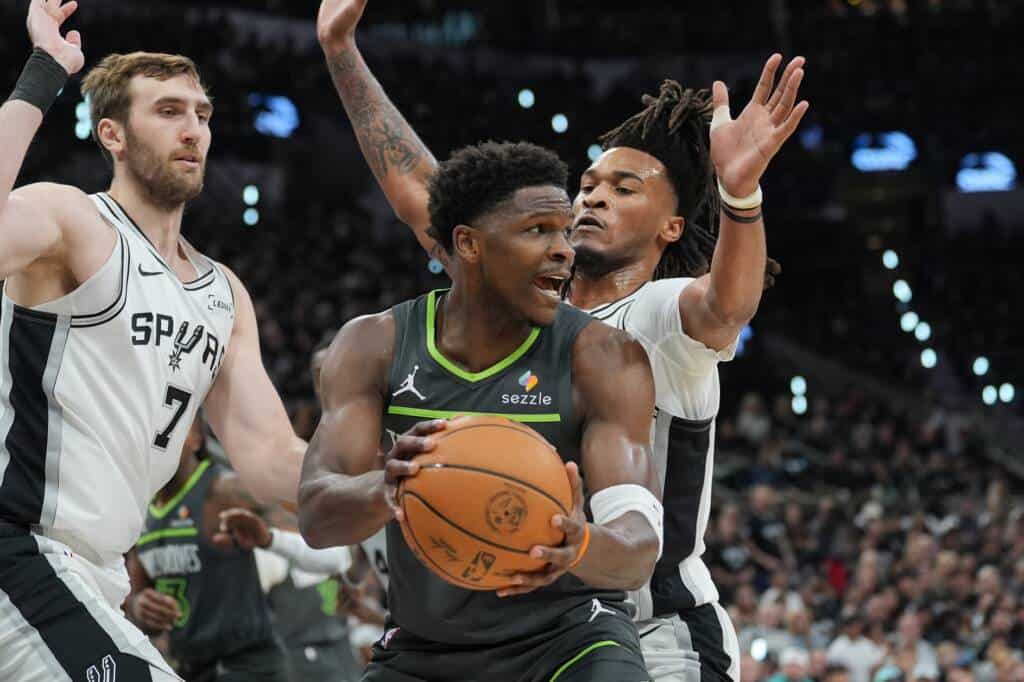
In Game 2, that changed. The Spurs realized Edwards as a fully healthy threat — doubling him as soon as he checked in and trapping him near the half-court line, which shelled up Edwards’ offense and caused Minnesota’s offense to start snowballing.
“You’ve got to get off of it,” Finch said. “You’ve got to use it as a catalyst for ball movement, which is what it should be. I thought we dribbled in tough spots. I thought we were late getting off of it. I thought our spacing around it wasn’t really good. And our decision-making when the ball came out of there wasn’t good either.”
At halftime, Edwards had 8 points on 3 of 10 shooting. No other Wolves player was in double figures, and they trailed by 24 points. Barring a miracle, the game was already going in the direction that Edwards knew it could have.
“The natural tendency for teams that steal the first away game, they get blown out in Game 2,” Edwards, who finished with 12 points on 5 of 13 shooting, said. “So we can’t come out cool. We came out cool, and what happened? We got blown out. My momma used to tell me, ‘A hard head makes a soft ass,’ and that’s what happened tonight.”
San Antonio took a 47-point lead in the second half. Game 2 had turned into one of those [italics] blowouts. One side couldn’t make a shot, the other couldn’t miss. Those games happen, and they don’t have to be the end of the world, even in the playoffs. But the Wolves set up that type of game by their own wrongdoing.
Not only were the Wolves tentative in their execution, but they also committed 22 turnovers and shot 52% from the free-throw line.
“We got beat in every way possible,” Randle, who finished with 12 points on 4 of 10 shooting, said with a smile. “It’s as simple as that. There’s not really much to say about this game. They outhustled us, outphysicaled us, outexecuted us, played better defensively [with] more energy. They just beat us in every way in this game. And we have got ot come back next game and be better.”
In the final minutes of Game 2, Edwards was smiling on the bench. Players were joking with each other because Anderson’s pregame comments were accurate. This team can reach a level far beyond their six-seeded finish. And they proved over the last two weeks that they can reach that level and sustain it in the playoffs.
Losing Game 2 on the road after stealing Game 1 isn’t that bad. But how the Wolves let it happen — despite their emotions on the bench late in the game — is. They gave their opponent far too much momentum than they should have.
Now, as the series shifts to Minneapolis, the Wolves must rediscover the team that rises beyond their regular-season finish.