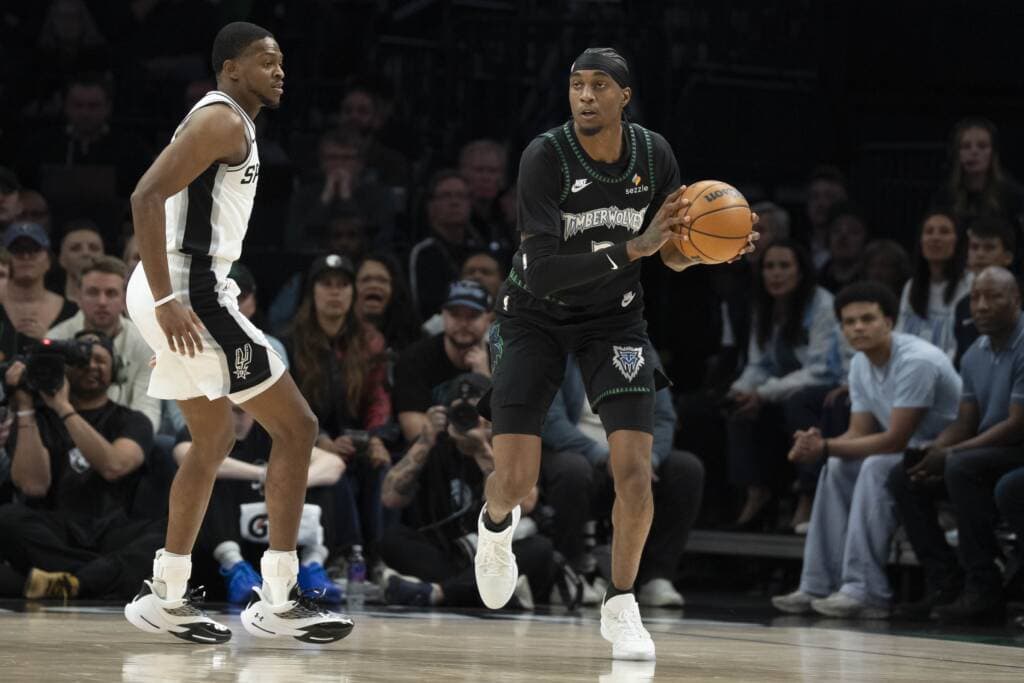

After the Minnesota Timberwolves traded Julius Randle and Naz Reid in the offseason, Jaden McDaniels is positioned to be one of the Wolves’ most important two-way players. The team will lean on his length, versatility, and growing offensive game more than ever. With Julius Randle and Naz Reid gone, Minnesota’s frontcourt and wing usage opens up, and McDaniels looks like he can absorb more responsibility without losing the defensive value that makes him special.
Jaden McDaniels fits best as a jumbo wing-forward who can defend across multiple positions, slash off the ball, and punish mistakes as a connector rather than a pure hub. That role becomes even more valuable now because the Wolves need someone who can handle tougher defensive matchups while also helping replace some of the scoring and movement that Randle and Reid previously provided.
His usage will likely look like more touches, more possessions as a secondary option, and more chances to attack closeouts rather than stand in the corner. McDaniels is not the kind of player Minnesota should ask to become a full-time offensive engine, but he has room to grow into a much larger supporting role. He’s most valuable when he plays within the flow of the offense, cuts hard, finishes in transition, and takes advantage of the pressure Anthony Edwards creates.
Physically, McDaniels is a rare problem for opponents because he combines height, length, and agility. He’s listed at 6’9”, with a long wingspan, which gives him the size to bother forwards and the mobility to stay with smaller players on the perimeter.
That kind of frame is exactly why McDaniels has become such a useful defensive weapon for Minnesota. What stands out most is how fluid he moves for someone that tall. He can slide laterally, recover quickly, and challenge shots without needing to gamble. McDaniels also has enough bounce to finish above the rim in space. He is wiry rather than bulky, but he plays with more force than his build suggests, which helps him on drives, cuts, and contested finishes.
On offense, McDaniels is at his best when his athletic traits are paired with simple decision-making. He can cut, run the floor, attack a hard closeout, and hit open threes when defenses overlap on Edwards. His development as a shot creator adds another layer to Minnesota’s offense. However, his efficiency will depend on staying in a role that maximizes his instincts rather than forcing him into too much isolation.
That’s the biggest question now: Can McDaniels translate increased opportunity into steady production without sacrificing the things that already make him valuable? The answer probably lies in balance. Minnesota doesn’t need him to become a star scorer overnight; it needs him to become a more complete, more assertive version of himself.
McDaniels’ skill set is tailor-made for a team that wants size, switchability, and defensive bite around its stars. If he takes a step forward, the Wolves can survive the losses of Randle and Reid with greater lineup flexibility and more defensive pressure on the other end. However, if he stalls, Minnesota may have to lean too heavily on Edwards for creation and on role players for spacing.
Jaden McDaniels is the bridge between Minnesota’s current identity and whatever comes next. His physical tools make him unique, but his real value will come from how effectively he turns those tools into steady two-way impact.