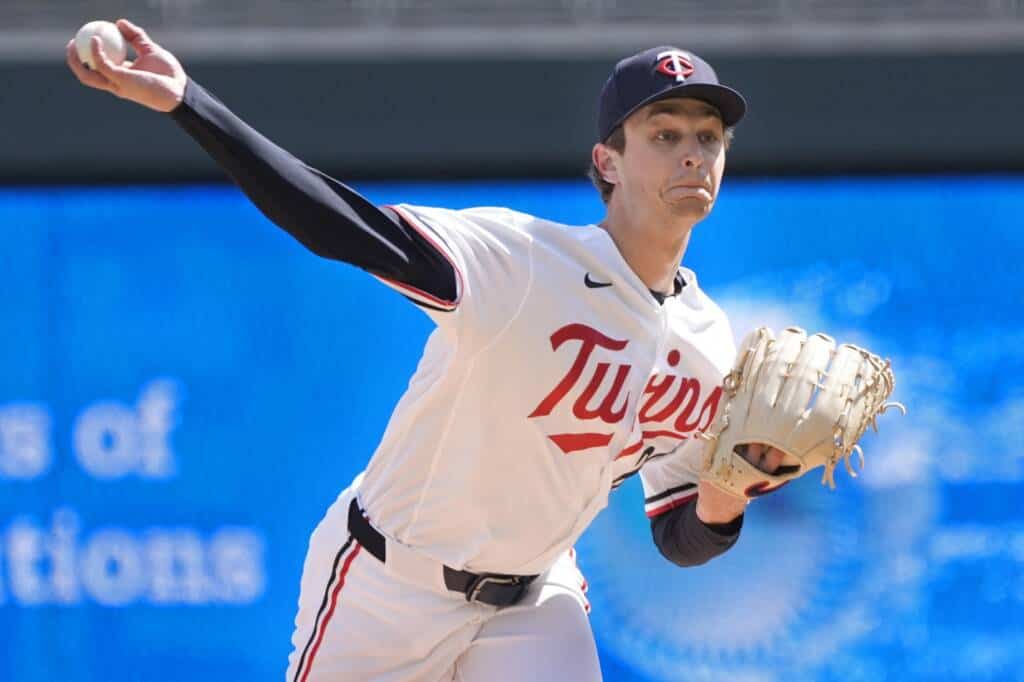

Chris Paddack is a gregarious man, and he offered some insight into life as a Minnesota Twins player after they traded him to the Detroit Tigers.
“My life got twisted upside down in a matter of 24 hours,” Paddack said. “I’ve been traded before, but never at the deadline. It’s going to take some time getting used to. Everybody has been awesome so far. These facilities here, all the coaching staff, nutritionists, the kitchen – it’s amazing what they have compared to what we had over at the Twins.”
Rarely has someone landed in Detroit and said things are better there.
Target Field cost $555 million to construct, and Hennepin County paid $350 million of that bill. The Twins have since paid for improvements to the ballpark, and it remains a state-of-the-art facility.
Still, how does Detroit have a better kitchen?
It’s a microcosm of what plagues the Twins. They have a mansion, but won’t hire a plumber when the sink backs up. They ask you to draw the curtains on a nice summer day to save on the HVAC bill. Don’t even think about walking out onto the deck to fire up the grill. One of those planks will snap, and you’ll end up splayed out in the backyard.
Eventually, the Twins will have new ownership. The Pohlads say they will sell. They want $1.7 billion, and the Tampa Bay Rays sold for $1.7 billion. Someone will eventually stop squabbling over paying off the team’s debt and buy it because it’s a baseball team. It’ll be worth significantly more in five years, let alone ten, so long as they support it.
The Twins are a vestige of a time when parsimonious ownership failed to spend in Minnesota. The Wilfs didn’t blink when it was time to pay Justin Jefferson and T.J. Hockenson. Marc Lore and Alex Rodriguez immediately extended Naz Reid and Julius Randle after taking over for Glen Taylor. The NHL punished Craig Leipold for spending too much on Zach Parise and Ryan Suter, and he’s pledged to pay Kirill Kaprizov.
Here’s how Mark Wilf, president and co-owner of the Vikings, describes how his family views Minnesota’s NFL team.
“Of course, it’s a roller coaster, the wins, the losses, but it brings the community together,” he said at a recent press conference. “It is something people care deeply about, and as owners, like I’ve always said, for my brother Zygi, myself, our entire family, we view ourselves as stewards of a tremendous community asset.
“We know how much people care about the Minnesota Vikings, and we’re working hard day in and day out, and I assure everybody that we’re working day in and day out to bring us those Super Bowl trophies.”
Conversely, here is Joe Pohlad, the Twins’ Executive Vice President, Brand Strategy and Growth, on WCCO radio after Minnesota won a playoff series for the first time since 2002.
“In today’s game, you can see there are a number of different ways to win,” he said after slashing payroll by over $30 million after winning in the playoffs. “You see that both with the Tampa Bay Rays and with the Baltimore Orioles having lower payrolls, turning out very successful products on the field, but also investing in other areas of the business. That is something that we are doing.
“Without question, the television situation is having an impact on our business, but beyond that, we’re just trying to right-size our business. That goes into it as well.”
The TV situation he mentions here refers to the decline of the cable bundle, which led to a dispute with Bally Sports and resulted in a blackout during the middle of last season. Professional sports teams generate most of their revenue from season ticket sales and television rights.
Now the Twins are selling individual subscriptions to watch games. Slashing payroll after a playoff win doesn’t help season-ticket sales, and it’s hard to sell TV subscriptions for a losing team.
Pohlad mentioned Tampa and Baltimore as models.
The Rays are in a market with many displaced fans, given how many Midwesterners and people from the East Coast retire in Florida. They also don’t have a stadium. Tampa is a sub-.500 team that missed the postseason last year and hasn’t won a playoff game since 2021.
Meanwhile, the Orioles have won 46% of their games this year. They last won a playoff game in 2014.
Derek Falvey dismantled much of the core he built since the Twins hired him in 2016 at this year’s deadline. They’re paying Carlos Correa $33 million to return to Houston and cleared $71 million off the books from now until 2028.
Trading Jhoan Duran and Brock Stewart is one thing. Duran’s velocity is declining, and Stewart has an injury history. Willi Castro’s versatility and Harrison Bader’s defense had value to many buying teams. But offloading Correa for a 26-year-old with a 6-plus ERA in High-A? Trading away Griffin Jax and North St. Paul’s Louis Varland?
That means the entire house is coming down.
“As we entered this deadline,” Falvey said in a press conference, summarizing Minnesota’s trade deadline moves, “[our goal] is to try and figure out if we could find ways to do deals that we thought were in the best interests of the long-term build of this team.”
The issue is that Falvey is burning major-league talent to make a sunrise he may never see. Prominent ball-knowers are openly speculating about whether a new ownership group would retain him after the Twins miss the playoffs for the fourth time in five years.
Many fans would be happy to see the Twins part ways with Falvey and Rocco Baldelli. However, it would be hard for any GM and manager to succeed after ownership slashes payroll following a playoff victory. Depth was the primary difference between the 2022 and 2023 teams, and GMs need payroll to cover depth, let alone retain superstars. The last two years have been a period of institutional failure.
The new owners are likely to do a teardown, even though the Twins’ mansion was a good property. Had the old owners taken care of it, it might have become something magnificent. They were developing pitchers, and many of the team’s top prospects were breaking into the league.
Adding a $15 million starter and enough depth that they weren’t asking Jonah Bride and Joey Wentz to come off the waiver wire and produce would have gone a long way to sustaining success. Instead, ownership cut payroll, and the team lapsed.
We don’t know if someone will eventually buy the Twins, or if they’ll take care of them after making the purchase. It’s not our house, we just share dreams with its ghosts. The potential contraction in 2001, trading Johan Santana, and failing to build a team around Joe Mauer.
All we ask is that if you buy a $1.7 billion estate, hire a plumber when the sink backs up.