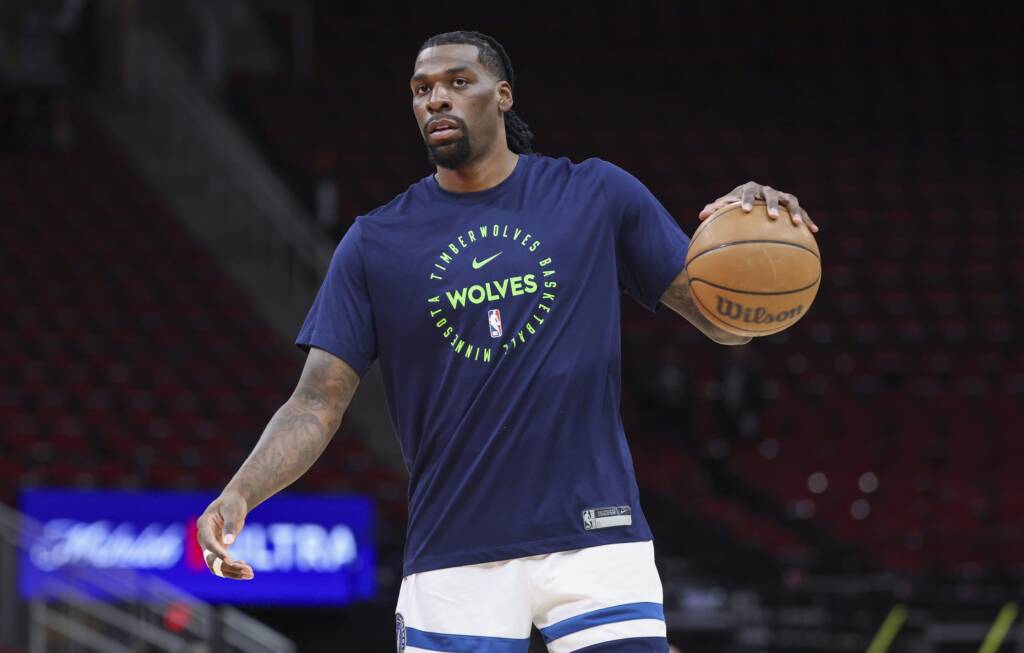

Naz Reid has always defied expectations.
From his roots as a five-star high-school prospect to his time at LSU and going undrafted, Reid has had to battle to make it in the league. Reid has only been in the NBA for six seasons but has seen a lot. He has built off his first couple of seasons on a rebuilding Minnesota Timberwolves roster to become a crucial part of a winning roster.
Reid has been in a lot of high-pressure, fight-or-flight scenarios.
His latest is becoming Minnesota’s second offensive option. He has filled multiple roles, with Julius Randle missing 11 games and Rudy Gobert four due to injuries.
Over the last three seasons, Reid has blossomed into one of Minnesota’s most dynamic offensive players. He has found the balance between his mesmerizing on-ball skill and maintaining winning team basketball.
Reid constantly adjusts to his circumstances. Transforming from one of Minnesota’s end-of-rotation prospects to the franchise’s longest-tenured player and someone to hold the utmost trust in.
Despite the fluidity of his role, Reid has learned to become unfazed by change.
“I mean, I’m still in with the same group of guys,” Reid said regarding his first start of the season against the Washington Wizards on Feb. 1. “I play extended minutes, [so] I kinda play with everybody. So, starting the game 0-0, opposed to (subbing in when) whatever the score is, from that aspect, other than that, nah.”
Reid’s offensive play style and malleability give Chris Finch a lot of lineup freedom. Reid is currently part of 10 different 5-man lineup combinations that have played 50-plus minutes this season. Only two other players in the NBA qualify for those parameters. Bam Adebayo and Anthony Edwards.
Reid is comfortable playing alongside Gobert, Randle, and Luka Garza. However, he can also slide up to the 5 and give the Timberwolves a completely different identity.
Reid’s skillset and production have come a long way in his six years in the league, but he is far from a perfect player. His 6’9” frame and defensive inefficiencies can be troublesome as a big. However, if Finch places Reid in the correct lineups, depending on the opponents’ personnel, he can weaponize Reid and always find ways to set him up for success regardless of the matchup.
After a slower start to begin the season, Reid began to find his groove in the new year. He averaged 16.4 points and 5.4 rebounds on 53.5/56/73.3 shooting splits in 26.8 minutes per game in January.
Therefore, when Randle injured his groin on Jan. 30 against the Utah Jazz, it was easy to forecast Reid’s implementation into the starting lineup. His 3-point gravity positively affects Edwards, giving him more space to operate downhill. Additionally, entering February, Reid and Gobert had a plus-4.1 net rating as a two-man lineup combination in their 591 minutes played together.
Still, making rotational changes is often easier said than done. Swapping around players into different roles changes the entire roster’s DNA. Therefore, Reid was going to garner more responsibilities. Spot starters are likelier to close games, consistently play 30-plus minutes, and be relied upon to bring efficient scoring every game while down one of their key scorers. Without Randle for the time being, Reid could no longer sink into the background on a cold shooting night.
However, Reid has delivered in 11 games without Randle. He’s averaging 20.3 points, 9.1 rebounds, 3.3 assists, and 1.5 blocks per game and holding 45.1/34.5/90.6 shooting splits, a 56.9% true shooting percentage, with 2.7 3-pointers made per game. Reid has 22 or more points in eight of those 11 games played.
It has been an important sample size for the Timberwolves to work with as they assess their future, with Randle’s return on the horizon. The Wolves have reportedly cleared him for full-contact, 5-on-5 basketball practice activities. They anticipate he will return during Minnesota’s four-game road trip.
The Wolves need Randle’s scoring punch and creation for the stretch run. However, much of this 11-game sample will influence Minnesota’s decision-making in the off-season. Minnesota created more flexibility when they traded Karl-Anthony Towns for Randle and Donte DiVincenzo, but it only delayed significant future decisions.
Randle and Reid hold player options this offseason. Reid will decline his because he will earn more than his $15 million cap hit. Randle’s player option is more complicated. His $30 million cap hit creates an interesting decision for the Timberwolves. They have seen their hand with Reid and Randle and would be foolish to let Reid leave in free agency. However, it remains to be seen whether Randle will pick up his player option by the June 30 deadline.
Aside from the financial implications, Reid has proven to the Timberwolves that he can play a more prominent role. Building around him as one of the team’s best scoring options would be difficult to burden. However, his adaptability as an offensive weapon gives the Timberwolves many more options for success than Randle’s more straightforward style of play.


