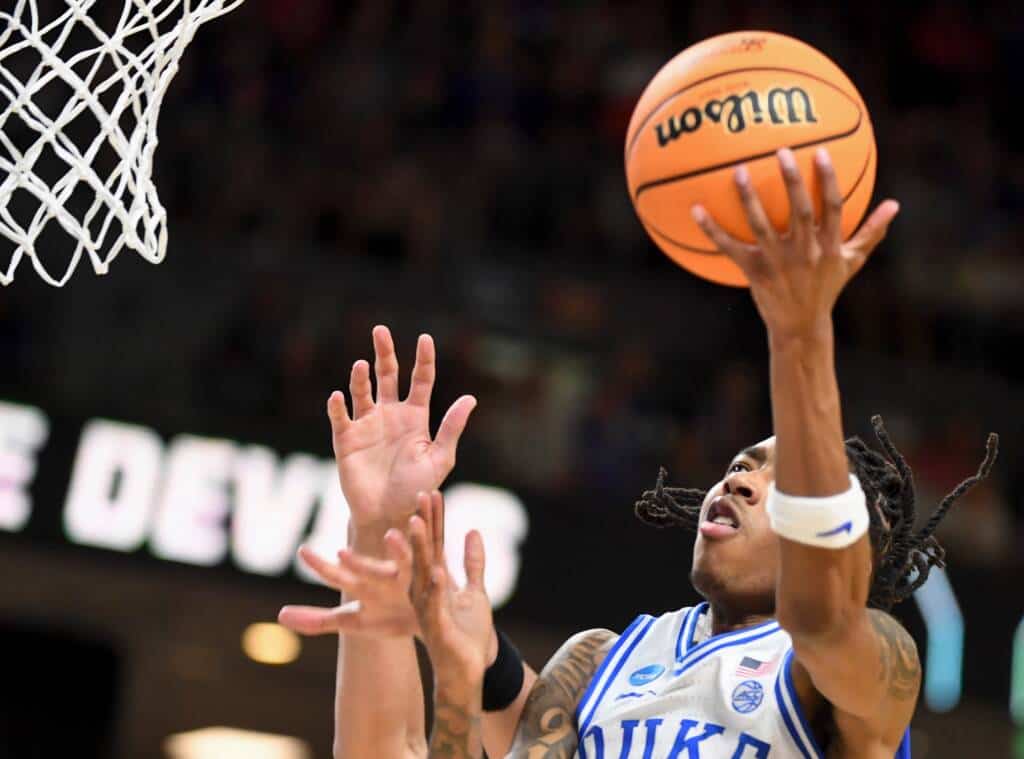
It looked as if Terrence Shannon Jr. was following in the footsteps of previous young players who departed from the Minnesota Timberwolves with talented offense but not enough defensive prowess to earn consistent minutes in Chris Finch’s rotation.
Josh Minott, Luka Garza, and Leonard Miller showed flashes of enticing offensive ability in the G-League and the NBA, but they had defensive shortcomings. Minott and Garza signed with the Boston Celtics last offseason. Meanwhile, the Wolves traded Leonard Miller to the Chicago Bulls at this year’s deadline.
Just over one month ago, Shannon was bound for a similar fate. Even with all his flashy dunks and breakneck sprints in transition, Finch was growing increasingly frustrated with the 25-year-old’s defense. But late in the season, Shannon’s importance to the Wolves changed almost as quickly as he changed ends of the court.
Finch has a notably quick hook with young players. It’s hard for them to get minutes, and when they do, it’s even harder to stay on the court for long stints. Still, Finch isn’t concerned when a young player misses a string of shots.
If they are quality looks, Finch will likely live with the misses and keep that player on the floor. But if that player deviates from the defensive game plan, gets backcut off the ball, or gets blown by on the perimeter, Finch — a more traditional, hard-nosed coach — is far less patient.
In the first round this year against the Denver Nuggets, Finch was out of solutions for Shannon’s defense, short of pulling him off the court entirely.
“I don’t clean it up, he cleans it up,” Finch told the media after Minnesota’s 125-113 Game 5 loss in Denver. “It starts with [you’ve] got to be ready, he’s got to be engaged, he’s got to be fully committed to that side of the ball.
“The only way I can clean him up is by sitting him on the bench, right? That’s the only way I can clean it up. He knows what we need from him right now, so he’s got to be ready, and he’s got to be ready to execute defensively.”
Shannon scored 15 points on 6 of 10 shooting off the bench against Denver in Game 5. He also shot 2 of 4 from deep. Still, the former first-round pick played the second-fewest minutes in Finch’s rotation that night because he made repeated defensive game plan mistakes.
But two days later, in Game 6, Shannon had a unique opportunity to show his value to the team by responding effectively to Finch. He had a rare opportunity in a close-out playoff game. One that Minott, Garza, and Miller — logjammed behind Minnesota’s front court depth — rarely ever got in a regular-season game, let alone in the postseason.
Finch started Shannon in Game 6 and played him 34 minutes because the Wolves were missing Anthony Edwards (left knee), Donte DiVincenzo (right Achilles), Ayo Dosunmu (right calf), and Kyle Anderson (illness).
Shannon scored 24 points on 9 of 20 from the floor and 1 of 7 from deep. He wasn’t a glaring defensive liability; the Wolves won 110-98, and Shannon started looking like a vital part of the team.
He proved that the Wolves need him on the court, which held true into the second round against the San Antonio Spurs. Shannon started two games, averaged 10.7 points in 24.5 minutes, and showed meaningful defensive improvement. Shannon reestablished himself as a key member of Minnesota’s young core and a valuable contributor in the present as the Wolves look for ways to improve their roster this summer.
Finch told Paul Allen on KFAN last week that the Wolves “definitely need another ball handler and playmaker” entering next season.
Finch elected to start Donte DiVincenzo over Mike Conley this year, which naturally shifted Edwards to more of a point guard role. As a result of that transition, Finch believes Edwards learned lessons that will pay off in the future. But in the present, the Wolves know they put too much pressure on Edwards to be a point guard, which hindered them against San Antonio’s blitzing pressure against Edwards in the second round. That defense forced the ball out of Edwards’ hands frequently at the half-court line and severely limited Minnesota’s offense.
“There is no doubt we need somebody to kind of help him,” Finch said. “[We] just put too much on his plate.”
Downsizing Edwards’ on-ball responsibilities will likely come from either a trade or a free-agent signing. Finch expects President of Basketball Operations Tim Connelly and his staff to be active in the trade market.
But even if the Wolves acquire a starting-level point guard — even someone like Kyrie Irving, Ja Morant, or Dejounte Murray — pairing Shannon in an on-ball role next to Edwards is still a lever Finch can (and should) pull this season. The Wolves will be without DiVincenzo for most of the year, and Conley, who is an unrestricted free agent but wants to play another season, shouldn’t be in the rotation if he returns.
Minnesota will need all of the primary ball-handling help it can get.
Shannon, within his 6’6” frame, is most comfortable operating with the ball in his hands, especially as the primary ball handler who brings it up the court. His first-step speed and twitchy crossovers allow him to break point-of-attack defense and get to the rim, which he did frequently in this year’s playoffs.
That is a dynamic alongside Edwards that the Wolves desperately need to apply pressure on opposing defenses and discourage them from blitzing him. But this season, Shannon frequently spaced off the ball from the corners, which prevented him from finding a rhythm. Finch recognized that as his mistake.
“I think we finally found the best deployment of him,” Finch told KFAN. “He’s one of these guys who needs the ball in his hands more. … And I think he can play well alongside Anthony as the primary ball handler.”
The downhill threat that Shannon poses, when it is paired with Edwards spacing one pass away, could open up more catch-and-shoot threes for Minnesota’s five-time All-Star. The Wolves want to generate as much “easy” offense as possible for Edwards, and allowing Shannon to serve as the acting point guard alongside him could make that happen.
Switching Shannon from an off-ball player to an on-ball threat, who’s always charged up to get downhill, could unlock a needed partnership between him and Edwards.
But for that to happen, Shannon must continue to develop as a passer, so when he acts as the primary ball handler and draws multiple defenders, he makes the right passes to open three-point shooters. He must also consistently defend, as he did against the Spurs, with intelligence, quick feet, and aggression.
One month ago, it was unclear if Shannon was capable of doing that. And I was unsure about his future in Minnesota because of it. But much like his coast-to-coast opportunities, which happen in the blink of an eye — where he flips a turnover into an and-one — Shannon flipped from a one-sided young player into someone who will likely play a big part in the improvement of Minnesota’s offense next season.