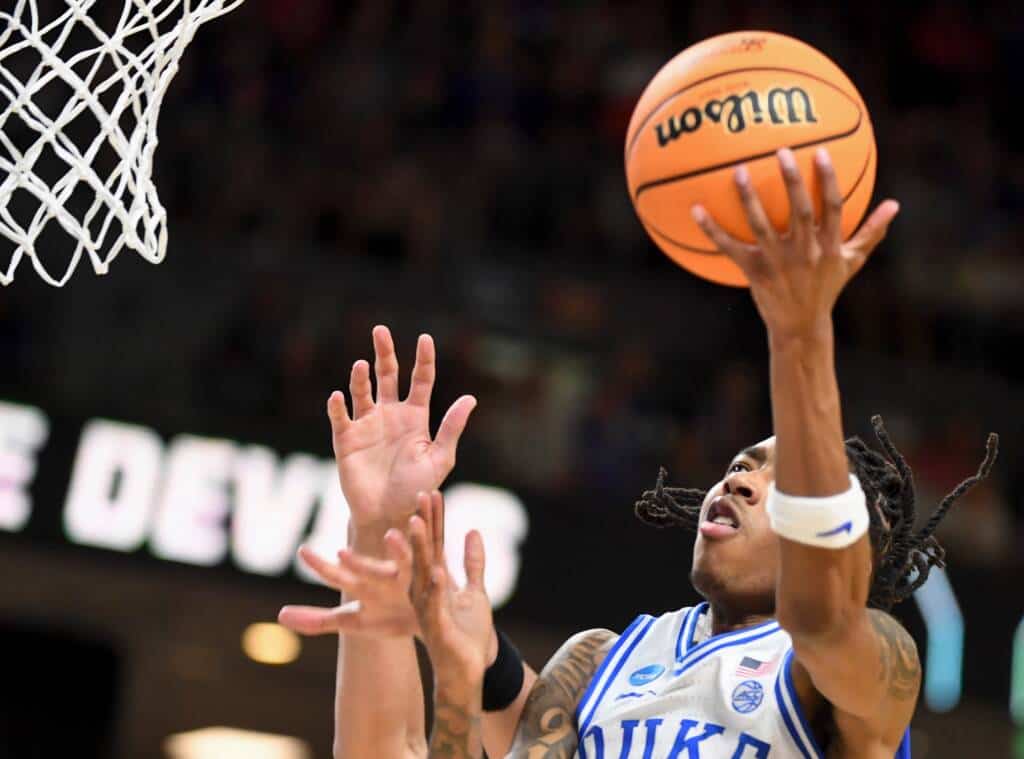
Tim Connelly believes the Minnesota Timberwolves did more good than bad this season. Through all of the ups and downs — the immaturity, the losing streaks, the winning streaks, the injuries, the loud wins, the equally as loud losses — he saw many individual successes from the roster he assembled.
But collectively, those successes didn’t add up to a championship. So, Minnesota’s President of Basketball Operations faces difficult decisions this summer. He may pull the trigger on another splashy trade, but doing so may require him to part ways with players who fit this team long-term. Anything is on the table.
But right now, the only noise buzzing around social media is false aggregations, rumors, and clickbait.
The Finals begin Wednesday. Once they are over, there will be more transactions. So while we wait, I have filled out my 2025-26 Wolves report card, individually breaking down a successful team that once again proved not good enough to make the Finals.
Anthony Edwards: B+
- Regular season stats: 28.8 PTS | 5.0 REB | 3.7 AST | 2.9 TOV | 48.9% FG | 39.9% 3P | 55.4% 2P | 79.6% FT | 35.0 MIN | 61 of 82 GP
- Playoff stats: 21.6 PTS | 5.7 REB | 2.7 AST | 2.5 TOV | 42.8% FG | 31.7% 3P | 48.7% 2P | 82.4% FT | 32.4 MIN | 10 of 12 GP
While acting as Minnesota’s point guard, Edwards turned in statistically the best season of his career. But he played only 61 games, which made him ineligible for postseason awards such as All-NBA or MVP voting.
Edwards was more consistently elite on offense this season than in past years. He further limited the total number of power-outage games, which was an emphasis I had for him as he entered the year. However, Edwards’ assist numbers were down from the 4.5 he averaged last season. He needs to improve as a passer, figuring out ways to empower his teammates and break free of double teams and half-court blitzes. The Wolves also need to figure out better ways to enable him as an on-ball creator with schematics, lineups, and roster construction.
I would also like to see Edwards become a more focused off-ball defender — mitigating instances where he ball-watches as the player he is defending cuts for an open layup or an offensive rebound. He’s struggled with that his entire career.
Edwards is the leader of this team. He possesses the talent necessary to be an MVP. But that responsibility and those expectations merit a harder grading curve.
Julius Randle: C-
- Regular season stats: 21.1 PTS | 6.7 REB | 5.0 AST | 2.7 TOV | 48.1% FG | 31.5% 3P | 54.7% 2P | 80.2% FT | 33.0 MIN | 79 GP
- Playoff stats: 16.0 PTS | 7.5 REB | 2.8 AST | 2.8 TOV | 39% FG | 24.4% 3P | 43.5% 2P | 73.8% FT | 33.3 MIN | 12 GP
At the All-Star break, Randle felt slighted because he believed he should have been an All-Star. And he had a legitimate case. Through the first 56 games of the season, Randle averaged 22.3 points, 7 rebounds, and 5.4 assists on 49.2% from the floor. He was playing like the player he was to close last season, the player that rightfully earned a $100 million payday.
But after the All-Star break, Randle’s play ticked down below that All-Star level as the games became more important. Then, Randle’s play dropped off substantially in the second round against the San Antonio Spurs. He only completed nine total assists and committed 18 turnovers while shooting 34% from the floor.
Randle also struggled against the Oklahoma City Thunder in the Western Conference Finals last season. But the Timberwolves still decided to extend him. One poor series or matchup shouldn’t detract entirely from the body of work a player put in over an entire season. However, this year, Randle’s isolation-heavy playstyle, with no three-point shooting and inconsistent defense, has put a ceiling on how far this Wolves team can go.
Jaden McDaniels: A-
- Regular season stats: 14.8 PTS | 4.2 REB | 2.7 AST | 1.8 TOV | 51.5% FG | 41.2% 3P | 56.2% 2P | 83.5% FT | 31.7 MIN | 73 GP
- Playoff stats: 16.3 PTS | 5.8 REB | 2.4 AST | 1.4 TOV | 44.3% FG | 23.8% 3P | 50.7% 2P | 85.7% FT | 33.8 MIN | 12 GP
McDaniels averaged only one more shot attempt than last season but still increased his scoring average by over two points, blossoming into a dependable third option as an efficient scorer. Sometimes, he was unbelievably efficient. McDaniels doesn’t need more than 11 shot attempts to score 20 points, making him a great partner next to Edwards, who will typically hoist the bulk of Minnesota’s shots.
The 6’10” forward became more of an offensive fixture — both by scoring and with improved passing — while maintaining the energy required to defend the opposing team’s best perimeter player every night.
As McDaniels continues to develop, he must keep improving at defending without fouling in key moments and during crucial games. In the regular season, he averaged the third-highest fouls per game (3.3) of his career, and in the playoffs committed the most fouls in the NBA through the first two rounds (53). McDaniels is essential to Minnesota’s championship hopes, and they need him out on the court as much as possible.
Rudy Gobert: B+
- Regular season stats: 10.9 PTS | 11.5 REB | 1.6 BLK | 1.4 TOV | 68.2% FG (league best) | 00.00% 3P | 68.9% 2P (league best) | 52.6% FT | 31.3 MIN | 76 GP
- Playoff stats: 7.2 PTS | 9.3 REB | 1.1 BLK | 1.3 TOV | 49.3% FG | 00.00% 3P | 50.7% 2P | 47.4% FT | 31 MIN | 12 GP
The Timberwolves finished the regular season with the tenth-ranked defensive rating, which Finch said was unacceptable because they want to be a defensively oriented team. This season, Minnesota’s defense was far too inconsistent to meet that goal. However, that isn’t an indictment of Gobert. Instead, the Wolves’ shortcomings on defense reflected their collective and repeated struggles to defend at the point of attack.
With Gobert on the court this season, opponents shot 44.6% from the floor, and Minnesota registered an 110.9 defensive rating, which is 2.2 points better than its tenth-ranked season average. With Gobert off the court, opponents shot 48.6%, and Minnesota posted a 119.7 defensive rating, which would have ranked fourth-worst in the league.
In the first round against Denver, Gobert held Nikola Jokić to 42.1% shooting against him in a herculean defensive effort. Gobert earned his eighth All-Defensive First Team nomination this season, tied for the second most in NBA history.
Offensively, Gobert’s scoring was down from last season. But much of that was because Minnesota’s passing to him was inconsistent. McDaniels built a reliable connection with Gobert. But outside of him, the Wolves once again struggled to keep Gobert engaged. He also shot the second-lowest free-throw percentage of his career.
Ideally, you would like to see Gobert — who dominates favorable matchups — be forceful against big, strong teams. But that has never been who Gobert is since he joined the Wolves, and they can’t expect him to change at this stage of his career. He has also never been a floor spacer, and that clogs scoring lanes for Edwards. Perhaps Minnesota trades him because of that. Still, he’s essential to the defense, so the Wolves would have to replace his rim protection and rebounding in the short term.
Donte DiVincenzo: A
- Regular season stats: 12.2 PTS | 4.1 REB | 3.8 AST | 1.4 TOV | 40.6% FG | 37.9% 3P | 49.7% 2P | 74.3% FT | 30.4 MIN | 82 GP
- Playoff stats: 10.8 PTS | 3.8 REB | 4.0 AST | 1.0 T/O | 50% FG | 47.8% 3P | 55.6% 2P | 24.0 MIN | 4 GP
DiVincenzo was the glue that held this team together, finishing the season as one of four players league-wide who started all 82 games. He also attempted the most catch-and-shoot threes league-wide in the regular season (496), connecting on 38.3% of them. His off-ball floor spacing was essential next to Edwards.
Finch replaced Mike Conley with DiVincenzo in the starting lineup the night before the regular season began, which Minnesota’s head coach admitted put the Timberwolves behind schedule. DiVincenzo isn’t a natural point guard, and the Wolves believe they put too much pressure on Edwards to be the primary ball handler. Still, DiVincenzo was Minnesota’s most consistent contributor, showing up for every game with a level of energy, hustle, passion, and selflessness that his teammates lacked.
After rupturing his Achilles tendon in Game 4 of the first round against the Denver Nuggets, the Wolves will be searching for ways to replace his three-point shooting next to Edwards next season and, more importantly, his winning attitude.
Naz Reid: B
- Regular season stats: 13.6 PTS | 6.2 REB | 2.2 AST | 1.6 TOV | 45.6% FG | 36.2% 3P | 55.6% 2P | 73.2% FT | 26.1 MIN | 77 GP
- Playoff stats: 12.6 PTS | 7.3 REB | 2.1 AST | 1.3 TOV | 48.4% FG | 40% 3P | 55.2% 2P | 64.7% FT | 26.9 MIN | 12 GP
Reid’s season began with tragedy after his sister, Toraya, was shot and killed by her boyfriend in September. Understandably, it took a while for Reid to refind his rhythm on the court.
But eventually he did, and in the first half of the season, it looked like he’d win the Sixth Man of the Year award for the second time in his career. Then, a grueling right shoulder injury caused him to shoot 27% from three overall in the final 27 games of the season, derailing his offensive impact.
Through it all, Finch praised Reid for always discovering ways to positively impact games. Whether that was through rebounding, passing, playing hard, or improving his defense as the season went on. Reid competed through adversity. And in the postseason, the electric, sparkplug offense reappeared at a crucial time for the Wolves as they navigated through injuries.
Moving forward, Reid appears best suited to play small forward. Finch’s triple big lineup of Reid, Randle, and Gobert worked well. But for Finch to deploy Reid as a small forward consistently, the New Jersey native must continue to develop his perimeter defense.
Ayo Dosunmu: A-
- Regular season stats (with Wolves): 14.4 PTS | 4.2 REB | 3.5 AST | 1.5 TOV | 52.1% FG | 41.4% 3P | 57.5% 2P | 92.5% FT | 28.9 MIN | 24 GP
- Playoff stats: 15.6 PTS | 3.6 REB | 4.1 AST | 1.5 TOV | 50% FG | 42.5% 3P | 54.1% 2P | 92.6% FT | 29.2 MIN | 10 GP
Immediately after landing in Minnesota at the trade deadline, Dosunmu became acclimated with the Wolves’ style of offense and drove winning. Minnesota’s bench, which ranked 23rd in total points scored at the deadline, sorely needed Dosunmu to bring plug-and-play impact to close the season. And the fact that he provided it at such a high level immediately was impressive.
Throughout his first 34 total games with the Wolves, he was exactly the player the Wolves knew they were getting — a capable scorer with on-ball chops who competes defensively. Now, he’s Connelly’s No.1 free agent priority this summer.
“He’s a guy we thought we knew pretty well, and we liked him from afar,” Connelly said during his exit interview. “Now seeing him day to day, we love him.”
Dosunmu enters the summer as an unrestricted free agent. But the Wolves have his bird rights, which can make it easier for them to re-sign him without running out of cap space to build a competitive team. Dane Moore laid out a scenario in which the Wolves re-sign Dosunmu while staying below the second apron line.
Terrence Shannon Jr.: B-
- Regular season stats: 5.6 PTS | 1.1 REB | 0.9 AST | 0.6 TOV | 45% FG | 40.8% 3P | 48.4% 2P | 80% FT | 12.5 MIN | 43 GP
- Playoff stats: 11.8 PTS | 2.6 REB | 1.3 AST | 0.9 TOV | 40.4% FG | 25% 3P | 48.4% 2P | 91.7% FT | 22.6 MIN | 9 GP
Shannon struggled to fit in Minnesota’s offense for most of the regular season. He’s a natural on-ball player whom Finch frequently deployed off-ball. Shannon’s unwillingness to attempt layups with his right hand hampered his offense.
He also made too many defensive game-plan mistakes, and Finch called him out for that after Game 5 against Denver. But after that point, Shannon averaged 12.6 points with improved defense in 26 minutes per game over Minnesota’s final seven postseason contests, three of which he started.
Shannon reasserted himself as a part of Minnesota’s long-term core.
The next step for him is to keep growing as a defender and to figure out ways to be a better off-ball threat, such as knowing when to cut, screening, and being a capable catch-and-shoot from the corners. Finch must also conjure up ways to keep him involved with consistent on-ball opportunities in the flow of the offense.
Bones Hyland: B-
- Regular season stats: 8.5 PTS | 1.8 REB | 2.6 AST | 1.0 TOV | 45.3% FG | 38.8% 3P | 56.8% 2P | 78% FT | 16.6 MIN | 71 GP
- Playoff stats: 4.6 PTS | 1.3 REB | 1.5 AST | 0.8 TOV | 30% FG | 26.5% 3P | 37.5% 2P | 87.5% FT | 11.6 MIN | 10 GP
After the Nuggets traded Hyland to the LA Clippers in 2023, his role in the NBA was sporadic. But he stayed ready for his next opportunity, and when it came this season, he proved to those around the league that he’s still a positive asset in a winning team’s rotation.
Hyland brought a level of pace and on-ball creation to the Wolves this year that they lacked off the bench. Sometimes his offense was streaky. Sometimes his offense was wild, but that was a good thing for the Wolves.
From that wildness came exciting, exhilarating, and loud shot-making off the bench. That shot-making helped connect Hyland with Wolves fans, who would follow along with his “Skelly Celly” after he made threes at Target Center. Even Minnesota Twins infielder Brooks Lee hit the Skelly Celly across the street at Target Field after picking up an RBI in April.
Defensively, Hyland had stretches where he was a liability. And in the playoffs, his role decreased because of that defense and a lack of shot-making. Still, Hyland, who enters the summer as an unrestricted free agent, wants to return to the Wolves next season.
Jaylen Clark: C-
- Regular season stats: 4.0 PTS | 1.8 REB | 0.6 AST | 0.7 STL | 43.4% FG | 32.7% 3P | 52.0% 2P | 65.7% FT | 13.1 MIN | 68 GP
- Playoff stats: 1.7 PTS | 1.2 REB | 0.5 AST | 0.2 STL | 25% FG | 25% 3P | 25% 2P | 100% FT | 9.5 MIN | 6 GP
Clark didn’t take the leap that I was hoping to see from him.
Defensively, Clark put his lockdown point-of-attack skills on display every time he took the court. But the former 53rd overall pick wasn’t consistently in Finch’s rotation down the stretch of the regular season because he was a liability on offense. Players who can defend like Clark will always have a role in the NBA, so long as they can make open catch-and-shoot threes. That’s all Clark has to do to earn regular playing time.
Instead, he shot 32.7% on threes this season; his teammates began not passing him the ball when he was open, and he would pass up open shots to attack the rim and draw a foul. Clark will need to develop some sort of an offensive game (right now, all that has to be is open 3-point shooting) to become a mainstay in Finch’s rotation. If not, he may meet a similar fate to Josh Okogie’s with the Wolves.
Mike Conley: C+
- Regular season stats: 4.5 PTS | 1.7 REB | 2.9 AST | 0.6 TOV | 33.5% FG | 33.7% 3P | 32.7% 2P | 90% FT | 18.4 MIN | 54 GP
- Playoff stats: 4.4 PTS | 1.3 REB | 2.7 AST | 0.4 TOV | 50% FG | 50% 3P | 50% 2P | 100% FT | 14 MIN | 12 GP
At many points, this appeared to be Conley’s final season in the NBA. In Year 19, the Ohio State Buckeye struggled to convert layups and floaters at the rim and hit open threes, which have been his two main avenues to score with the Wolves.
Defensively, his age (38) and size (6’1”) seemed to be limiting him. But through all the struggles, Finch kept faith in Conley, largely because of his defense, actually. Finch could count on Conley to not deviate from the defensive game plan while bringing a sense of calm to Minnesota’s offense, even if he wasn’t scoring.
And Conley played very well in the playoffs. He proved to himself that he can make it to his 20th season in the NBA. Conley also proved that he should do it in Minnesota.
Joan Beringer: A
- Regular season stats: 3.9 PTS | 2.3 REB | 0.7 BLK | 0.3 TOV | 66.3% FG | 70.3% FT | 7.9 MIN | 40 GP
- Playoff stats: N/A (all of his minutes were in garbage time)
For as high as the Wolves were on Beringer coming out of the private workout they held with the French teenager in a Chicago suburb one week before the draft, they were not expecting him to be NBA-ready his rookie year.
Beringer was never going to be in Finch’s rotation this season, barring a cataclysmic injury, such as Gobert going down for the season. However, Beringer played 15 or more minutes seven times. He started in three games and played a slew of meaningful minutes.
Aside from occasional foul trouble and jumping on too many pump fakes around the rim, Beringer aced every test this season. He was productive rolling out of screens, maintained high energy levels, and showed off his defensive versatility.
I didn’t expect him to look so good at the NBA level so quickly. He started playing basketball five years ago, for crying out loud. But Beringer could be ready for a consistent role as early as next season. While the Wolves probably shouldn’t bank on that, he’s an incredibly fast learner who played way ahead of the curve in his rookie year. Who is to say he can’t be a 15-minute-per-game guy next year?
Kyle Anderson: C+
- Regular season stats (with Wolves): 4.6 PTS | 3.7 REB | 3.3 AST | 0.8 TOV | 47.3% FG | 00.0% 3P | 50.7% 2P | 77.3% FT | 19.1 MIN | 19 GP
- Playoff stats: 1.9 PTS | 0.9 REB | 1.9 AST | 0.8 TOV | 35.3% FG | 00.0% 3P | 37.5% 2P | 37.5% FT | 7.6 MIN | 8 GP
The Wolves signed Anderson after the trade deadline and paid him $567,470 for the 21 regular-season games that he was active for. They never signed him to be the uber impactful postseason performer that Anderson was during his first stint. Instead, the Wolves brought him in to help run Minnesota’s offense off the bench to close the season and be a much-needed leader in the locker room. And that was just what he did.
The highlight of Anderson’s second stint in Minnesota came in the Wolves’ second-to-last game of the season, where they beat the Houston Rockets on the road 136-132 in exhilarating fashion. They had no business winning that game. But they did it behind a team effort that featured 17 points, 9 assists, 7 rebounds, and 2 steals on 7 of 12 shooting from Slo-Mo, who was in the starting lineup and played 33 minutes.