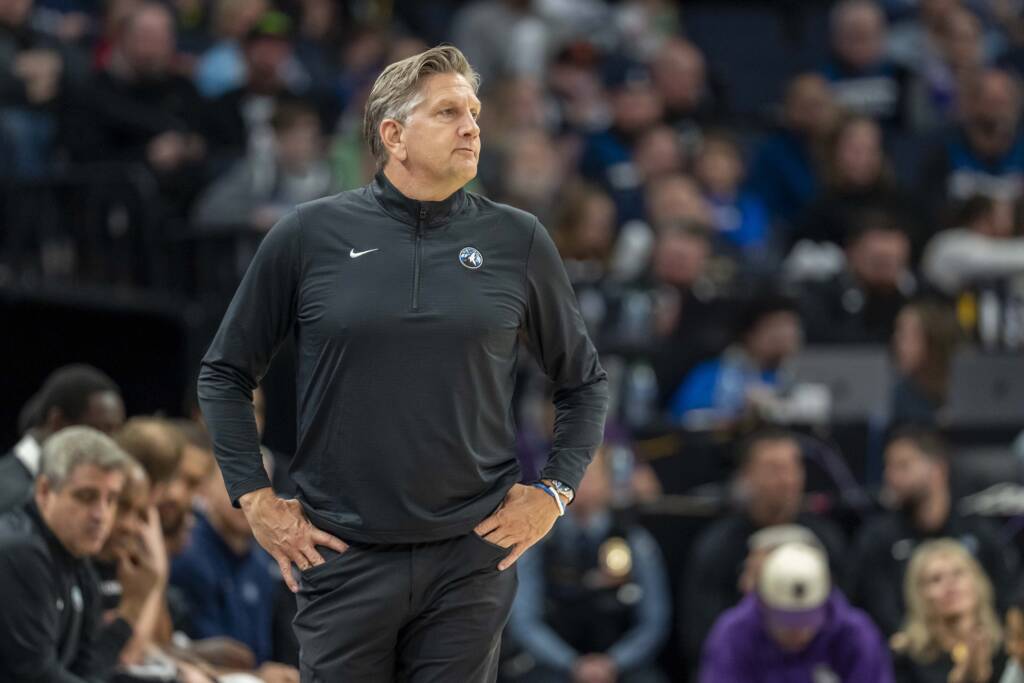

Chris Finch coached his first playoff series against the Memphis Grizzlies in 2022. During the fourth quarter of Game 6, he made a controversial decision.
D’Angelo Russell committed two turnovers within just over one minute of each other. After his second turnover, a dismayed Finch had seen enough. He jerked back in his chair before popping up and signaling to the bench for Jordan McLaughlin to replace Russell.
It was win or go home for Minnesota, and Finch was desperate. He benched Russell for the rest of the game. The Wolves ultimately fell 114-106, concluding an aspiring building-block season. Finch’s choice to bench his starting point guard didn’t result in the Wolves forcing a Game 7, but it felt like the right move at the time, even though it upset Russell.
“No. Not at all,” Russell said when a reporter asked him during his exit interview if he was okay with being benched. “Of course I want to be out there.”
Not only was it Finch’s first playoff series, but it was also his first full season in Minnesota. The Wolves have made it to the playoffs in all four full seasons with Finch at the helm – their second-longest playoff streak in franchise history. They have been the underdog in the first round each time. Last year, Finch’s club got out of the first round for the first time since 2004.
If they hope to do the same this year, Finch must once again dig deep into his bag and return to the coach who is not afraid to make changes and live with the results.
Finch is an even-keeled coach. However, that doesn’t mean he does not get fired up, stick up for his players to the officials, or coach his team hard; Finch does all those things.
However, he always keeps the greater picture in mind. Most professional coaches have that mindset, and it ultimately drives winning. An 82-game regular season is filled with many high tides, low tides, and momentum shifts. Having a coach like Finch at the helm who tries his best to keep the team from getting too high or too low is necessary so players do not get seasick.
The Timberwolves experienced constant changes this season. They ultimately closed with a 17-4 record while taking advantage of an easier schedule. However, that wasn’t before the forceful currents jostled them around earlier in the year.
Minnesota was 17-17 on Jan. 5 after dropping three straight games. Finch’s new-look starting lineup (Mike Conley, Anthony Edwards, Jaden McDaniels, Julius Randle, and Rudy Gobert) struggled, especially with low energy levels in the first quarter.
Fans wanted to see Finch make changes earlier than January 6, but that is when he did. Finch benched Conley from the starting lineup and replaced him with Donte DiVincenzo.
“I don’t think I am being particularly stubborn,” explained Finch on January 4. “There is a chain reaction to everything that you do. There are other combinations and things that go on the floor that are just as important, if not more so important than the starting lineup.”
Still, everything changes come playoff time. Finch’s patience was a driving factor in Minnesota’s hot finish to the regular season. However, the season now shrinks down to seven games. A team can advance in as few as four games, which the Wolves did last year in the first round against the Phoenix Suns.
However, the Los Angeles Lakers can end their season this year just as quickly.
The Suns smashed the Timberwolves 125-106 in Game 82 last season. By halftime, it was apparent that Minnesota would play Phoenix in the first round. Therefore, Finch didn’t want to show his hand and waited until Game 1 to adjust his strategy.
Bradley Beal hung 36 points on the Wolves in Game 82. Devin Booker dropped 23 points, Grayson Allen had 20, and Kevin Durant contributed 15.
Finch put Karl-Anthony Towns on Allen, leaving Edwards to guard Durant, McDaniels to guard Booker, and Conley to guard Beal. Towns didn’t match up well against Allen. Phoenix involved Allen in pick-and-pop actions, which left Towns vulnerable on the perimeter. Beal also picked apart Conley inside and out.
In Game 1, Finch resolved the situation by putting Towns on Durant, McDaniels on Booker, Edwards on Beal, and Conley on Allen. Durant did his thing against KAT, averaging 26.8 points on 55.2% from the floor in the series. However, Finch lived with that because McDaniels held Booker to 4 of 12 shooting in the individual matchup, despite Booker averaging 27.5 points on 49% from the floor overall.
Beal also averaged 16.5 points on 44.1% from the floor. Allen recorded seven combined points on 1 of 5 from deep through the first two games before missing the final two games with an injury.
Finch’s defensive realignment kept the Suns at bay, which gave Minnesota’s offense the momentum it needed to blow Phoenix out of the water.
A year later, it’s obvious that Phoenix is not a threat in the Western Conference. The Suns fired Frank Vogel after the Wolves swept them. They recently fired his replacement, Mike Budenholzer, after the Suns went 36-46 in his first season and missed the playoffs. Minnesota has also won eight straight games against the Suns, including its sweep last season.
After outcoaching Vogel in the playoffs last season, Finch and his staff now face a more challenging task.
JJ Redick leads the third-seeded Lakers from the sideline. He’s an established basketball sicko who will be coaching in his first playoff series. Redick will be ready to punish the Wolves in Game 1, probably running solely on Starbucks after staying up grinding film every night this week. His two best players, LeBron James and Luka Dončić, will be ready to embark on a playoff run that the national media expect will be lengthy.
By beating the Utah Jazz 116-105 on Sunday, the Wolves stayed out of the Play-In Tournament, giving them nearly an entire week to prepare for the Lakers.
“We found last year it was key to the entire playoff run for us,” Finch told Paul Allen on KFAN on Tuesday regarding Minnesota’s week to prepare for Game 1. “Going into that Phoenix series, we were [0-3] against them, and we had to really kind of reinvent ourselves. We were able to do everything that’s targeted, whether that’s player development, offensive, and defensive strategy.”
The Wolves have only faced the Luka-Lakers once and didn’t have Randle and Gobert. The officials also tossed Edwards halfway through. Therefore, Minnesota is essentially playing this version of the Lakers for the first time.
The benefit of that, especially for Game 1, will go to whatever team is more prepared. Finch and his staff will leave no rock unturned leading up to Game 1 on Saturday in Los Angeles. Each coach has a specific area they will focus on, posing and answering many of the same questions that Wolves fans have debated on social media.
- Does Randle’s blend of physicality and foot speed make him a good matchup against Dončič?
- Should we reduce Conley’s minutes and bring him off the bench to prevent the Lakers from targeting him?
- Should we lean into our size or run smaller lineups to combat LA’s game plan?
- How do we put Edwards in the best position to handle double teams wisely and not succumb to the Lakers’ attempts to get in his head?
Perhaps Finch makes a significant change, such as benching Conley for a more favorable matchup. Maybe Finch’s creativity manifests in how he lines his players up on defense.
Regardless, the playoffs are where Finch likes to get creative. He is also unafraid to make controversial moves, particularly when his back is against the wall. He has ample time to prepare during the week break before Game 1. Finch can also adjust because both teams have two days off after Game 1, Game 2, and Game 4.
He must dig deep into his bag of tricks to upset LA and advance out of the first round for the second-straight season.

