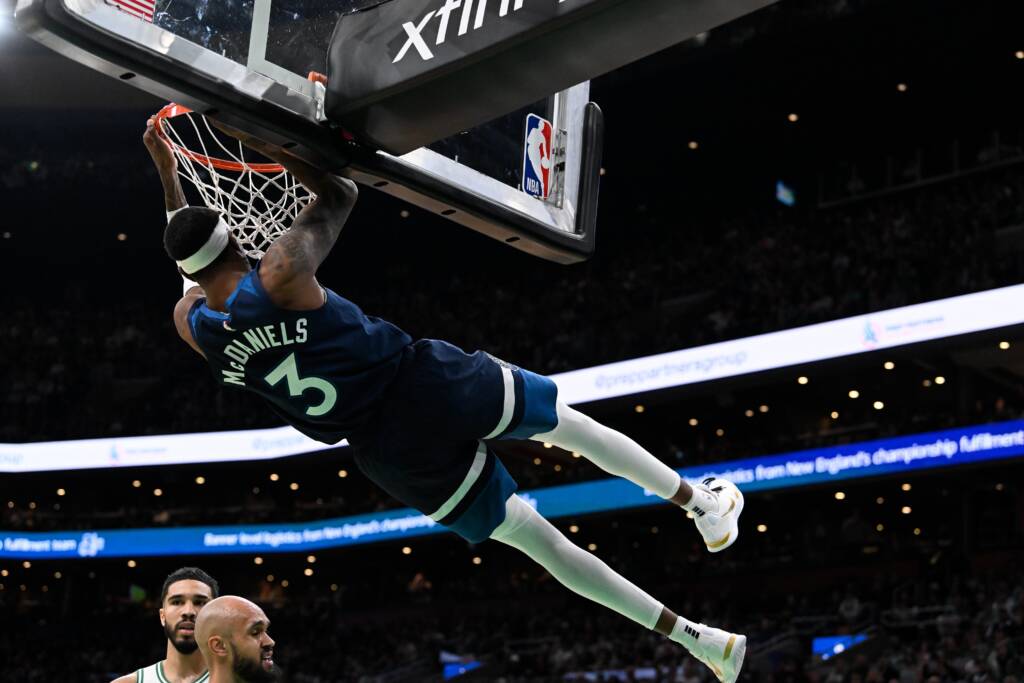

Ever since the Minnesota Timberwolves drafted Jaden McDaniels 28th overall in 2020, his teammates and coaching staff have done their best to instill the utmost confidence in him. They’ve praised him in postgame press conferences or on the court.
Those around Jaden know how vital his play is for Minnesota’s success.
The Timberwolves have won 6 of their last 7 games, and McDaniels has played his best ball of the season. He’s averaging 10.6 points, 5.3 rebounds, and 1.9 steals with 49.2/45.5/85.7 shooting splits. It’s no coincidence that some of Minnesota’s most connected team play has correlated with McDaniels’ best stretch of games.
During media availability Tuesday, Chris Finch expressed his admiration for McDaniels’ recent play and grit on the court.
McDaniels has brought balance and versatility to the Timberwolves throughout these seven games. He’s combined his prior flashes of play into more consistent production in his varying roles on both sides of the ball.
At 24, McDaniels is young but experienced as a fifth-year player. He has always been seen as a high-ceiling player, so his slower development pathway is fairly ordinary. McDaniels has always had tools, but his game-to-game and sometimes quarter-to-quarter output has differed.
Offensive comfortability has always been McDaniels’ most difficult battle to overcome. His role is simple. He operates in the corner as a kickout catch-and-shoot three-point shooter and occasionally gets structured on-ball duties on Chicago/Zoom actions. McDaniels sometimes earns freelance ball-handling duties. However, his shaky handle in traffic and lack of physicality limit his rim-pressure abilities.
Still, McDaniels’ issues always involve finding consistency, and his confidence wavers when he is inconsistent. This issue goes back to his time at the University of Washington.
When Minnesota’s offense has relied upon McDaniels for his three-point shot on kickouts, he has offered mixed results. He’s a career 35.2% three-point shooter and a 35% catch-and-shoot three-point shooter on 3.5 attempts from three per game. Even if he catches fire from range, he likely cannot get enough opportunities to capitalize. Therefore, the Wolves cannot rely on him as a perimeter threat.
McDaniels’ three-point volume has remained low over this seven-game stretch. He has only attempted 3.1 threes per game, but he’s been efficient. McDaniels has made 10 of 25 threes and 8 of his 17 catch-and-shoot attempts during these seven games. Even with that success, Jaden still sits at 32.6% from three and 31.6% on catch-and-shoot attempts this season.
There has been a drastic correlation between McDaniels’ three-point shooting and whether the Wolves win or lose. McDaniels is shooting 22 for 49 (44.9%) in Minnesota’s 14 wins and 9 of 46 (19.6%) in its 11 losses, highlighting McDaniels’ value as a floor spacer.
Minnesota’s roster construction has put a greater strain on McDaniels because Rudy Gobert and Julius Randle already occupy the paint. Therefore, they need McDaniels’ ability to knock down kick-outs from Anthony Edwards as a safety blanket. Defenders always gravitate toward Edwards’ drives instead of McDaniels in the corners.
Better three-point shooting will earn McDaniels more respect from defenders, giving others more driving lanes.
McDaniels’ game has blossomed because of his controlled aggression. He’s often had rough patches littered with foul trouble and inconsistency that starts on defense. When McDaniels has to come off the floor because of foul trouble, it affects the rest of his game.
Throughout his NBA career, there have been numerous examples of Jaden picking up two quick fouls and finding himself in a rut for the rest of the game.
Because of the extended controlled aggression, McDaniels played two of his best rebounding games of his career. Over a two-game stretch, he tallied 20 rebounds, including his first career double-double against the San Antonio Spurs on Sunday.
McDaniels plays a vital role as Minnesota’s primary point-of-attack defender. He’s also one of their best help-side low-man defenders. Therefore, if McDaniels gets off to a slow start, it has a domino effect on the rest of the unit’s capabilities. Limiting the touch fouls further allows him to use his 6’9” frame to snare more rebounds and finish off possessions.
During Minnesota’s six wins in seven games, McDaniels has limited foul trouble and maximized his defensive playmaking abilities. He has posted 1.4 fouls and 1.9 steals per game. On December 13, he had a career-high five steals against the Los Angeles Lakers.
It is a tough ask, but McDaniels has showcased why he’s an All-Defensive team caliber talent.
During this run, Minnesota’s defense has returned to last season’s form. They have a league-best 92.8 DRTG in those seven games, a massive lead over the second-place Oklahoma City Thunder’s 103.4 DRTG. They’ve recaptured their identity.
Defense will always be McDaniels and Minnesota’s strength. It has always been Jaden’s spot to build from within as a pro. By finding his defensive swagger again, McDaniels can focus on continuing to develop his offensive skill set. While he may not be a sharp-shooting three-point option, he can still meaningfully impact the game.