
Eighteen games into Rudy Gobert’s first season with the Minnesota Timberwolves, the team was 10-8 amid a five-game winning streak. The pendulum was on an upswing as Minnesota maneuvered through the growing pains of integrating Gobert into its offense. However, that five-game win streak ended up being Minnesota’s longest in a season filled with more downward dives than upward swings.
They crawled to a 42-40 record before being bounced in five first-round games against the eventual champion Denver Nuggets.
It was a season defined by injuries, poor chemistry, and changes. However, one of those changes corrected the Timberwolves’ poor start to the season, lifted them to the playoffs, and eventually powered them to the Western Conference Finals a year later.
“We brought Mike [Conley] in, and that turned a lot of things around in Rudy’s first year,” Anthony Edwards explained following Minnesota’s 115-104 loss against the Sacramento Kings on Nov. 27. “He was just so positive, and we are just so negative right now.”
Minnesota’s negativity stemmed from dropping its fourth straight game and falling two games below .500 eighteen games into the 2024-25 season. It was their lowest point since 2022, when the Wolves dropped six-straight games in late December. They finished the rest of the season with a 26-20 record.
Still, it took a mid-season trade that sent D’Angelo Russell to the Los Angeles Lakers in a three-team deal for Mike Conley and Nickeil Alexander-Walker before Minnesota formed into a team capable of making the playoffs.
With the Wolves undergoing many of the same issues this season they did in 2022-23, it’s easy to draw comparisons. However, Tim Connelly making another one of his seismic trades at the deadline would not solve Minnesota’s issues.
Instead, it would create more.
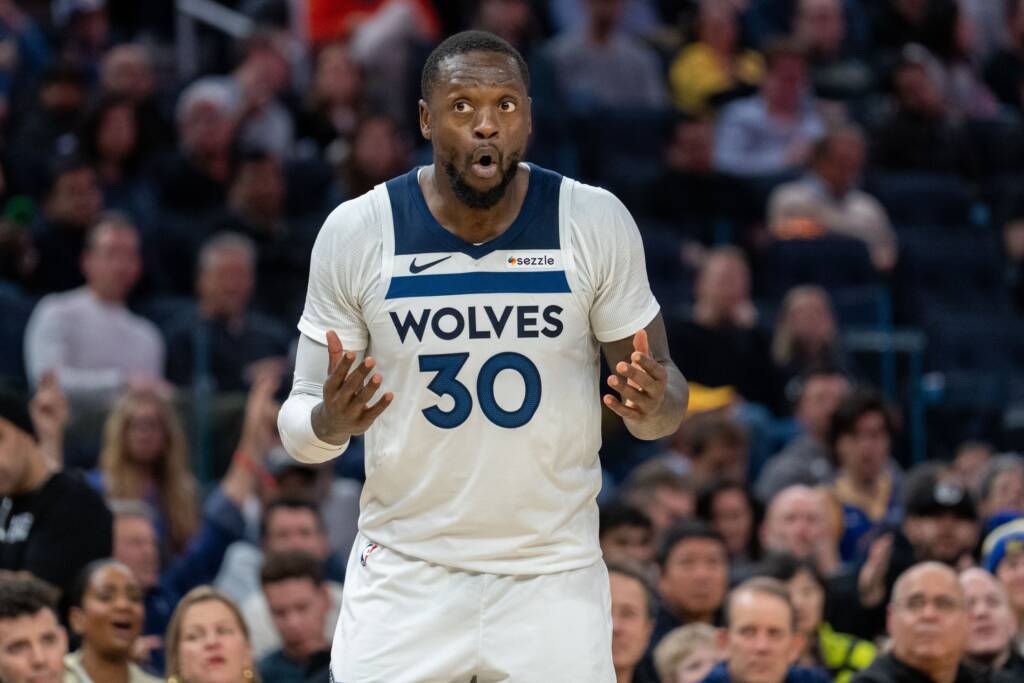
Minutes before Minnesota’s home opener against the Toronto Raptors, Julius Randle addressed the crowd, which is common in the NBA. Usually, the team will send its best or most liked player to center court with a microphone so they can thank the crowd for their support and prophesize a great season. Before Randle could speak, the Target Center crowd was on its feet, welcoming him to Minnesota in deafening fashion.
“It was amazing,” Randle told reporters postgame. “I wasn’t expecting that at all.”
The ovation felt like the entire state of Minnesota rallying around a player they could have been leery of. Randle was the big return in the Karl-Anthony Towns trade and replaced KAT in the starting lineup. The wounds were still fresh for a fanbase blindsided by the move. However, Randle immediately applied Neosporin with his 33-point performance against the Sacramento Kings in the second game of the season, quickly getting his new fanbase to buy into what he was selling.
In his inspiring home debut, Randle scored 24 points, grabbed nine rebounds, and recorded five assists, leading the Timberwolves to a 112-101 win.
It would always be a daunting task for Randle to replace Towns, not only in replacing KAT’s on-court production but also in the respect he had in the community. The fans who cheered Towns for nearly a decade gave Randle an early reception filled with hope of what was to come. However, seven weeks later, the honeymoon phase has seemingly passed.
The Timberwolves are seven months removed from the Western Conference Finals and have yet to look like a team capable of repeating a similar playoff run. They have a 14-11 record through 24 games, two more wins than they had at the same time in Gobert’s first season. However, Minnesota’s record doesn’t accurately depict where the team sits.
“I think I like where we’re at, not in terms of the standings, but more in terms of the things we’ve been through as a team and our awareness right now,” said Rudy Gobert after Minnesota’s 114-106 loss to the Golden State Warriors on Dec. 8. “We know we can exactly feel, like a game like tonight, we can exactly feel what happened.”
On the same night that Edwards cited Conley’s arrival as the turning point two years ago, he called this year’s team soft and front runners. The Wolves are 6-1 since his comments and have finally figured out that their identity lies on defense after nearly two months of soul-searching.
Minnesota has held six of its last seven opponents under 100 points and three under 90. Their defense ranks first in the NBA by a wide margin during that stretch. The Wolves have had a 92.8 defensive rating since their 6-1 stretch started. The next closest team in the No. 1 seeded Oklahoma City Thunder with a 103.5 defensive rating.
Finch’s squad has returned to the defensive stalwart they were a season ago by getting production from up and down the roster.
- Jaden McDaniels has set the tone by playing some of the best defense of his career while staying out of foul trouble.
- Edwards has been bought in and is winning one-on-one matchups.
- Teams fear Gobert at the rim again because of the Wolves’ better execution of defensive schemes.
- Conley is rounding things out with non-stop pressure at the point of attack.
- Alexander-Walker is coming off the bench and providing his usual exasperating defense.
- Most notably, Randle has sharpened his defense over the last two games, especially off the ball, which has been one of the bigger holes in his game for most of the season.
During their stretch of sitting at the top of the defensive rating leaderboard, the Wolves have had the fourth-worst offensive rating in the NBA (105.7). They’ve had the fifth-worst turnover percentage (16.7%) and are shooting 44.4% from the floor, which is the seventh-lowest. The issues are still glaring, but they are winning games, much of which boils down to their connectedness.
“I do like where the team is. I like where our spirit and competitiveness is,” Finch told Paul Allen on KFAN after the second game in San Francisco. “I like where our connectivity is. It feels like it is finally taking root.”
Connelly made one of his many seismic trades at the deadline two years ago. Flipping DLo for Conley and Alexander-Walker turned out to be one of the best moves on his resume in Minnesota. However, it took a while before that move looked good.
The KAT-Randle trade could be similar.
After receiving a boisterous reception early in the season, Randle has upset fans with lazy defense, seemingly poor on-court mannerisms, and head-scratching turnovers. It can be easy to compare his faults to DLo’s. However, that doesn’t mean trading Randle is the right solution.
Connelly and his staff knew the player they were getting in Julius. While he may be hard to watch at times, he was a winner in New York after bouncing around to begin his career. Maybe stability is the best remedy for Randle’s inconsistency. He’s settling into a groove, playing with a sharper edge, and so are the Wolves.
What ails Randle’s game isn’t completely curable, which is part of the Julius Randle Experience. However, chemistry and connectivity are the best ways to mask his faults.
Minnesota has proven that chemistry greatly benefits the team’s success, especially under the Edwards-led regime. However, the league’s second-apron financial restrictions would make it difficult for the Wolves to pull off a big trade. That would also continue to feed more change to a team that has been poisoned by it for many years.
The Wolves were a trade away from a playoff-contending team two seasons ago, but that isn’t the case now. They have the talent and are rounding the corner. More importantly, players are figuring each other out and settling into a groove. Breaking that up with a sizeable trade at the deadline would not propel the team like it did in 2023. Instead, it would cause the wheels to fall off completely.


