
Football is finally back.
Although it may be a little while before Week 1, at least training camp has arrived. We may have gotten some clips from minicamp and OTAs, but now the fans will have a chance to go out and see football players in real, live action.
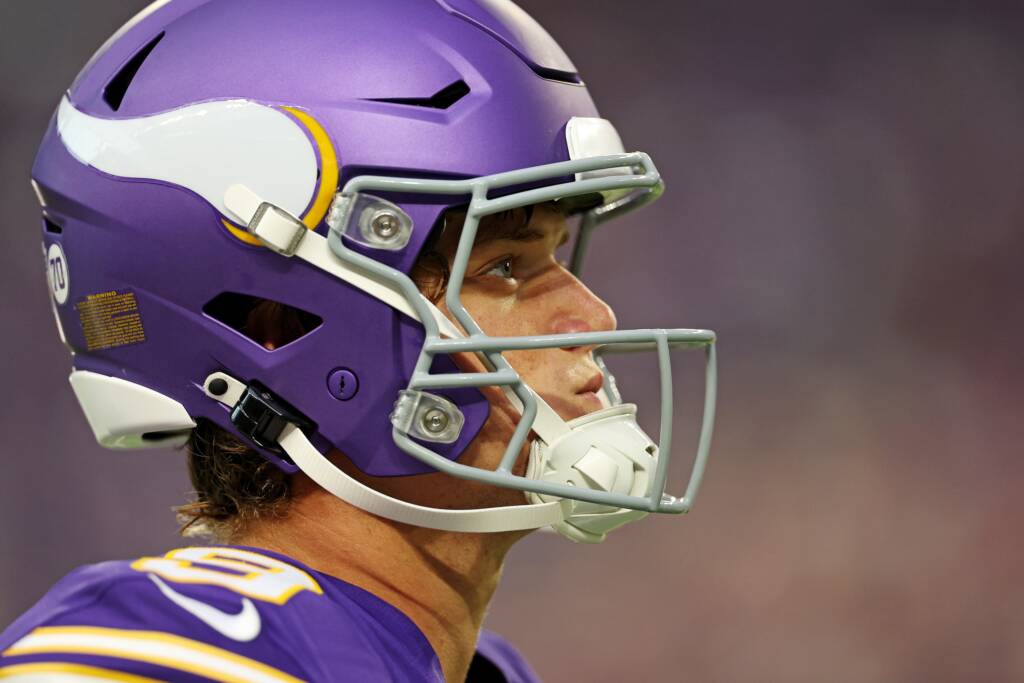
With the advent of camp comes the crescendo of the hype that’s been building around each team all offseason. For the Minnesota Vikings, the focus of that hype is young QB J.J. McCarthy. A meniscus injury after only one tantalizing preseason game ended his 2024 season. Despite the lost time, he appears to be fully recovered heading into training camp, and glowing profiles of the mental work McCarthy did while recovering from the injury are coming out in force.
Those profiles are well done and offer insight into McCarthy’s process for preparing to face NFL defenses and his mentality as he works back from injury. Still, they don’t really shed any light on what we might expect from McCarthy on the field in 2025. Across the media landscape, there’s not much discussion of who McCarthy is on the field.
You might get conversations about how McCarthy has a great situation, or general uncertainty over him because he hasn’t played a regular-season snap. What you won’t get is actual conversations of who McCarthy is as a player and how his play style fits into Minnesota’s offense. He won’t get covered on shows about rookie QBs transitioning to the NFL because he’s not a rookie. Podcasts dedicated to second-year QBs will flat out ignore him because he didn’t play in 2024.
Before the frenzy of the season begins, I think it’s important to establish expectations for McCarthy the player. Team success is certainly one way to look at it, but the Vikings winning football games is not the only standard we should have for McCarthy. I revisited the work I did last year, where I watched all of McCarthy’s 2023 season at Michigan, charted it, and also analyzed each of his reps in his sole preseason game with the Vikings.
To project McCarthy into his role as a starting NFL quarterback, let’s break it down into chunks, examining each aspect of quarterback play and how it fits within Minnesota’s offense.
Pocket movement
Dropback footwork is crucial for NFL quarterbacks. It can sometimes get left behind in college spread offenses, where the focus is on attacking space. Fortunately, McCarthy’s experience at Michigan was in a progression-based system, with a wider variety of drops and more under-center work than many college players experience.
McCarthy was in the pistol or under center about 15% of the time during his final year at Michigan. That’s about half as often as the Vikings went under center in 2023, but it’s critical experience for McCarthy. He can take snaps from under center, turn his back to the defense, and proficiently run either straight dropback play action or rollouts, both of which are common in Minnesota’s offense.
He was consistently accurate with his dropback depths, which is a significant help to the offensive linemen’s pass protection. Inconsistent drop depth plagued Jaren Hall‘s failed start in his only opportunity with the team. McCarthy also has the skill to tie his footwork with his reads as he progresses through the play.
The play below was a great example of that skill.
That ties in heavily to what the Vikings want to do on offense. QBs under Kevin O’Connell must have this skill. Below is an example where Sam Darnold did it, finding Justin Jefferson for the first down.
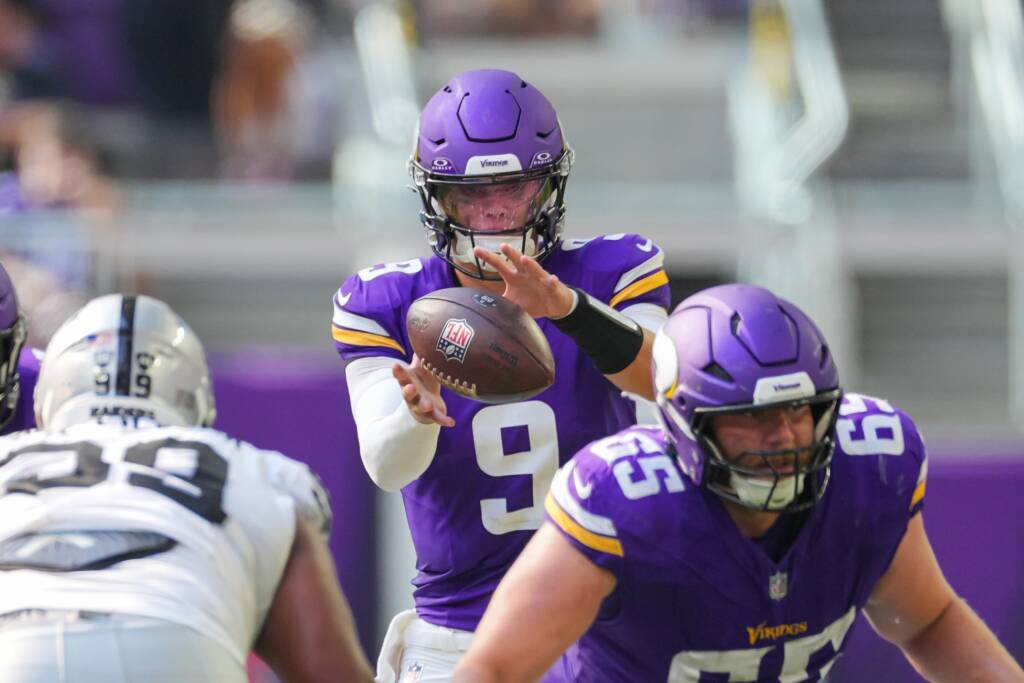
Pressure management is another critical component of a QB’s game. Throughout his time at the University of Michigan and in his lone preseason game, McCarthy managed pressure very well. It’s worth examining McCarthy’s successes under pressure at Michigan and also observing how he mitigated pressure and delivered consistent success in last year’s preseason game against the Las Vegas Raiders.
McCarthy played well under pressure and also rarely created his own pressure at Michigan. In his final year, PFF charted him as responsible for just 13 of the 113 pressures he faced (my charting counted just eight). That was the lowest rate of the six first-round QBs from McCarthy’s class.
Comparing McCarthy’s 11.5% responsibility rate to the NFL, it would rank seventh among the QBs who faced 100 or more pressures in 2024. Poetically, it’s right behind Sam Darnold, who created his own pressures 10.8% of the time, per PFF.
His final game against the Detroit Lions and playoff failure against the Los Angeles Rams may be hard to ignore, but Darnold played quite well against pressure for most of the 2024 season. He also faced quite a bit of it; teams pressured him on 39.1% of his dropbacks. Part of that was due to the depth of the passing concepts the Vikings were running and the time it took for those concepts to develop.
Darnold averaged a time to throw of 3.08 seconds in 2024, which ranked fourth among QBs. He also scrambled much less frequently than all of the QBs around him. Jalen Hurts, Lamar Jackson, Caleb Williams, C.J. Stroud, Brock Purdy, and Bo Nix scrambled at least 40 times while Darnold only scrambled 29.
Darnold stands out because of how deep the Vikings asked him to throw. His average depth of target of 9.3 yards was also fourth in the NFL. Looking at McCarthy’s Michigan numbers, PFF has him with an ADOT of 9.4 yards and a time to throw of 2.84 seconds. Defenses are worse in college, so the best QBs can push the ball further downfield quicker than in the NFL. Still, it’s good that McCarthy’s numbers were at least comparable to Darnold’s.
McCarthy may end up facing a higher pressure rate on the Vikings than he did in college because he will have to hold onto the ball longer due to the offense’s design. Still, it’s notable that McCarthy excelled at mitigating pressure at Michigan, and I’m hopeful that he can continue to do so in 2025.
I’d expect Minnesota’s overall pressure rate allowed to decrease in 2025. Even if McCarthy allows a few more pressures than Darnold did, the overall improvements to the offensive line should more than make up for the difference.
delivering the football
Managing the pocket is one thing, but a quarterback’s main job is to deliver the ball to his receivers. Pocket management helps a QB play within rhythm, but he still needs to process what is happening with the defense, find an open receiver, and throw an accurate pass.
From the mental side of things, McCarthy was a promising, if imperfect prospect. He regularly threw the ball with anticipation, releasing the pass before his receivers broke their routes, which prevented defenders from making plays on the ball and helped create consistent completions.
The third play in the above reminds me of the below Darnold throw:
Playing with anticipation is naturally more difficult to do in the NFL than it is in college. Therefore, McCarthy will have to incorporate all of the hours of meetings and scouting reports the team asked him to work on in his ESPN profile. Correctly identifying coverages will help him throw with anticipation in the NFL, and we can’t say with certainty that he’ll be able to do it before we see it in action.
However, if I had to bet, I would say that McCarthy will be able to do it. He ran so many concepts at Michigan that carry over to what he’ll do with the Vikings. In the compilation above, you can see several digs and routes that access the intermediate middle of the field. That’s an area the Vikings access often; Darnold attempted passes there 12.8% of the time. The only area he threw to more often was the short middle, at 18.6%.
In the anticipation cutup, you also see routes like comebacks on the sideline, out routes, and corner routes that are critical parts of the Vikings offense. TE option routes, like the ones below, are another crucial piece that McCarthy was able to deliver on in college.
The Vikings love running option routes with T.J. Hockenson on critical third downs. Here’s an example of a great conversion against the Jacksonville Jaguars from this year. McCarthy’s experience and confidence with these types of plays should translate to the NFL.
Mentally, two areas of concern for McCarthy’s game worry me heading into this season. I think he can eliminate both with more experience, but these could lead to ups and downs as McCarthy adjusts to the NFL. The first is a set of what I’ll call “turndowns.” These are plays where he had a receiver who was part of the progression looks open, but chose not to throw the ball to him.
Here’s a compilation of plays where I thought he missed opportunities.
Several of these plays are still completions, but they’re not often positive ones. The completions are mostly checkdowns that leave bigger gains on the table. Having too many of these will lead to failed drives and frustration as the offense stalls out.
My second concern for McCarthy is a little bigger. He rarely chose to throw the ball away at Michigan. I only charted him with two total throwaways, and PFF only counted one across 312 passing attempts. By contrast, Darnold threw the ball away 33 times in 2024, which was third in the NFL.
Now, it’s also noteworthy that McCarthy only threw four interceptions and nine interceptable passes in 2023 at Michigan, so he may not have needed to throw the ball away all that often. Still, it’s notable that his interception in the preseason game was on a throw he probably shouldn’t have tried.
Prudent throwaways are a critical part of not making a negative play worse. McCarthy probably needs to throw the ball away more, and it will likely take some time for him to learn the correct balance between his playmaking ability and taking the easy way out.
Overall, McCarthy’s decision-making is good. But what about his arm?
It’s quite good. Everyone seemed to have a quote praising McCarthy’s arm talent during offseason training, but anyone who questioned his arm before that simply didn’t watch McCarthy’s tape at Michigan. He regularly threw passes downfield and from the opposite hash with great velocity.
McCarthy’s arm strength also showed up immediately in his preseason action.
McCarthy was also quite good at throwing from different platforms and on the run. Here’s a big compilation of his throws on the move:
I feel obligated to mention this play, which still blows my mind every time I see it.
McCarthy has the arm talent to make any throw the Vikings will ask of him. Whether he’ll be consistently accurate is a little more uncertain. At Michigan, statistically, he was a fairly accurate passer who produced well, even when compared to other first-round picks. Below is a chart of his passing stats by direction, where most squares are green (obviously, green is above average and red is below average).

If you look at general accuracy, McCarthy also shows up in the green. However, you can see that while he excels throwing over the middle, the numbers to the outsides are not as positive.

That brings me to the final chart I developed, which is for pinpoint accuracy. Pinpoint throws are much easier for receivers to catch than generally accurate throws, where they have to adjust to the ball, leading to a higher drop rate and a better chance for the defender to get in the play. McCarthy ended up below average throwing both deep and to the left, which was one of the biggest concerns I had for him heading into last season.

The root cause of McCarthy’s issues appeared to be mechanical, with his footwork on throws resulting in misses. Luke Braun has obsessed over QB mechanics, and McCarthy’s mechanics in particular, diving into practice tape to see what tweaks the team has made to help McCarthy improve his accuracy issues. He’s much more qualified to speak on the changes than I am, and you can watch what he found for free at his Patreon.
The moral of the story is that McCarthy still doesn’t have perfect mechanics, but that they are improved, and he should be accurate enough to succeed in the NFL.
To sum up McCarthy’s arm, I expect him to be able to execute all of the throws asked of him in Minnesota’s offense. Whether it’s providing good velocity on an out route, going over the top on a vertical route, or zipping the ball in a tight window over the middle on a comeback, McCarthy can make the throw. He will make quality throws on the run and will probably also make a handful of incredible, highlight reel plays.
However, I’ll be watching to see if he can be consistently accurate. He may not be at Joe Burrow‘s level, but I would expect him to hit somewhere around 75% in PFF’s adjusted accuracy metric. Players in that range last year included Darnold, Kyler Murray, Josh Allen, Justin Herbert, Drake Maye, Jordan Love, and Brock Purdy.
using his legs
McCarthy also impacted the game as a runner at Michigan. By my charting, he had 27 designed runs and 20 scrambles in 2023. He averaged 7.1 yards per attempt on designed runs and an impressive nine yards per attempt on scrambles.
His designed runs were mostly zone-read plays, with some other concepts mixed in. They broke down into the following types:
- 18 zone-read (traditional “read option”) plays
- 3 GT counter/option
- 3 QB draws
- 2 QB sweeps
- 1 QB sneak
Here’s a compilation of McCarthy’s scrambles:
And here’s a compilation of his designed runs:
McCarthy isn’t the type of overwhelming athlete who demands a heavy dose of carries in the run game, but he’s effective at it. I’d like the Vikings to incorporate some QB run concepts into their offense, but I’m not sure they’ll use him heavily in this facet. Darnold also proved to be an effective scrambler for the Vikings, with several nice escapes from pressure and timely first-down pickups. However, the Vikings rarely asked him to execute designed runs.
Darnold had 67 rushing attempts, and with 29 scrambles, that means that he technically had 38 designed runs, but most of those were either QB sneak attempts or kneeldowns. PFF only credits him three zone-rushing attempts and one gap scheme attempt, which indicates that he really only attempted four designed runs. Even in 2023, with Josh Dobbs, PFF data suggests that he attempted only four designed runs across his five starts.
Darnold was an underrated athlete, but McCarthy seems more athletic to me. McCarthy will probably also be underrated as a runner throughout his career, but I hope the Vikings try to incorporate a bit of QB run game into the mix this season. It should help make the offense more efficient.
What can we expect from JJ McCarthy in 2025?
I’m not going to make a yardage or TD prediction for McCarthy, or a win prediction for the Vikings. Instead, I want to boil down a profile of what I think McCarthy will look like out in the field.
I think McCarthy will manage the pocket well and consistently drop back and move around to mitigate pressure, much like a veteran. He showed that ability in college, and I expect it to continue in the NFL. McCarthy may break the pocket a little more often than I’d like. While I don’t think he’ll be an elite scrambler, he should contribute positive value on scrambles similar to the way Brock Purdy does.
I think McCarthy will consistently attack downfield in Minnesota’s vertical offense. I expect his average depth of target to be above the norm, and I wouldn’t be surprised if it’s near the top of the league. I also expect him to pepper the middle of the field, and throw to the intermediate middle specifically at one of the highest rates in the league.
The Vikings’ offense focuses on attacking that area, and it’s where McCarthy performed his best at Michigan. He should have strong positive flashes, including at least a couple of scramble plays with highlight throws downfield that make top 10 reels.
I also expect blemishes. McCarthy may struggle with accuracy in stretches, particularly on deep passes and to the left. He may also put the ball in harm’s way a bit more often than he did in college, and it’s worth anticipating some games with multiple turnovers.
Nothing is certain, but I honestly think by the end of the season, McCarthy will look like at least the third-best QB from the 2024 draft class. Jayden Daniels should certainly still be up top, and I’ll leave room for Drake Maye to build on his rookie season or Caleb Williams to completely turn it around, with Maye being significantly more likely than Williams. I think McCarthy will outperform what Bo Nix did in Denver in 2024, and also that Nix’s performance will regress in 2025. I don’t see Michael Penix Jr. outperforming McCarthy.