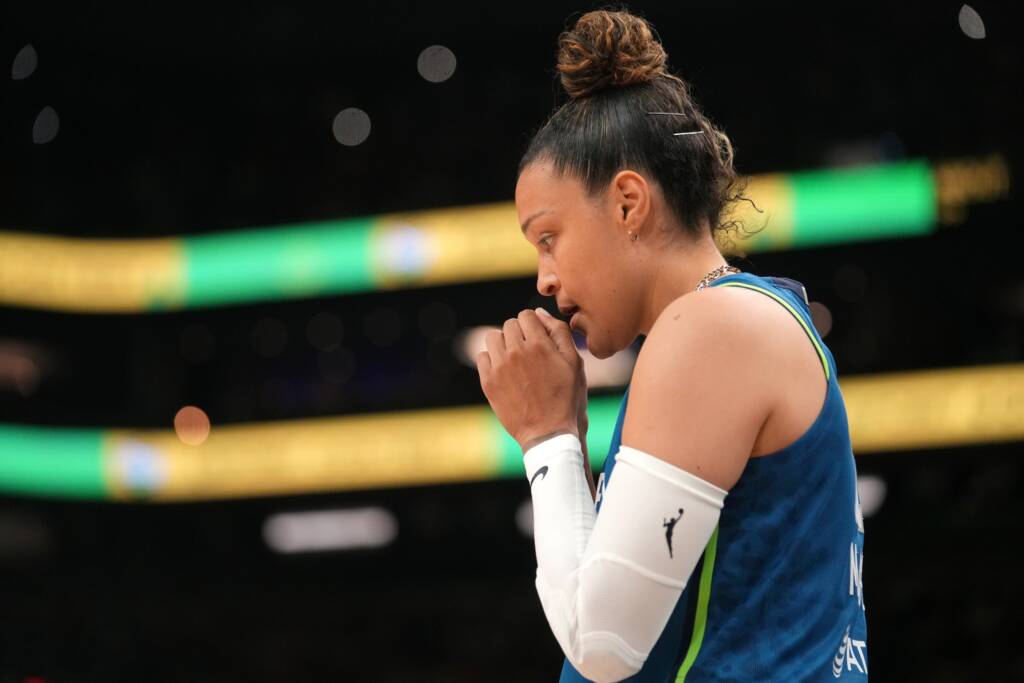

Few players in the WNBA make the same impact as veteran Minnesota Lynx guard Kayla McBride. She’s one of the league’s most lethal shooters, and Cheryl Reeve has long found ways to fully maximize her players. Still, the blend of structure and freelance the two share has maximized McBride’s shooting gravity and allowed her to take advantage of defenders.
McBride has showcased her innate shooting ability throughout July. She has scored 20 or more points in 8 straight games, which is the second-longest streak in Lynx history behind Maya Moore’s 11 games.
Over that eight-game stretch dating back to the July 6 matchup against the Connecticut Sun, Kayla McBride has averaged 26.8 points per game. She’s shooting 54.5% from the field and 50% from three on 8 attempts per game, posting a 73.6% true shooting percentage.
In her age-34 season, McBride is averaging 18.2 points per game, which would tie her career high set in 2018. McBride has also moved up to fifth all-time in three-pointers made this season. She’s just 34 makes from passing Becky Hammon for fourth all-time.
Olivia Miles’ historic rookie season and Napheesa Collier’s return may garner all of the headlines. Still, few players can impact that game like McBride.
It starts with McBride’s three-point shooting prowess. She possesses the rare knack of being able to always find a way to beat an opponent off-ball. Defenders face a tough scouting report with McBride.
Let’s start with opponents playing over the top of her pindown actions.
In the video below against the Seattle Storm, the Lynx looked to find McBride on one of their most used actions, which features two pindowns off-ball looking to get McBride a three-point attempt.
Seattle defends it well, playing over the top of the screen, so McBride falls back to the corner. While they took away the initial action, the possession is far from over. Such is the glory of Cheryl Reeve’s offense and the buy-in she gets from her players. Even if the set is stifled, or the target player doesn’t receive the ball, there’s always a way to beat the defense.
Olivia Miles resets to Natasha Howard, who initiates an empty side pick-and-roll with McBride. However, instead of McBride flowing into the pick-and-roll, she uses her shooting gravity. The defender elects to take away the screen and limit McBride from getting a three-pointer up, and she shoots backdoor for the lay.
In the next game in Seattle, the Lynx showcased another way of using McBride’s off-ball gravity with a Horns UCLA Peja action. It’s an action Minnesota has used often this season, which has multiple routes to success.
The action is based on the Horns alignment, with two players in the corner and two at the elbow. The Lynx have frequently flowed into this with Nia Coffey and now Napheesa Collier, as the initiator and then cutting target. Kayla McBride starts at the elbow, where she serves multiple purposes. She is a key threat as the “Peja” target, which is an off-ball backscreen into a handoff.
Kayla McBride is so dynamic in this action because she’s a fantastic, willing screener for her teammates. Her gravity alone opens up the back screen find to Collier here against Seattle. Opponents have to respect the UCLA cut, but they also have to respect McBride’s secondary action, sliding up to the handoff with the opposite elbow. Defenders have limited time to react to so many moving parts.
This same concept has also been on display within the Lynx’s Horns Flare actions. Similarly, they use McBride as a step-up screener, approaching from the Horns alignment to further increase the difficulty of guarding so many moving parts.
The concept is masterfully designed because it gives Olivia Miles a driving lane to her right hand. It allows McBride to have a potential flare-out for three if defenses load up on Miles. If both players are loaded up on, the opposite corner is likely to be open for a kickout.
Below is another look at the Horns Flare action against the Chicago Sky. Miles’ drive is cut off, and Chicago defends McBride’s flare well, tagging again late from the left corner. However, McBride continues to curl, and Miles finds her on the back door. There’s a hidden genius within McBride’s deliberate movement.
Kayla McBride has found her own scoring over the past month, but her real value lies in how she can make her teammates better. McBride could legitimately spend an entire game without shooting any threes or field goals and still make her teammates’ lives easier.
Cheryl Reeve is wise to optimize McBride as a three-point shooter on off-ball screens, within movement-based half-court actions where McBride can screen and react, and place McBride in the corner to make it difficult for defenders to low-help. However, McBride has showcased an incredibly high basketball IQ, taking advantage of defenses all season, even when they think they have the set figured out. That’s nothing short of incredible.
McBride’s 26.8 points per game and 73.6% true shooting percentage make her an impact player. However, even when her shot has not always fallen, McBride has continued to impact winning in all of the minutiae of the game for the Lynx offense.