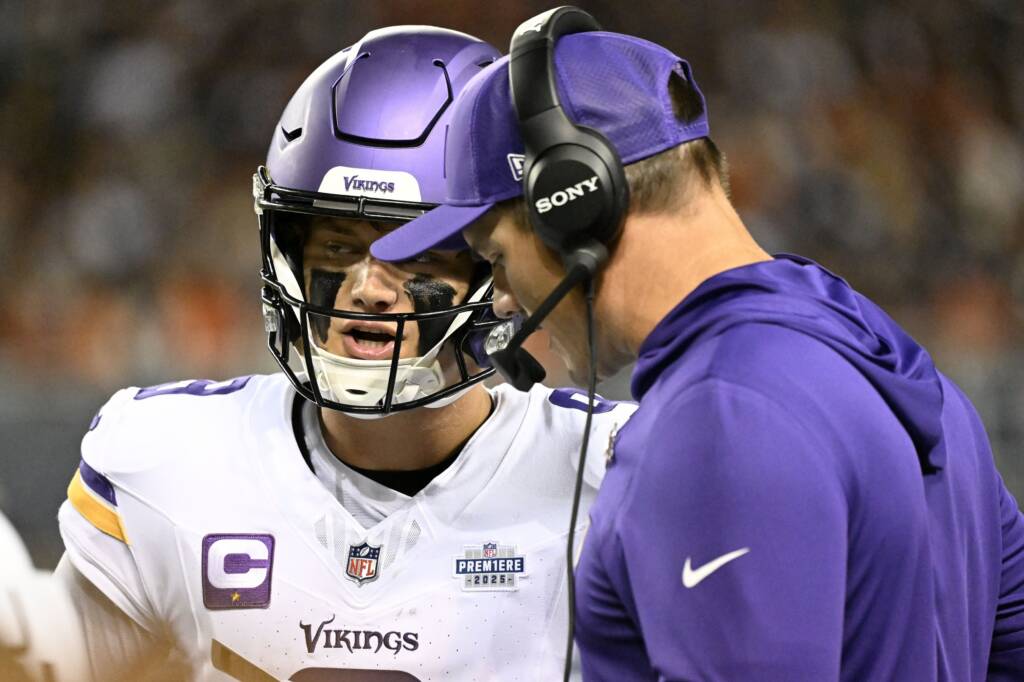

Kevin O’Connell was optimistic about J.J. McCarthy’s progress in June. McCarthy was picking up on the finer points of being a quarterback, laying a foundation he could lean on during training camp and into the season.
“He’s doing a great job of handling everything and just enjoying seeing the process, rep-to-rep improvement,” O’Connell said after organized team activities. “We just kind of want to continue to stress him above the neck, and then when we get out here on the grass, it’s techniques, fundamentals, rhythm, timing, and all the things that go into playing quarterback in our offense.”
Unfortunately, all that promise dissipated by December.
McCarthy had his worst game in Minnesota’s 23-6 Week 12 loss to the Green Bay Packers on November 23. He finished 12 of 19 for 87 yards, with no touchdowns and two interceptions. He had steadily regressed since playing well in Detroit earlier in November. His 34.2 passer rating was a season low, worse than his Week 2 game against the Atlanta Falcons (37.5), where he played with a high ankle sprain.
“I went into [the Packers game] with a lot of things that I felt I did pretty well with my feet, just staying calm and all that,” he said after the loss. “There’s little things that show up in a big way in these types of games. Just making sure that every play, there’s full intensity, focus, and urgency. I think we slipped a couple of times with that today.”
It wasn’t surprising that he struggled in Lambeau Field against Green Bay’s defense before Micah Parsons tore his ACL. However, it was less than a month removed from his breakout Week 8 game in Detroit. It was also two weeks before he got back on track against the Washington Commanders in Week 14.
McCarthy only played in 10 games, throwing for 1,632 yards, 11 touchdowns, and 12 interceptions. The Vikings haven’t committed to McCarthy after his inconsistent, injury-riddled campaign, vowing to bring in veteran competition in camp. However, each game told a different story, which is worth dissecting as we evaluate McCarthy’s first season.
O’Connell asks a lot of his quarterbacks, and McCarthy would fix one aspect only to mess up another. The story of his season was his inability to put it all together until late. Even then, he played well against poor defenses, elevating a 4-8 team to 9-8.
First, McCarthy must read two complicated plays. One is the primary play, which likely offers the most upside. However, it may not work against certain defenses. In that case, the quarterback “cans” to the second play, which is often safer or designed to counter specific defensive formations.
Upon breaking the huddle, he must decipher the defense. Typically, McCarthy will identify the “Mike,” or the middle linebacker, how many safeties the defense has placed in the backfield, and the defensive formation.
Teams typically deploy “heavier” formations that typically have more linemen and linebackers, with one safety back, to stop the run. Meanwhile, they use “lighter” formations, which feature two safeties back and multiple cornerbacks to stop the pass. Whether he “cans” to the backup play depends on what he sees from the defense.
Sometimes the Vikings send a receiver in motion to help determine whether the defense is in man or zone coverage. If the defense is in man coverage, a cornerback will trail the receiver. If it is in zone, the defenders will stay put.
Upon reading the defense, McCarthy will set his protections. That means offering instructions on who to block. He occasionally will call for a running back or tight end to assist with blocking if he feels an all-out blitz is coming. Veteran center Ryan Kelly helped him with this process. However, he suffered three concussions last year and was only available for eight games.
Finally, McCarthy must snap the ball using a unique cadence, progress through his reads across the field at the right timing, and deliver the ball with sound mechanics.
McCarthy often broke the huddle late in his debut against the Chicago Bears. He read the plays too quickly off the play sheet on his arm band, confusing with his teammates who were trying to hear him over the Soldier Field crowd. As a result, he had to rush through setting protections and didn’t know where to go with the ball.
He led a fourth-quarter comeback that salvaged Minnesota’s first game against the Chicago Bears. However, McCarthy didn’t build off that game and had issues managing the huddle in a 22-6 loss to the Atlanta Falcons a week later.
McCarthy suffered a high ankle sprain in that game, which kept him out until Week 8. Still, he returned and played well, despite Ford Field’s stifling cacophony. McCarthy attributes his success in the Detroit Lions game to building off his experience playing at Soldier Field.
However, McCarthy didn’t build off the Week 8 game against the Lions. Kevin O’Connell had McCarthy throw 42 times a week later against the Baltimore Ravens. Like earlier in the season, he had trouble managing the huddle, this time at home. McCarthy completed with a season-low 47.6% of his passes and threw a third-and-one interception that changed the momentum of the season.
McCarthy mostly played poorly against the Bears in Minneapolis. He finished 16 of 32 for 150 yards with a touchdown and two interceptions, good for a 47.7 passer rating, his third-lowest number. However, despite accuracy issues and the turnovers, he nearly led the Vikings on a game-winning drive had they not botched the kickoff.
That led to McCarthy’s low point of the season, his fiasco in Lambeau. He missed the next game, Week 14 in Seattle, with a concussion. However, had a season-high passer rating of 129.2 against Washington upon his return. McCarthy followed that up with a 15-for-24, 250-yard game in Dallas, good for a 108.0 passer rating.
McCarthy finished the final four games 54 of 84 for 703 yards, with five touchdowns, two interceptions, and a 100.4 passer rating. However, that comes with multiple caveats. The Vikings were eliminated from the playoffs before kickoff in Dallas. The Packers sat most of their starters in Week 18. McCarthy also suffered a hand injury in Week 15 against the New York Giants and again in Week 18 against the Packers.
O’Connell also modified his offensive approach to help McCarthy. He removed syllables from the playcalls, told him not to focus on his mechanics, and reduced the number of throws he made over the middle.
Ultimately, O’Connell probably had more success with Kirk Cousins and Sam Darnold because they weren’t juggling playcalling in the huddle, making checks at the line, and adjusting their mechanics while trying to learn his complex offense. They may not have had every step down, but they weren’t trying to figure it all out simultaneously like McCarthy.
Therefore, it’s hard to know what the future holds for McCarthy. He played well late in the season, but the Vikings were already out of the playoffs. He suffered a high ankle sprain, a concussion, and a hand injury – all coming off a lost year to a meniscus tear.
Other star quarterbacks, like Joe Burrow, Lamar Jackson, and Josh Allen, struggled in their first seasons. Still, the Vikings haven’t committed to J.J. McCarthy as their starter next season. Last June, they appeared confident they had made the right decision by moving on from Darnold. By December, it looked like they would be better off with the veteran quarterback.
Now, like last season, they enter the offseason with more questions than answers.


